


Logbook
Dream and Story Hunters
09/06/15 10:31
Johann's real name is actually Hans. He isn't a Catholic priest or a Buddhist monk; he's a Methodist pastor. I meet him in Chiang Mai, Thailand's second largest city, rather than the isolated village where I had been expecting to find him.
Which shows that causality and chance can coexist. It's an effect of the uncertainty principle coined by Heisenberg, one of the legends of my personal cosmology, of those mysteries that I don't understand but which lend themselves to many interpretations. Not to mention that the very name is extraordinarily fascinating and evocative.
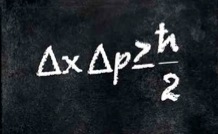
Heisenberg's Uncertainty Principle. Photograph: Alamy
But let's start at the end (which isn't actually the end). So, I meet Hans or Johann, who turns out to be neither whom nor where I expected him to be. How it happens and why is the plot for a story that is waiting to be told. A story that begins in an Italian restaurant in Bangkok, where I hear a priest or a monk, who for almost thirty years has lived "somewhere near the Burmese border", moving between the Karen villages dotted around the mountains in the area.
This is just the start of a series of events that kicked off then and continued in an apparent cause and effect link. But they were also entirely random, determined by my freely made personal choices, and often pure impulses. The uncertainty principle magically brings with it a concept of self-determination.
That's how it happened for Hans: many years ago he chose to be a missionary in Thailand because he was interested in Buddhism and had read Siddhartha. He came to the isolated Karen village, even more isolated than where I looked for him, by pure chance. "There were so many open doors," he says. Once through the door to the village, still protected by the Spirits, he had to find a point of contact with the Karen people, a way of communicating the Word. He found it by studying their legends and their dreams, which he compares to those in the Bible (there are actually many similarities, beginning with the name of God: Y'wa, for the Karen).
So, at the Thai-Vietnamese restaurant where we spend the early afternoon, I am reminded of Jung's archetypes and Freud's dreams, Jeremiah's lamentations, the wi and the k’thi thra, the Karen prophets and shamans with their Spirits. Interesting and engaging company.
I mull over and slightly regret the meetings and characters that preceded them and that led me here. The Italian calling himself an adventurer with many stories to tell, the young Karen priest who doesn't understand what I'm looking for, the apparition of a charming Bernadette.
"The funny thing is I don't know who I'm looking for, but it's good to set off at dawn to do it," I noted down on the morning I began following this story. It was as though, for the umpteenth time, I were trying to trigger my own personal butterfly effect. By getting on an old bus rather than with a flutter of wings.
"In the end, it's about believing in God," says Hans.
I believe. And I thank him for this story.
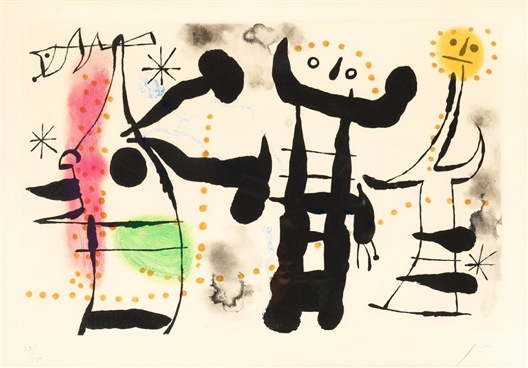
Les Philosophes, by Joan Mirò
Which shows that causality and chance can coexist. It's an effect of the uncertainty principle coined by Heisenberg, one of the legends of my personal cosmology, of those mysteries that I don't understand but which lend themselves to many interpretations. Not to mention that the very name is extraordinarily fascinating and evocative.
Heisenberg's Uncertainty Principle. Photograph: Alamy
But let's start at the end (which isn't actually the end). So, I meet Hans or Johann, who turns out to be neither whom nor where I expected him to be. How it happens and why is the plot for a story that is waiting to be told. A story that begins in an Italian restaurant in Bangkok, where I hear a priest or a monk, who for almost thirty years has lived "somewhere near the Burmese border", moving between the Karen villages dotted around the mountains in the area.
This is just the start of a series of events that kicked off then and continued in an apparent cause and effect link. But they were also entirely random, determined by my freely made personal choices, and often pure impulses. The uncertainty principle magically brings with it a concept of self-determination.
That's how it happened for Hans: many years ago he chose to be a missionary in Thailand because he was interested in Buddhism and had read Siddhartha. He came to the isolated Karen village, even more isolated than where I looked for him, by pure chance. "There were so many open doors," he says. Once through the door to the village, still protected by the Spirits, he had to find a point of contact with the Karen people, a way of communicating the Word. He found it by studying their legends and their dreams, which he compares to those in the Bible (there are actually many similarities, beginning with the name of God: Y'wa, for the Karen).
So, at the Thai-Vietnamese restaurant where we spend the early afternoon, I am reminded of Jung's archetypes and Freud's dreams, Jeremiah's lamentations, the wi and the k’thi thra, the Karen prophets and shamans with their Spirits. Interesting and engaging company.
I mull over and slightly regret the meetings and characters that preceded them and that led me here. The Italian calling himself an adventurer with many stories to tell, the young Karen priest who doesn't understand what I'm looking for, the apparition of a charming Bernadette.
"The funny thing is I don't know who I'm looking for, but it's good to set off at dawn to do it," I noted down on the morning I began following this story. It was as though, for the umpteenth time, I were trying to trigger my own personal butterfly effect. By getting on an old bus rather than with a flutter of wings.
"In the end, it's about believing in God," says Hans.
I believe. And I thank him for this story.
Les Philosophes, by Joan Mirò
0 Comments
The arrogance of ignorance
25/11/14 15:33
Taiji Quan: meaning supreme ultimate (Taiji) boxing or fist (Quan). It is more widely known as Tai Chi and is practised as a gentle form of exercise and breathing technique. Many people know about it and have tried it. Very few know about Thai Chi. Just one person, in fact. The unknown author of a short article published on an online journal. The article seems to meld together two different concepts - Tai Chi and Muay Thai, i.e. Thai boxing (Muay). It's not a mistake. It is a demonstration of ignorance. Which paradoxically becomes cultural arrogance in its condemnation of a discipline practised even by children (for over a thousand years). Of course, the regime is harsh and often the children are being paid to fight. But they are not “instigated” by their parents, as the article claims. You only have to see the respect these children command in Thailand to know that. As well as the complex codes regulating family relationships. And the training the village children go through, which they see as play as well as an initiation rite. You would have to look outside the politically correct box. You would have to... But it's useless trying to explain in desperate cases such as this.
But this case is useful for one thing - as a paradigm for the new journalism: widespread, participatory, all-understanding and all-knowing, in which everyone knows everything and creates a world to resemble themselves…
…A world in which nothing is considered as something, emptiness as fullness. (Confucius).
But this case is useful for one thing - as a paradigm for the new journalism: widespread, participatory, all-understanding and all-knowing, in which everyone knows everything and creates a world to resemble themselves…
…A world in which nothing is considered as something, emptiness as fullness. (Confucius).
Archetypes
06/11/14 11:27
It took me a few days but in the end I understood: motorbikes are like warships.

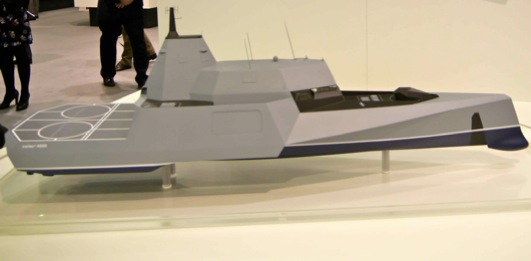
I realised this at the Ducati 2015 World Première, at which new bikes from the global brand are presented for the very first time. The idea that warships and advanced naval weaponry systems reminded me of something came to me at Euronaval, the largest naval defence trade show. I kept wondering about it as I watched these presentations of weaponry systems or the maritime surveillance network, Marsur.
I watched the series of images, which looked like so many videogames or MTV videos, and tried to pin down the style of the show. I was immersed in an augmented reality in which my perceptions were amplified by the very fact that I was close to instruments designed to expand sensory capacities.
Sometime later I attended the Ducati première, quite by chance and out of personal curiosity. And in the promo films and technical specs of the motorbikes I recognised the same emotions – the same nervous system reactions – I had experienced at Euronaval.
The similarities could also extend to semantics (for example the use of the term “configuration”) and materials (carbon fibre first and foremost for its appearance).
But the closest and yet the most ambiguous comparison leads me to consider motorbikes and weapons as expressions of our species' primary drives, the materialisation of myths, cultural archetypes. James Hillman, the philosophical and psychological visionary who passed away a few years ago, would call them the “constants of the human dimension”. All too human.
About similarities: listen to the two soundtracks
I realised this at the Ducati 2015 World Première, at which new bikes from the global brand are presented for the very first time. The idea that warships and advanced naval weaponry systems reminded me of something came to me at Euronaval, the largest naval defence trade show. I kept wondering about it as I watched these presentations of weaponry systems or the maritime surveillance network, Marsur.
I watched the series of images, which looked like so many videogames or MTV videos, and tried to pin down the style of the show. I was immersed in an augmented reality in which my perceptions were amplified by the very fact that I was close to instruments designed to expand sensory capacities.
Sometime later I attended the Ducati première, quite by chance and out of personal curiosity. And in the promo films and technical specs of the motorbikes I recognised the same emotions – the same nervous system reactions – I had experienced at Euronaval.
The similarities could also extend to semantics (for example the use of the term “configuration”) and materials (carbon fibre first and foremost for its appearance).
But the closest and yet the most ambiguous comparison leads me to consider motorbikes and weapons as expressions of our species' primary drives, the materialisation of myths, cultural archetypes. James Hillman, the philosophical and psychological visionary who passed away a few years ago, would call them the “constants of the human dimension”. All too human.
About similarities: listen to the two soundtracks
The last frontier
07/10/14 15:57
Borneo has been called “the last frontier bordering on myth”. I have crossed the frontier of that myth many times. Each time it was harder to come out of it, with the body and the mind. Once I risked not coming out at all. Not in one piece, at least. It is chiefly the mind that gets lured into a web of sensations, visions and dreams; after two weeks there, you can't get out of it.
I am thinking about this again because an old friend has asked me to contribute towards a book on Italians in the Pacific. I chose to write a chapter on Odoardo Beccari, a naturalist from Florence who, between 1865 and 1878, explored the forests of far Southeast Asia. He was often isolated for months at a time. This is how he described the forest: “Infinite and varied are the aspects under which it presents itself, as are the treasures it conceals…Its mystery, sacred to science, rewards the believer equally as much as it does the investigative philosopher.” You understand why his writings inspired Salgari. But Beccari is not a character from a Salgari novel. He is more complex, as is revealed in his book, “In the forests of Borneo”, written with passionate, philosophical and even poetic words. He is more similar to certain Conrad characters, or Conrad himself.
As I do my research on Beccari, I discover new stories and come across others lost amongst my papers, bringing back memories of books read and journeys made. An intrigue of plots and characters forms, featuring seas, forests and rivers, sandbanks and deep oceans, pirates and pirate hunters, privileged gentlemen and unlucky adventurers, traders, explorers, old carts and Land Rovers.
Lost in this library of Babel, I think the only way to get out is to embark on a new path - any one will do. Perhaps beginning with these Bassifondi. Before my memory of them is also lost, the dreams merging with nightmare and the visions with ghosts.
Borneo - according to the introduction to Conrad's “Almayer's Folly” - is one of those scenarios that are a “metaphor for the actions happening there”.
I am thinking about this again because an old friend has asked me to contribute towards a book on Italians in the Pacific. I chose to write a chapter on Odoardo Beccari, a naturalist from Florence who, between 1865 and 1878, explored the forests of far Southeast Asia. He was often isolated for months at a time. This is how he described the forest: “Infinite and varied are the aspects under which it presents itself, as are the treasures it conceals…Its mystery, sacred to science, rewards the believer equally as much as it does the investigative philosopher.” You understand why his writings inspired Salgari. But Beccari is not a character from a Salgari novel. He is more complex, as is revealed in his book, “In the forests of Borneo”, written with passionate, philosophical and even poetic words. He is more similar to certain Conrad characters, or Conrad himself.
As I do my research on Beccari, I discover new stories and come across others lost amongst my papers, bringing back memories of books read and journeys made. An intrigue of plots and characters forms, featuring seas, forests and rivers, sandbanks and deep oceans, pirates and pirate hunters, privileged gentlemen and unlucky adventurers, traders, explorers, old carts and Land Rovers.
Lost in this library of Babel, I think the only way to get out is to embark on a new path - any one will do. Perhaps beginning with these Bassifondi. Before my memory of them is also lost, the dreams merging with nightmare and the visions with ghosts.
Borneo - according to the introduction to Conrad's “Almayer's Folly” - is one of those scenarios that are a “metaphor for the actions happening there”.
Just like Cicero
28/05/14 09:27
"Libertas, quae non in eo est ut iusto utamur domino, sed ut nullo," wrote Marcus Tullius Cicero. “Liberty, which does not consist in slavery to a just master, but in slavery to no master at all”. The quote is from De re publica (II, 43). Written between 55 BC and 51 AD - two thousand and seventy years ago - it is a treatise on political philosophy similar to The Republic by Plato, which contains another formidable aphorism: “Until philosophers rule as kings, or those who are nowadays called kings and leading men become genuine and adequate philosophers ... cities will have no rest from evils”.
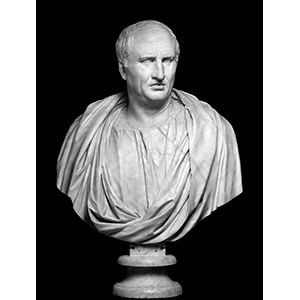
I will confess a grave sin: I had forgotten about Cicero, Plato and other giants of my Western, Italian culture. I freely admit: it took my reading a novel whose main character is Cicero to get me thinking about him again. The book isn't a masterpiece, but it appeared to me like a case of synchronicity. The “meaningful coincidences”, as the manifestations of this phenomenon are known, were numerous: in Cicero's Rome and today's Bangkok (where there is no Caesar let alone a Cicero, but plenty of Catilines), discussions abound on freedom and its limitations, coups d’état, patricians and plebeians, fortune-tellers and omens, tribunes of the people and consular candidates.
But these aren't the most meaningful coincidences. In the end, too much, or too little, is already being said about Thailand. The case of synchronicity led me to reflect again on the different ways of perceiving culture, civilisation and progress.
When I go back to Italy, or I speak to Italians travelling or living abroad, I often hear the same complaint: there is no difference between Thailand or other countries in the region and Europe, and especially Italy. In fact, Italy often comes out worse in the comparison. And more so when it comes to future predictions. But that is to forget that we experience the reality in countries such as Thailand in a privileged way. We look but we don't see, we don't analyse. In short, we don't know. The coup in Thailand, the introduction of sharia law in Brunei, and the human rights violations in Southeast Asian countries appear to us as marginal phenomena compared to the economic crisis that may yet mark the decline of the West. We are so focused on ourselves as to forget what we are a part of - our social system and our values.
We forget Cicero. We forget our culture and our reality. Or worse, we do not know the former and we cannot appreciate the latter. This is the one thing in which we are truly globalised, in a world of virtual reality where information is self-referential and where connection creates incommunicability.
It is a reflection that also works in the opposite direction, for others. Asians, especially Thais, justify inequalities, coups d’état, restrictions and human rights violations by affirming that their countries are not ready for democracy, that Western values cannot yet be applied to them. At the same time, however, they dispute those same values by talking up their proclaimed moral superiority that would derive from keeping their own values intact.
But it is precisely in the “intangible” goods - i.e. governance, innovation, the rule of law, welfare, freedom of ideas - that Europe can reaffirm its role, and define a cultural mode. Provided it has the conscience and capacity to do so.
Just like Cicero.
I will confess a grave sin: I had forgotten about Cicero, Plato and other giants of my Western, Italian culture. I freely admit: it took my reading a novel whose main character is Cicero to get me thinking about him again. The book isn't a masterpiece, but it appeared to me like a case of synchronicity. The “meaningful coincidences”, as the manifestations of this phenomenon are known, were numerous: in Cicero's Rome and today's Bangkok (where there is no Caesar let alone a Cicero, but plenty of Catilines), discussions abound on freedom and its limitations, coups d’état, patricians and plebeians, fortune-tellers and omens, tribunes of the people and consular candidates.
But these aren't the most meaningful coincidences. In the end, too much, or too little, is already being said about Thailand. The case of synchronicity led me to reflect again on the different ways of perceiving culture, civilisation and progress.
When I go back to Italy, or I speak to Italians travelling or living abroad, I often hear the same complaint: there is no difference between Thailand or other countries in the region and Europe, and especially Italy. In fact, Italy often comes out worse in the comparison. And more so when it comes to future predictions. But that is to forget that we experience the reality in countries such as Thailand in a privileged way. We look but we don't see, we don't analyse. In short, we don't know. The coup in Thailand, the introduction of sharia law in Brunei, and the human rights violations in Southeast Asian countries appear to us as marginal phenomena compared to the economic crisis that may yet mark the decline of the West. We are so focused on ourselves as to forget what we are a part of - our social system and our values.
We forget Cicero. We forget our culture and our reality. Or worse, we do not know the former and we cannot appreciate the latter. This is the one thing in which we are truly globalised, in a world of virtual reality where information is self-referential and where connection creates incommunicability.
It is a reflection that also works in the opposite direction, for others. Asians, especially Thais, justify inequalities, coups d’état, restrictions and human rights violations by affirming that their countries are not ready for democracy, that Western values cannot yet be applied to them. At the same time, however, they dispute those same values by talking up their proclaimed moral superiority that would derive from keeping their own values intact.
But it is precisely in the “intangible” goods - i.e. governance, innovation, the rule of law, welfare, freedom of ideas - that Europe can reaffirm its role, and define a cultural mode. Provided it has the conscience and capacity to do so.
Just like Cicero.
The illusions of poverty
12/05/14 16:32
Women sitting on their haunches, wearing colourful saris. A position of congenital elegance that many Western women try in vain to assume.
In Bangladesh it is one of the causes of uterine prolapse. Following early marriage, numerous pregnancies, or working in the fields.
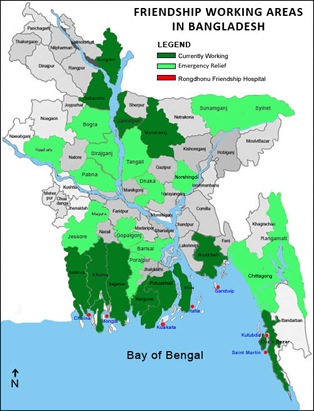
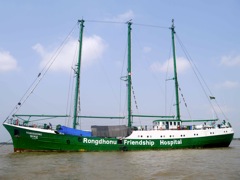
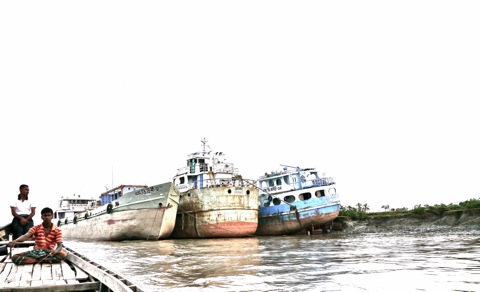
They sit like this on the “Rongdhonu”, the ship that Greenpeace gave to Friendship, an organisation that aims to provide medical assistance in the poorest and most isolated areas of one of the world's poorest and most isolated countries. One of these areas, the very poorest and most isolated, is in the Bay of Bengal, where the Ganges and the Brahmaputra meet in an immense delta of swamps and lowlands. Regularly devastated by cyclones and submerged by seawater. A wet world where drinking water is hard to find.
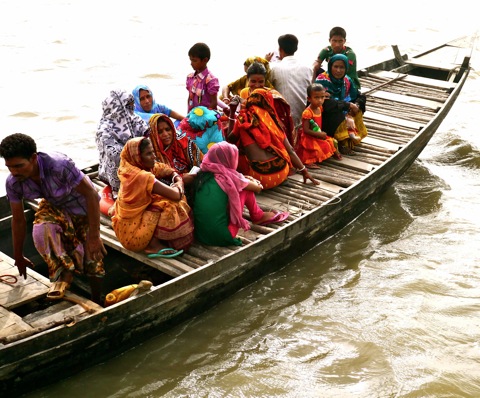
Some of these women are lucky: they are being operated on by a team of doctors from the United States. Others less so. Such as the one who perhaps has cancer – she doesn't know for sure, she may not find out until it is too late. She doesn't seem upset. In a place where the most common illness can be fatal, cancer is just another sickness. I watch her as she returns to land on board a nouka, a beaten up fishing boat, which ferries its load of women in saris between the shore and the hospital ship. As the distance grows, the scene begins to resemble a Gauguin painting. In places such as this, perspective, or distance, is no longer a point of view; it creates an illusory paradox.
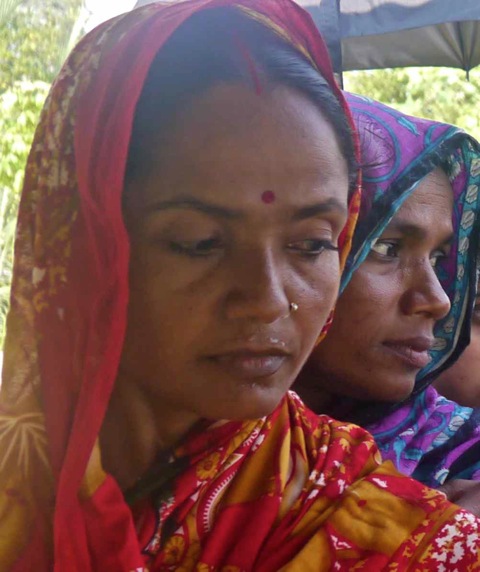
Poverty creates beauty and pure beauty is made by poverty. Such as the woman dragging a net as she wades in the river. You don't feel the weight of the net or the mud on the riverbed, the effort that day after day causes her pelvic organs to collapse. You only see a colour reflected in the current.
On the deck of the Rongdhonu, though, you are up close: you smell the same smells, feel the same heat, see the women waiting in line or being stretchered back on deck after an operation: asleep, they are placed on a folding bed by other women because the men, according to the rules of Islam, cannot touch them. They will convalesce here, sheltered by a sheet of canvas, for two or three days. Under one of the beds, a catheter bag rests next to a pan of lentil dahl.
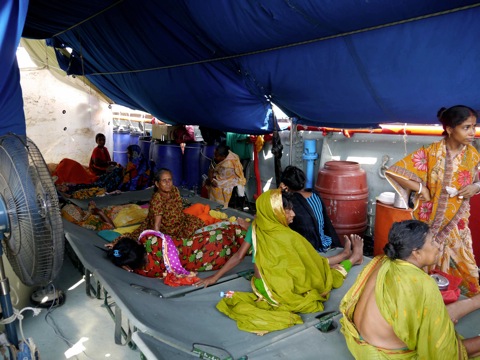
It's yet another paradox: they have been operated on by a top team, which they may remember as if it were a dream, but are then immediately returned to their natural human condition.
The same happens, in reverse, for the all-female American doctors and nurses. They move between an operating room that, though limited, meets Western standards, and a gangway on the ship that looks increasingly like an old tramp steamer as the days pass. But they have no time to notice the contrast. These women are the demonstration that the impact between cultures can generate positive energy.
The mirages disappear as night falls. It's a quiet time. The stars are bright, with no land pollution to dim them. The air cools. A village atmosphere is recreated on deck: the patients are cared for by their relatives, some eat, some lie on a mat on the deck with their children beside them. The few men present murmur quietly amongst themselves.
On the bridge, the captain and a few members of the crew pray towards the west. The engineer brings me a dark, sweet tea, and I offer him a cigarette in return. He tells me that there are pirates further south, amongst the Sundarbans mangroves. Just down current from there, Bani Shanta, a strip of mud and huts, is home to about a hundred prostitutes. Both the pirates and the prostitutes rely on the traffic in the delta: the cargo ships carrying goods not worth the insurance and crews that are only valued by the prostitutes.
"But it is beautiful here," concludes the engineer, throwing the last of my cigarettes into the river.
It truly is beautiful, but the nocturnal silence doesn't last. A storms rips through two hours later. The wind could well tear away the canvas sheltering the patients. It should be taken down, but the rain is torrential. The women and their families have to be taken indoors. They gather in any available space. The day's heat given off by the sheet metal stagnates. A few fans try to disperse it, but they soon stop because the on-board generator overloads.
This is no cyclone, or even a mid-monsoon tempest. It's just a storm, but it makes you understand the impact of a violent climate when all you have over your head is a bit of canvas or the roof of a hut, while the ground turns to mud. Big natural disasters kill tens of thousands of people in a short space of time, but this kind of weather also kills - just more slowly. It destroys you day by day, due to illness or the inability to repay a loan, which you may have taken out to set up a shrimp farm that was washed away by high tides.
On board the Rongdhonu, I find an article I set aside for this trip and then forgot. It is entitled Poor Choices. It's a review-reflection on certain essays that analyse the roots of extreme poverty, the condition of a billion people living on little more than a dollar a day. But also the inadequacy of our world to tackle the problem. “Poverty presents both a moral and an intellectual challenge,” I read. And while I read, I realise that the second is the most difficult to tackle. We have to overcome conceptual and cultural barriers that have almost become a moral law. Like the support for certain local NGOs used to enter politics. Or the mystical support for the microcredit system. We have to listen to Shushuma, a sixty-year-old woman who got a loan of 10,000 taka (about 95 euro) from the Grameen Bank at an interest rate of 18%. She gave the money to her son, for that shrimp farm.
In Bangladesh it is one of the causes of uterine prolapse. Following early marriage, numerous pregnancies, or working in the fields.
They sit like this on the “Rongdhonu”, the ship that Greenpeace gave to Friendship, an organisation that aims to provide medical assistance in the poorest and most isolated areas of one of the world's poorest and most isolated countries. One of these areas, the very poorest and most isolated, is in the Bay of Bengal, where the Ganges and the Brahmaputra meet in an immense delta of swamps and lowlands. Regularly devastated by cyclones and submerged by seawater. A wet world where drinking water is hard to find.
Some of these women are lucky: they are being operated on by a team of doctors from the United States. Others less so. Such as the one who perhaps has cancer – she doesn't know for sure, she may not find out until it is too late. She doesn't seem upset. In a place where the most common illness can be fatal, cancer is just another sickness. I watch her as she returns to land on board a nouka, a beaten up fishing boat, which ferries its load of women in saris between the shore and the hospital ship. As the distance grows, the scene begins to resemble a Gauguin painting. In places such as this, perspective, or distance, is no longer a point of view; it creates an illusory paradox.
Poverty creates beauty and pure beauty is made by poverty. Such as the woman dragging a net as she wades in the river. You don't feel the weight of the net or the mud on the riverbed, the effort that day after day causes her pelvic organs to collapse. You only see a colour reflected in the current.
On the deck of the Rongdhonu, though, you are up close: you smell the same smells, feel the same heat, see the women waiting in line or being stretchered back on deck after an operation: asleep, they are placed on a folding bed by other women because the men, according to the rules of Islam, cannot touch them. They will convalesce here, sheltered by a sheet of canvas, for two or three days. Under one of the beds, a catheter bag rests next to a pan of lentil dahl.
It's yet another paradox: they have been operated on by a top team, which they may remember as if it were a dream, but are then immediately returned to their natural human condition.
The same happens, in reverse, for the all-female American doctors and nurses. They move between an operating room that, though limited, meets Western standards, and a gangway on the ship that looks increasingly like an old tramp steamer as the days pass. But they have no time to notice the contrast. These women are the demonstration that the impact between cultures can generate positive energy.
The mirages disappear as night falls. It's a quiet time. The stars are bright, with no land pollution to dim them. The air cools. A village atmosphere is recreated on deck: the patients are cared for by their relatives, some eat, some lie on a mat on the deck with their children beside them. The few men present murmur quietly amongst themselves.
On the bridge, the captain and a few members of the crew pray towards the west. The engineer brings me a dark, sweet tea, and I offer him a cigarette in return. He tells me that there are pirates further south, amongst the Sundarbans mangroves. Just down current from there, Bani Shanta, a strip of mud and huts, is home to about a hundred prostitutes. Both the pirates and the prostitutes rely on the traffic in the delta: the cargo ships carrying goods not worth the insurance and crews that are only valued by the prostitutes.
"But it is beautiful here," concludes the engineer, throwing the last of my cigarettes into the river.
It truly is beautiful, but the nocturnal silence doesn't last. A storms rips through two hours later. The wind could well tear away the canvas sheltering the patients. It should be taken down, but the rain is torrential. The women and their families have to be taken indoors. They gather in any available space. The day's heat given off by the sheet metal stagnates. A few fans try to disperse it, but they soon stop because the on-board generator overloads.
This is no cyclone, or even a mid-monsoon tempest. It's just a storm, but it makes you understand the impact of a violent climate when all you have over your head is a bit of canvas or the roof of a hut, while the ground turns to mud. Big natural disasters kill tens of thousands of people in a short space of time, but this kind of weather also kills - just more slowly. It destroys you day by day, due to illness or the inability to repay a loan, which you may have taken out to set up a shrimp farm that was washed away by high tides.
On board the Rongdhonu, I find an article I set aside for this trip and then forgot. It is entitled Poor Choices. It's a review-reflection on certain essays that analyse the roots of extreme poverty, the condition of a billion people living on little more than a dollar a day. But also the inadequacy of our world to tackle the problem. “Poverty presents both a moral and an intellectual challenge,” I read. And while I read, I realise that the second is the most difficult to tackle. We have to overcome conceptual and cultural barriers that have almost become a moral law. Like the support for certain local NGOs used to enter politics. Or the mystical support for the microcredit system. We have to listen to Shushuma, a sixty-year-old woman who got a loan of 10,000 taka (about 95 euro) from the Grameen Bank at an interest rate of 18%. She gave the money to her son, for that shrimp farm.
The dark depths of the soul
22/04/14 14:18
Six miles or so outside Chiang Mai, Thailand's second largest city, in the north, the country's first Benedictine monastery has just been opened. Five monks live there, all of them Vietnamese. I read this on the AsiaNews website. The agency Pontifical Institute for Foreign Missions points out that this is “a first concrete step in the ‘new evangelisation’, since its importance does not lie primarily in its educational or social role, as it does in its monastic and contemplative life, which are also the bases of Buddhism”.
It is yet another example of synchronicity, in which events unlikely to be causally related are experienced as related: “meaningful coincidences”, Jung called them. I am working on a story about a Burmese “forest monk”. Who in turn is meeting with another Thai monk. It appears that story is continuing at Chiang Mai.
I try to contact the monastery. It's harder than you might think, but in the end I manage it and arrive there just a few days later. It's in an area known as Villa Farang, where the farang, or foreigners, who have married Thais build their houses. It is built on top of an old mango, banana and fig plantation, whose trees still provide shade and fruit. The former plantation also left behind a pond filled with catfish, two glasshouses which are now hen houses and a barn that provided bed and board for the workers and is now used as a kitchen and canteen. "So the smell of the food stays here," explains father Nicolà, the only one of the four monks who speaks a little English.
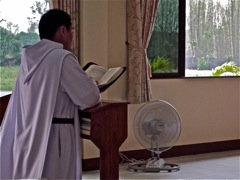
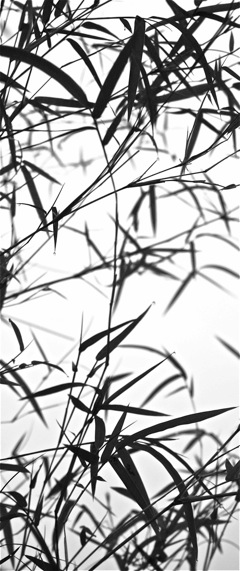
The actual monastery is a newly constructed white building. There are ten cells for the monks, eight guest rooms, utility rooms, a meeting hall and a chapel. I stay in a bright, comfortable room near the chapel, with a private bathroom with toilet and shower. From the window I can see a row of tall bamboo plants surrounding the monastery like a great green curtain.
The monks are kind and smiling. According to the Rule of Saint Benedict, “Ora et Labora”, they alternate moments of prayer with work, growing crops, doing chores and tending to the hen house.
In short, the monastery is a nice, calm place.
So why aren't I happy here? Why do I leave after just a few days?
It's not the hours they keep. They get up early - at four a.m. for morning prayers - but that's the coolest time of day and I can do some exercise.
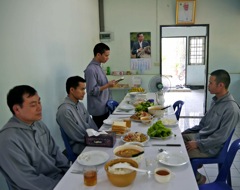
It's not the food. Unlike Buddhist monks, who eat a single meal a day at lunchtime, here they eat three square a day. And, apart from the spaghetti I must confess, it's all good. Probably because they look after me, going to the market every day to buy something special.
It's not because of the long periods of prayer set throughout the day according to canonical hours. Or because they pray in Vietnamese. Quite the opposite: the see-sawing tones help me focus on meditation more deeply than happens most of the time.
It's not because of the hours spent alone in between meals and prayers. I stroll around, I take photos of the bamboo, I talk to a gecko, I read and I write.

The fact is that there is nothing to feed my restlessness. Perhaps I am missing the unease I felt in the Shan mountains or on the Laos border with the “forest monks”. Those situations that give me a sense of total alienation. Perhaps mine is an existential unease. This feeling grows stronger when I discover that, according to the Rule of Saint Benedict, the worst kind of monks are the “gyrovagues, wandering aimlessly from one monastery to another, slaves to their own wills and appetites”.
But I don't understand the link between wandering and vice. Saint Benedict scorned these wanderers in the same way the samurai did the ronin, the masterless samurai. One way or another it always comes down to the juxtaposition between principle of authority and individual ethics.
Personally, I've always been fascinated by errant warriors. Like their monastic reincarnation, the Unsui of the Buddhist tradition, who walk from one temple to another seeking a master. The name means “clouds and water”, referring to a Chinese poem that says: “Wandering like clouds and flowing like water". Not to mention that one of the greatest errant monks was a mystical Christian, the Trappist Thomas Merton. He writes in one of his Prayers:
“My Lord God, I have no idea where I am going.
I do not see the road ahead of me.
I cannot know for certain where it will end.
Nor do I really know myself, and the fact that
I think I am following Your will does not mean that I am actually doing so.”
Perhaps, though, the cause of my unease is a recurrence of situations that risk me losing my way, a bit like in this story.
Perhaps, in the end, I am delving too far into the dark depths of the soul. It's time to rise up again.
It is yet another example of synchronicity, in which events unlikely to be causally related are experienced as related: “meaningful coincidences”, Jung called them. I am working on a story about a Burmese “forest monk”. Who in turn is meeting with another Thai monk. It appears that story is continuing at Chiang Mai.
I try to contact the monastery. It's harder than you might think, but in the end I manage it and arrive there just a few days later. It's in an area known as Villa Farang, where the farang, or foreigners, who have married Thais build their houses. It is built on top of an old mango, banana and fig plantation, whose trees still provide shade and fruit. The former plantation also left behind a pond filled with catfish, two glasshouses which are now hen houses and a barn that provided bed and board for the workers and is now used as a kitchen and canteen. "So the smell of the food stays here," explains father Nicolà, the only one of the four monks who speaks a little English.
The actual monastery is a newly constructed white building. There are ten cells for the monks, eight guest rooms, utility rooms, a meeting hall and a chapel. I stay in a bright, comfortable room near the chapel, with a private bathroom with toilet and shower. From the window I can see a row of tall bamboo plants surrounding the monastery like a great green curtain.
The monks are kind and smiling. According to the Rule of Saint Benedict, “Ora et Labora”, they alternate moments of prayer with work, growing crops, doing chores and tending to the hen house.
In short, the monastery is a nice, calm place.
So why aren't I happy here? Why do I leave after just a few days?
It's not the hours they keep. They get up early - at four a.m. for morning prayers - but that's the coolest time of day and I can do some exercise.
It's not the food. Unlike Buddhist monks, who eat a single meal a day at lunchtime, here they eat three square a day. And, apart from the spaghetti I must confess, it's all good. Probably because they look after me, going to the market every day to buy something special.
It's not because of the long periods of prayer set throughout the day according to canonical hours. Or because they pray in Vietnamese. Quite the opposite: the see-sawing tones help me focus on meditation more deeply than happens most of the time.
It's not because of the hours spent alone in between meals and prayers. I stroll around, I take photos of the bamboo, I talk to a gecko, I read and I write.
The fact is that there is nothing to feed my restlessness. Perhaps I am missing the unease I felt in the Shan mountains or on the Laos border with the “forest monks”. Those situations that give me a sense of total alienation. Perhaps mine is an existential unease. This feeling grows stronger when I discover that, according to the Rule of Saint Benedict, the worst kind of monks are the “gyrovagues, wandering aimlessly from one monastery to another, slaves to their own wills and appetites”.
But I don't understand the link between wandering and vice. Saint Benedict scorned these wanderers in the same way the samurai did the ronin, the masterless samurai. One way or another it always comes down to the juxtaposition between principle of authority and individual ethics.
Personally, I've always been fascinated by errant warriors. Like their monastic reincarnation, the Unsui of the Buddhist tradition, who walk from one temple to another seeking a master. The name means “clouds and water”, referring to a Chinese poem that says: “Wandering like clouds and flowing like water". Not to mention that one of the greatest errant monks was a mystical Christian, the Trappist Thomas Merton. He writes in one of his Prayers:
“My Lord God, I have no idea where I am going.
I do not see the road ahead of me.
I cannot know for certain where it will end.
Nor do I really know myself, and the fact that
I think I am following Your will does not mean that I am actually doing so.”
Perhaps, though, the cause of my unease is a recurrence of situations that risk me losing my way, a bit like in this story.
Perhaps, in the end, I am delving too far into the dark depths of the soul. It's time to rise up again.
Dream Maps
31/03/14 17:50
"Then there are dream maps…," begins the cartographer as we sail by the long, white beach of an island off the coast of Cambodia.
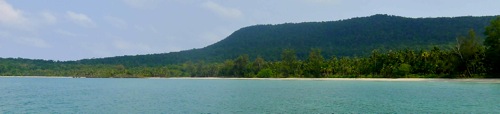
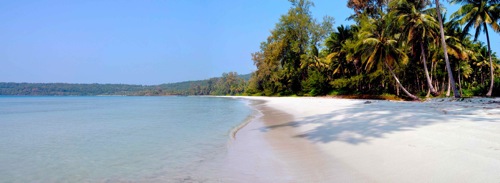
The cartographer spends a lot of time in a bungalow built on red posts sunk into the water. It is his retreat. It was his base for making the maps of the islands. Before that, he did the same job in Tibet and Nepal.
Dream maps, though, are not of fantastical, imaginary places. They do not represent places, like that beach, in which an island dreamscape materialises. They are not comparable to the mind maps of the Australian Aborigines, who follow the ways created by the unceasing walking of their mythical forebears in the Tjukurrpa, or Dream Temple.
They are a mixture of all of these, according to the cartographer and other dreamers like him. They are maps of real, existing places. But they are also dreams because they represent dreamed-about places that were thought not to exist, to be the stuff of legend, but which were found by following a myth or a story. As happened to him. "I was told that on a Himalayan path there was a door that opened onto a valley…Well, I found the door and it did open onto a valley." And that is how he came to draw the map of Naar Phu, the lost valley, which is entered through a door and which is populated by the descendants of the Khampa warriors.
As we sailed amongst the islands and told each other stories about Asia, real and imagined, the maps materialised in the stories. "This is what cartographers are for. To draw what lies beneath, what the satellites cannot see." His was a topographic version of the tantric illusion of Maya, somewhere between illusion and disillusion, a way of perceiving the world like an illusion - or a dream. And in this narrated dream, the maps were populated by spirits. “The ancient cartographers used to write ‘Hic sunt leones’ (usually translated as Here be dragons) to denote unexplored territories. About the villages of fishermen and farm-labourers - people so very different from us - we can write just one, indubitable, line: ‘Here be spirits’,” William Butler Yeats wrote in one of his Irish Fairy Tales.
After that journey I continued to think, as if I were dreaming about a map made up of places, memories, journeys, books and encounters. I was “transfixed by meridians and parallels” as Alberto Ongaro told me long ago, in turn quoting Hugo Pratt.
I inevitably thought of the aphorism by Alfred Korzybski, the father of general semantics: “The map is not the territory”. I actually remember it more because it's one of Robert De Niro's lines in the film Ronin. The meaning is clear, but that boat trip led me to think that the map can be the territory, especially if it is a dream map. It is almost what Gregory Bateson, an adventurer of the mind, affirmed: “The distinction between the name and the thing named or the map and the territory is perhaps really made only by the dominant hemisphere of the brain. The symbolic and affective hemisphere, normally on the right-hand side, is probably unable to distinguish name from thing named. It is certainly not concerned with this sort of distinction.” Little wonder that Bateson theorised about the ecology of ideas, a holistic method aimed at identifying the connections between phenomena such as the structure of leaves, the grammar of a sentence, the bilateral symmetry of an animal, and the arms race.
While I was losing myself in these connections, I found a quote I had already seen before: “There is little difference between performing my rosary in chapel of a morning or fashioning a wind rose on a chart. Each is a form of meditation.” It fit perfectly with my mood and I believe that would also be the case for the cartographer. The quote comes from A Mapmaker's Dream, a novel by nomadic Australian author James Cowan, which relates the life of Fra Mauro, a 15th century monk and cartographer who dedicates his life to mapping the then known world, based on stories from travellers, sailors and merchants.
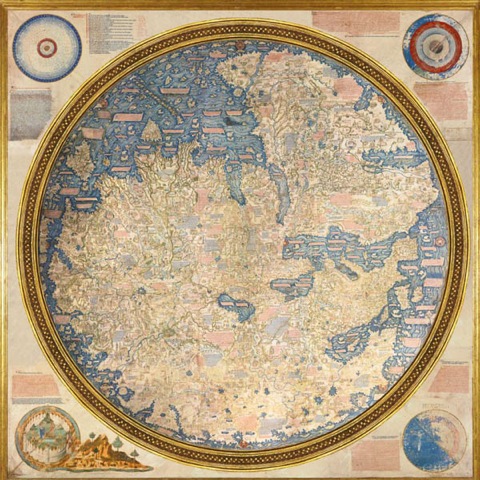
In the meantime, the dream maps and ancient planispheres overlapped with the possible routes taken by the mysterious missing flight MH370, which in turn, at least initially, intersected with those of the South China Sea, a potential theatre of world war or local conflict.
I had also chatted about these scenarios and intrigues with the cartographer. "Cartographers are a little like spies," he said. He was referring to the time of the Great Game (or Tournament of Shadows, as the Russians called it), when many of the men making Asia's maps were agents for some imperial power or another. But perhaps he wasn't only thinking of that time: the big intelligence agencies such as the U.S. Special Operations Command (USSCOM) are rediscovering the need to integrate geospace data with findings on the ground to better plan action in the dark areas of the planet. It is the rediscovery of humint, human intelligence. Intelligence, understood as being the “ability to acquire or apply knowledge and skills to new and difficult situations”, is not something that can be entrusted to a machine, nor to novices. Which is true of mapmaking, espionage, and anything else for that matter. But that's another story.
Or is it? Mapmaking, and geography, in this case, become a metaphor for the change and adaptation that people have to deal with, overturning Marshall McLuhan's view: The medium is NOT the message. This is demonstrated by the “prolific traveller and strategist” and chief analyst for Sratfor, Robert D. Kaplan, “Forget about the world being flat. Forget technology as the great democratizer”… “Territory and the bonds of blood that go with it are central to what makes us human,” he writes in a recent article entitled Geopolitics and the New World Order. It is in this light, for example, that we can understand and, above all, play the game in the South China Sea (as seen in Kaplan's latest book, Asia's Cauldron: The South China Sea and the End of a Stable Pacific), which is where the great East/West clash is really taking place.
"The earth is a map. There is no geography without meaning and without history." So said an old Aborigine, Warlpiri, whom I met in Australia's Red Centre.
The cartographer spends a lot of time in a bungalow built on red posts sunk into the water. It is his retreat. It was his base for making the maps of the islands. Before that, he did the same job in Tibet and Nepal.
Dream maps, though, are not of fantastical, imaginary places. They do not represent places, like that beach, in which an island dreamscape materialises. They are not comparable to the mind maps of the Australian Aborigines, who follow the ways created by the unceasing walking of their mythical forebears in the Tjukurrpa, or Dream Temple.
They are a mixture of all of these, according to the cartographer and other dreamers like him. They are maps of real, existing places. But they are also dreams because they represent dreamed-about places that were thought not to exist, to be the stuff of legend, but which were found by following a myth or a story. As happened to him. "I was told that on a Himalayan path there was a door that opened onto a valley…Well, I found the door and it did open onto a valley." And that is how he came to draw the map of Naar Phu, the lost valley, which is entered through a door and which is populated by the descendants of the Khampa warriors.
As we sailed amongst the islands and told each other stories about Asia, real and imagined, the maps materialised in the stories. "This is what cartographers are for. To draw what lies beneath, what the satellites cannot see." His was a topographic version of the tantric illusion of Maya, somewhere between illusion and disillusion, a way of perceiving the world like an illusion - or a dream. And in this narrated dream, the maps were populated by spirits. “The ancient cartographers used to write ‘Hic sunt leones’ (usually translated as Here be dragons) to denote unexplored territories. About the villages of fishermen and farm-labourers - people so very different from us - we can write just one, indubitable, line: ‘Here be spirits’,” William Butler Yeats wrote in one of his Irish Fairy Tales.
After that journey I continued to think, as if I were dreaming about a map made up of places, memories, journeys, books and encounters. I was “transfixed by meridians and parallels” as Alberto Ongaro told me long ago, in turn quoting Hugo Pratt.
I inevitably thought of the aphorism by Alfred Korzybski, the father of general semantics: “The map is not the territory”. I actually remember it more because it's one of Robert De Niro's lines in the film Ronin. The meaning is clear, but that boat trip led me to think that the map can be the territory, especially if it is a dream map. It is almost what Gregory Bateson, an adventurer of the mind, affirmed: “The distinction between the name and the thing named or the map and the territory is perhaps really made only by the dominant hemisphere of the brain. The symbolic and affective hemisphere, normally on the right-hand side, is probably unable to distinguish name from thing named. It is certainly not concerned with this sort of distinction.” Little wonder that Bateson theorised about the ecology of ideas, a holistic method aimed at identifying the connections between phenomena such as the structure of leaves, the grammar of a sentence, the bilateral symmetry of an animal, and the arms race.
While I was losing myself in these connections, I found a quote I had already seen before: “There is little difference between performing my rosary in chapel of a morning or fashioning a wind rose on a chart. Each is a form of meditation.” It fit perfectly with my mood and I believe that would also be the case for the cartographer. The quote comes from A Mapmaker's Dream, a novel by nomadic Australian author James Cowan, which relates the life of Fra Mauro, a 15th century monk and cartographer who dedicates his life to mapping the then known world, based on stories from travellers, sailors and merchants.
In the meantime, the dream maps and ancient planispheres overlapped with the possible routes taken by the mysterious missing flight MH370, which in turn, at least initially, intersected with those of the South China Sea, a potential theatre of world war or local conflict.
I had also chatted about these scenarios and intrigues with the cartographer. "Cartographers are a little like spies," he said. He was referring to the time of the Great Game (or Tournament of Shadows, as the Russians called it), when many of the men making Asia's maps were agents for some imperial power or another. But perhaps he wasn't only thinking of that time: the big intelligence agencies such as the U.S. Special Operations Command (USSCOM) are rediscovering the need to integrate geospace data with findings on the ground to better plan action in the dark areas of the planet. It is the rediscovery of humint, human intelligence. Intelligence, understood as being the “ability to acquire or apply knowledge and skills to new and difficult situations”, is not something that can be entrusted to a machine, nor to novices. Which is true of mapmaking, espionage, and anything else for that matter. But that's another story.
Or is it? Mapmaking, and geography, in this case, become a metaphor for the change and adaptation that people have to deal with, overturning Marshall McLuhan's view: The medium is NOT the message. This is demonstrated by the “prolific traveller and strategist” and chief analyst for Sratfor, Robert D. Kaplan, “Forget about the world being flat. Forget technology as the great democratizer”… “Territory and the bonds of blood that go with it are central to what makes us human,” he writes in a recent article entitled Geopolitics and the New World Order. It is in this light, for example, that we can understand and, above all, play the game in the South China Sea (as seen in Kaplan's latest book, Asia's Cauldron: The South China Sea and the End of a Stable Pacific), which is where the great East/West clash is really taking place.
"The earth is a map. There is no geography without meaning and without history." So said an old Aborigine, Warlpiri, whom I met in Australia's Red Centre.
Once upon a time an M16
07/03/14 15:34
The Vietnam war is over. Even though its veterans are alive. Even though it lives on in the morbid imagination of tourists. It's more than over: it's history. I have proof: an M16, the American assault rifle first used in 1967 in Vietnam.

It isn't a weapon any more. It's a relic, almost a fossil.
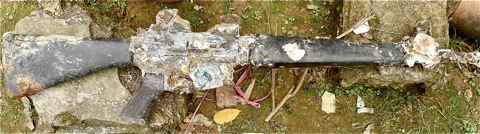
Encrusted with shells and deposits. It was fished out of the Perfume River, in Hue, the ancient commercial centre and capital of the Vietnamese empire and, many centuries later, the theatre of the Tet Offensive, one of the most ferocious battles of the “American” war, as they call it here.
The rifle is just another archaeological find, like the amphorae used to prepare nuoc mam, or fish sauce, the rice bowls, stone anchors or fishing net weights. Thousands of these objects belong to Ho Tan Phan, a smiling old gentleman and self-titled erudite, who has been collecting what the sampan fishermen bring to him for almost forty years. At first sight, his home and garden look like the den of a compulsive hoarder. Then you realise that it is a kind of historical warehouse. Amongst baskets filled with fragments of Chinese porcelain, stacks of vases, little amphorae and everyday objects, there are pieces of great beauty and value, including some celadon ceramic bowls.
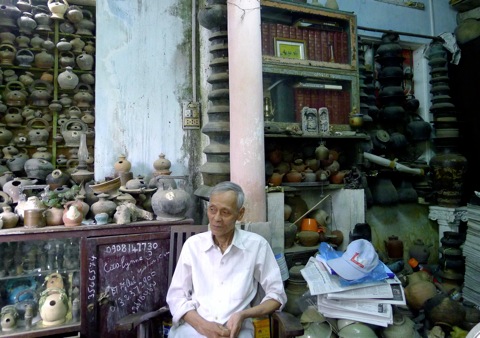
You wonder who these things belonged to, what human stories lie behind them, how they ended up on the river bed. The rifle prompts even more questions.
It is the poetry of mystery. And it brings to mind a verse by Baudelaire:
“Like prolonged echoes mingling in the distance
In a deep and tenebrous unity”
The echo reverberates in the mind: history is never over.
A scene from Full Metal Jacket: The battle of Hue.
It isn't a weapon any more. It's a relic, almost a fossil.
Encrusted with shells and deposits. It was fished out of the Perfume River, in Hue, the ancient commercial centre and capital of the Vietnamese empire and, many centuries later, the theatre of the Tet Offensive, one of the most ferocious battles of the “American” war, as they call it here.
The rifle is just another archaeological find, like the amphorae used to prepare nuoc mam, or fish sauce, the rice bowls, stone anchors or fishing net weights. Thousands of these objects belong to Ho Tan Phan, a smiling old gentleman and self-titled erudite, who has been collecting what the sampan fishermen bring to him for almost forty years. At first sight, his home and garden look like the den of a compulsive hoarder. Then you realise that it is a kind of historical warehouse. Amongst baskets filled with fragments of Chinese porcelain, stacks of vases, little amphorae and everyday objects, there are pieces of great beauty and value, including some celadon ceramic bowls.
You wonder who these things belonged to, what human stories lie behind them, how they ended up on the river bed. The rifle prompts even more questions.
It is the poetry of mystery. And it brings to mind a verse by Baudelaire:
“Like prolonged echoes mingling in the distance
In a deep and tenebrous unity”
The echo reverberates in the mind: history is never over.
A scene from Full Metal Jacket: The battle of Hue.
Melanie’s World
04/10/13 15:57
Melanie attached the image of a pirogue with two fishermen on board onto a piece of the wooden fishing boat washed up on a beach in the Philippines. These boats have then been reincarnated in The Explorer. I look at it on a wall at home. While he seems to watch the river, the Chao Phraya, through the window.
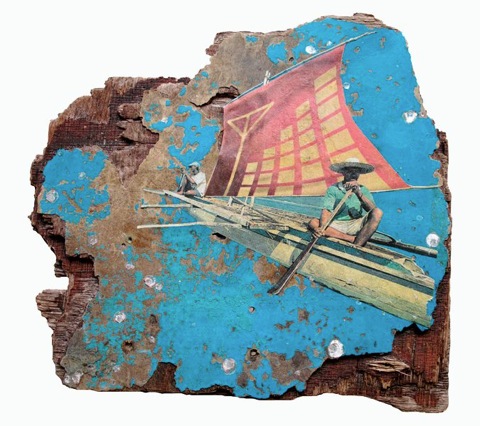
I imagine that I am on that pirogue, which from here seems to head towards the river and then into the Gulf of Thailand. Before perhaps heading to the Philippines. Or to Borneo, the Indonesian islands, a dot in the Sixth Continent.
It is one of those times that you ask yourself that same old question: “What am I doing here?” It's all you can think about and you lose yourself like a sailor losing his way on the ocean, not knowing which port to make for or having no final destination. He just keeps sailing as though on a ghost ship.
There is a feeling of being out of one's depth, and at the same time stranded and lost. Which might explain my long absence from Bassifondi. But it's good to take a break now and then. Like waiting for the prevailing wind to decide for you.
The Explorer is one of the works in Melanie's latest exhibition, entitled Traces. She gave it this name because, she says, she wanted those pieces of wood to deliver a message: less chaos, more essence.
Melanie Gritzka del Villar, a vague mixture of Louise Brooks and Frida Kahlo, is a half-German, half-Filipino artist who lives in Asia and Europe. It is probably this hybrid, cosmopolitan nature that characterises her work, both in the technique, using collages of different materials, and in the content, puzzles of different worlds.
For now, Melanie's world is in Bangkok. Her studio, in the popular north-eastern district, is inside a grey building where her fellow artists, designers and creatives of the “Thai post-modern art society” are based. It is called Hof Art and has a Bauhaus-like image, underlined by the name Hof , which recalls the German “place”. In fact, Hof is an acronym of Highly Optimistic & Friendly.
The Explorer led me to Melanie’s world. It was like a breath of fresh air.
I imagine that I am on that pirogue, which from here seems to head towards the river and then into the Gulf of Thailand. Before perhaps heading to the Philippines. Or to Borneo, the Indonesian islands, a dot in the Sixth Continent.
It is one of those times that you ask yourself that same old question: “What am I doing here?” It's all you can think about and you lose yourself like a sailor losing his way on the ocean, not knowing which port to make for or having no final destination. He just keeps sailing as though on a ghost ship.
There is a feeling of being out of one's depth, and at the same time stranded and lost. Which might explain my long absence from Bassifondi. But it's good to take a break now and then. Like waiting for the prevailing wind to decide for you.
The Explorer is one of the works in Melanie's latest exhibition, entitled Traces. She gave it this name because, she says, she wanted those pieces of wood to deliver a message: less chaos, more essence.
Melanie Gritzka del Villar, a vague mixture of Louise Brooks and Frida Kahlo, is a half-German, half-Filipino artist who lives in Asia and Europe. It is probably this hybrid, cosmopolitan nature that characterises her work, both in the technique, using collages of different materials, and in the content, puzzles of different worlds.
For now, Melanie's world is in Bangkok. Her studio, in the popular north-eastern district, is inside a grey building where her fellow artists, designers and creatives of the “Thai post-modern art society” are based. It is called Hof Art and has a Bauhaus-like image, underlined by the name Hof , which recalls the German “place”. In fact, Hof is an acronym of Highly Optimistic & Friendly.
The Explorer led me to Melanie’s world. It was like a breath of fresh air.
The non-commandments
17/06/13 11:36
As I go through life, some little rules and regulations come to mind.
They are all very personal. And this explains the first rule:.
Do not go by other people's commandments
Do not eat soup for breakfast
Do not write articles for free
Do not leave your passport with other people
Do not drink alcohol before sunset
Do not choose the middle seat
Do not trust cats
Do not wait for dawn to ask a woman if she wants to stay over
Do not get off at the first stop
Let the stupid ones die.
They are all very personal. And this explains the first rule:.
Do not go by other people's commandments
Do not eat soup for breakfast
Do not write articles for free
Do not leave your passport with other people
Do not drink alcohol before sunset
Do not choose the middle seat
Do not trust cats
Do not wait for dawn to ask a woman if she wants to stay over
Do not get off at the first stop
Let the stupid ones die.
Water and mountain
30/05/13 16:28
“What does it represent?” A stupid question.
“A landscape, as I see it.” A kind response.
You can sense that Jean Cabane's paintings are landscapes. They are the places of a French poet painter living in Hoi An, Vietnam. He walks between the sea and the rice paddies and draws what he sees as he sees it.
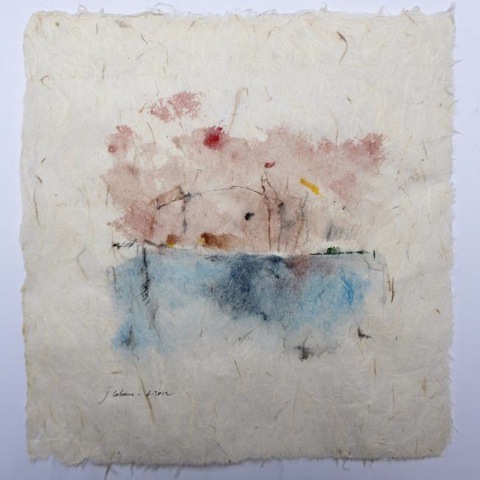
His work, painted with natural pigments on rice paper, resembles what a haiku would look like if it were drawn. A shanshui of the Chinese tradition, a landscape. And it isn't superfluous to note that the term landscape in Chinese is made up of the union of the two characters for mountain, shan, and water, shui. The Asian aesthetic, harmonised in Jean with the genetic imprinting of his native Provence, highlights not so much the cognitive aspect as the communication of emotions.
I know all of this. So why ask such a stupid question?
Probably because it is hard to escape the desire to place, define or nail down something that is altogether more subtle. It is as if I couldn't trust myself.
On the other hand, thinking back to my meeting with Cabane, whose life shares a few coincidences and experiences with my own, I realised that the shanshui, or landscape, in his composition of water and land, sea and mountain, or forest, has become the scenario in which I operate physically and mentally, where I search for ideas for articles, where the stories I should be telling are set.
Such as the stories of the monks I am following between north-east Thailand and the mountains of the southern Shan, in Burma. The stories of ghost ships in the Gulf of Thailand or of those tackling the waters of the South China Sea, with its islands, islets and rocks. The stories of deviations and digressions from those paths, with quiet moments spent on deserted beaches near the base and port of Cam Ranh, or the nimitti, the hallucinations of meditation, that set off anxiety and panic attacks.
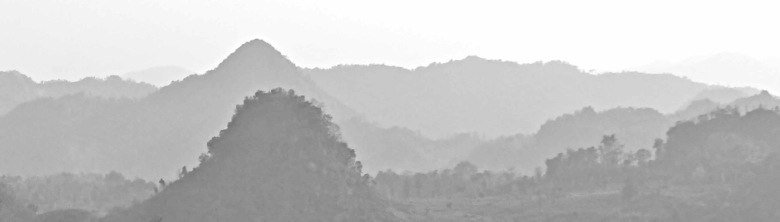
Moving confusedly around this landscape, between monks, archaeologists and poets, mysterious and menacing ships, ruins and wreckage, I look for the story within the stories.
I keep asking myself the same stupid question: “What does it represent?”
But I don't yet have the courage or the ability to respond: “A landscape, as I see it.”

“A landscape, as I see it.” A kind response.
You can sense that Jean Cabane's paintings are landscapes. They are the places of a French poet painter living in Hoi An, Vietnam. He walks between the sea and the rice paddies and draws what he sees as he sees it.
His work, painted with natural pigments on rice paper, resembles what a haiku would look like if it were drawn. A shanshui of the Chinese tradition, a landscape. And it isn't superfluous to note that the term landscape in Chinese is made up of the union of the two characters for mountain, shan, and water, shui. The Asian aesthetic, harmonised in Jean with the genetic imprinting of his native Provence, highlights not so much the cognitive aspect as the communication of emotions.
I know all of this. So why ask such a stupid question?
Probably because it is hard to escape the desire to place, define or nail down something that is altogether more subtle. It is as if I couldn't trust myself.
On the other hand, thinking back to my meeting with Cabane, whose life shares a few coincidences and experiences with my own, I realised that the shanshui, or landscape, in his composition of water and land, sea and mountain, or forest, has become the scenario in which I operate physically and mentally, where I search for ideas for articles, where the stories I should be telling are set.
Such as the stories of the monks I am following between north-east Thailand and the mountains of the southern Shan, in Burma. The stories of ghost ships in the Gulf of Thailand or of those tackling the waters of the South China Sea, with its islands, islets and rocks. The stories of deviations and digressions from those paths, with quiet moments spent on deserted beaches near the base and port of Cam Ranh, or the nimitti, the hallucinations of meditation, that set off anxiety and panic attacks.
Moving confusedly around this landscape, between monks, archaeologists and poets, mysterious and menacing ships, ruins and wreckage, I look for the story within the stories.
I keep asking myself the same stupid question: “What does it represent?”
But I don't yet have the courage or the ability to respond: “A landscape, as I see it.”
The time of stupid people
26/04/13 16:31
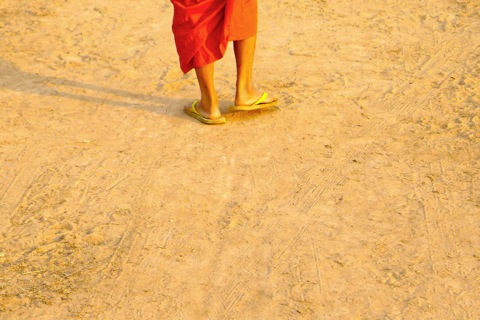
“It will take millions of lives for stupid people to be born smart," an old forest monk told me.
"I don't have that much time," I replied.
"Stop thinking about time."
That night, in a kind of kuti, or monk's cell, that the old man had built next to his own, I continued to think. About time and about stupid people. Time that passes and that seems to have become the time of stupid people.
I concluded that the old monk was right: let time pass without thinking about it. And without thinking about stupid people (which is getting increasingly difficult).
I have started working on a short story, maybe a book, on forest monks. Which at least partly explains my long absence from this blog.
"I don't have that much time," I replied.
"Stop thinking about time."
That night, in a kind of kuti, or monk's cell, that the old man had built next to his own, I continued to think. About time and about stupid people. Time that passes and that seems to have become the time of stupid people.
I concluded that the old monk was right: let time pass without thinking about it. And without thinking about stupid people (which is getting increasingly difficult).
I have started working on a short story, maybe a book, on forest monks. Which at least partly explains my long absence from this blog.
Lost in Translation
22/02/13 02:41
Many of the things I heard and noted down during a Chinese opera show held in a Bangkok street are probably incorrect. So I’ll write them here.
It’s yet another reference to the film Lost in Translation, in which a long drawn-out speech in Japanese is translated into English in just a few words. In this Bangkok street, the languages spoken were English, Thai, Mandarin and teochew, a dialect spoken in the east of the Chinese province of Guandong. “Very traditional Chinese,” says the young man who is my interpreter. Many linguists consider it to be one of the dialects most similar to archaic Chinese. The dialect has become the language of the so-called Teochew diaspora, approximately ten million people dispersed around Southeast Asia and the rest of the world.
“Destiny,” says the young man to explain the phenomenon that brought his grandfather from the south of China to Bangkok. The young man, however, does not know teochew. He speaks Thai and, very wisely, has also learned English and Mandarin, the official language used in the People’s Republic of China. He was called by Ms Phrasit, the director of the touring company – which performs in Bangkok, Thailand and also abroad, i.e. in Malaysia – who is the subject of a photo reportage in progress by Andrea Pistolesi (who took all these photos). This young man is supposed to be able to help me understand what is going on so that I can write about it.
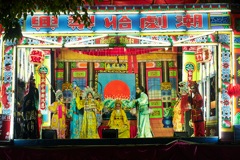
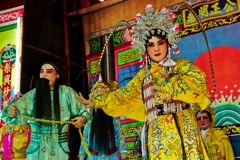
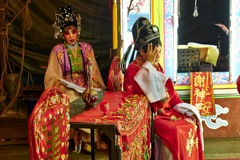
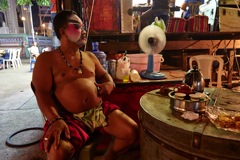
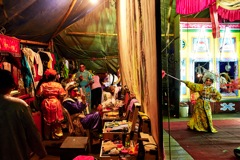
The problem is that before she can speak, Ms Phrasit has to mentally translate from Chinese to Thai. Then she tries to express the idea to the young man, who then translates into English. This is why it is hard to understand the name of the group she leads, for example. It sounds more or less like this: “This Chinese opera group has arrived and good luck to all”. After translating it, the young man looks puzzled and smiles. “It sounds strange, I know,” he says.
The title of the opera they are performing is even harder to understand. Ms Phrasit thinks about it for a long time. And finally gives up: “I don’t know how to say the title. It’s a new story. It’s the story of an honest person.” I should now point out that the lady previously explained that the stories they perform are “stories from the imagination”, in the sense that every year she writes two or three new ones, merging traditional and historical elements with everyday stories. The script is usually written by an author “from China” who is also the director, acting consultant and teacher for the actors who do not speak Chinese. Because, to complicate matters further, some of the actors are “pure Chinese” while others are “pure Thai”. In order to learn their parts, the latter must listen to a recording and then recite by rote.
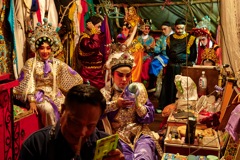
Paradoxically, then, it can be said that the Chinese opera show finds its traditional setting in Bangkok. They used to say that “a minute on stage requires ten years of rehearsal”. They may not take that long to get ready, but the backstage atmosphere cannot have changed much since this kind of performance began, almost two thousand years ago. The scene backstage is a show within a show, reproducing the script of play-actors in an Italian Commedia dell’Arte, Greek tragicomedy or Indian Sanskrit opera. With the addition of certain elements that create a post-modern image.
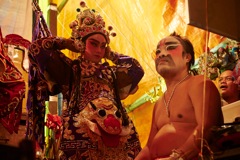
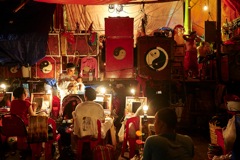
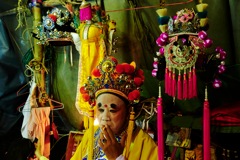
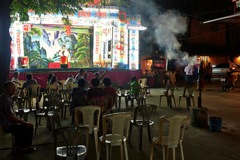
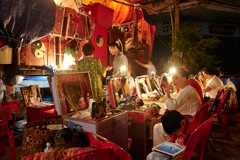
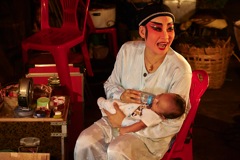
Some are eating soup, some chatting on the cell phone, kids are playing, one actress cradles her baby, a girl with tattooed shoulders eyes up an actor with a striped face. The actors put on their make-up and revise their lines. Some have the script on a tablet. Others are chatting online on social networks.
The company is made up of thirty or so people for whom this is their main job. They earn as a whole about thirty thousand bath per night (about 90 euro), which is split “more or less equally”, as Ms Phrasit puts it. They are commissioned by district committees, associations (the clans present in countries with a strong Chinese community), and individuals wishing to demonstrate their sense of gratitude, goodwill and belonging to the community. And Thailand is one of the countries in Southeast Asia where the Chinese presence is strongest and where Chinese opera is more popular than in China itself.
“There are about twenty companies like ours in Bangkok alone,” says Ms Phrasit, with evident pride in her company and in the Sino-Thai's connection to tradition.
Indeed, while we were walking around the area of Hua Lamphong station trying to find the location of the show (the directions were “near a temple near the station”), we came across another and only after a while realised it wasn't the one we were looking for. Fortunately one of the actors was the brother of our Ms Phrasit. “Everything starts with the family. Then it expands, it splits,” she will tell us later.
After spending some time backstage, I move to the other side of the street, facing the stage, where rows of plastic seats have been set out. There are not many spectators. Mostly women, and mostly elderly. Some are chatting amongst themselves. “Some are talking about the show and some are gossiping,” says the interpreter.
Following the show turns out to be even harder than understanding Ms Phrasit. The actors express themselves with a series of acute metallic sounds accompanied by gongs, erhu (the Chinese two-string “violin”), lutes and other traditional instruments. There are two women on stage, one of which is playing a male character. I ask if this has a special significance. “Thais like to see women dressed as men,” comes the reply.
In the end, I give up trying to understand. There will be time to write about the colours, sounds, movements and mask-like make-up. In Chinese opera, every tiniest detail is a symbol connected to mysterious philosophies and religions. I think by now there are very few specialists capable of decoding everything. Everyone else comes just to look, listen and chat.
Instead, I try to understand how my interpreter, a second-generation Sino-Thai, experiences the relationship with his traditions, whether one identity is dominant over the other. The reply is always the same: “Both.” In the sense that he feels as Chinese as he does Thai. He follows both Chinese and Thai rituals. He finds no contradiction between Chinese (Mahayana) and Thai Buddhism (Theravada). Or in business: certainly, China has become the second global superpower, and many are considering going back in a kind of historical recourse. But he believes he is in the best situation to run things between Thailand and the People’s Republic (without counting the adjacent countries).
We sit a while in silence and watch the show. But he looks bored.
“I don’t understand what they are saying,” he repeats.
I ask him whether he is fascinated by the stage show all the same, whether he feels it as part of his cultural heritage, whether he is interested at all.
“It's a show for old folks.”
“You really don’t like it?” I ask him several times.
“No.”
And suddenly the street scene turns into a scene from Christmas at the Cupiello's, the play by Edoardo De Filippo. Famous for the oft-repeated line “Te piace ‘o presepe?” (Do you like the nativity scene?), which the lead character, Luca Cupiello, constantly asks his son, Nennillo.
“Do you like the nativity scene?”.
“No. But so what, do I have to like it?”
And then again, pointing to the little waterfall in the nativity scene: “Do you like it?”
“No!”
It’s yet another reference to the film Lost in Translation, in which a long drawn-out speech in Japanese is translated into English in just a few words. In this Bangkok street, the languages spoken were English, Thai, Mandarin and teochew, a dialect spoken in the east of the Chinese province of Guandong. “Very traditional Chinese,” says the young man who is my interpreter. Many linguists consider it to be one of the dialects most similar to archaic Chinese. The dialect has become the language of the so-called Teochew diaspora, approximately ten million people dispersed around Southeast Asia and the rest of the world.
“Destiny,” says the young man to explain the phenomenon that brought his grandfather from the south of China to Bangkok. The young man, however, does not know teochew. He speaks Thai and, very wisely, has also learned English and Mandarin, the official language used in the People’s Republic of China. He was called by Ms Phrasit, the director of the touring company – which performs in Bangkok, Thailand and also abroad, i.e. in Malaysia – who is the subject of a photo reportage in progress by Andrea Pistolesi (who took all these photos). This young man is supposed to be able to help me understand what is going on so that I can write about it.
The problem is that before she can speak, Ms Phrasit has to mentally translate from Chinese to Thai. Then she tries to express the idea to the young man, who then translates into English. This is why it is hard to understand the name of the group she leads, for example. It sounds more or less like this: “This Chinese opera group has arrived and good luck to all”. After translating it, the young man looks puzzled and smiles. “It sounds strange, I know,” he says.
The title of the opera they are performing is even harder to understand. Ms Phrasit thinks about it for a long time. And finally gives up: “I don’t know how to say the title. It’s a new story. It’s the story of an honest person.” I should now point out that the lady previously explained that the stories they perform are “stories from the imagination”, in the sense that every year she writes two or three new ones, merging traditional and historical elements with everyday stories. The script is usually written by an author “from China” who is also the director, acting consultant and teacher for the actors who do not speak Chinese. Because, to complicate matters further, some of the actors are “pure Chinese” while others are “pure Thai”. In order to learn their parts, the latter must listen to a recording and then recite by rote.
Paradoxically, then, it can be said that the Chinese opera show finds its traditional setting in Bangkok. They used to say that “a minute on stage requires ten years of rehearsal”. They may not take that long to get ready, but the backstage atmosphere cannot have changed much since this kind of performance began, almost two thousand years ago. The scene backstage is a show within a show, reproducing the script of play-actors in an Italian Commedia dell’Arte, Greek tragicomedy or Indian Sanskrit opera. With the addition of certain elements that create a post-modern image.
Some are eating soup, some chatting on the cell phone, kids are playing, one actress cradles her baby, a girl with tattooed shoulders eyes up an actor with a striped face. The actors put on their make-up and revise their lines. Some have the script on a tablet. Others are chatting online on social networks.
The company is made up of thirty or so people for whom this is their main job. They earn as a whole about thirty thousand bath per night (about 90 euro), which is split “more or less equally”, as Ms Phrasit puts it. They are commissioned by district committees, associations (the clans present in countries with a strong Chinese community), and individuals wishing to demonstrate their sense of gratitude, goodwill and belonging to the community. And Thailand is one of the countries in Southeast Asia where the Chinese presence is strongest and where Chinese opera is more popular than in China itself.
“There are about twenty companies like ours in Bangkok alone,” says Ms Phrasit, with evident pride in her company and in the Sino-Thai's connection to tradition.
Indeed, while we were walking around the area of Hua Lamphong station trying to find the location of the show (the directions were “near a temple near the station”), we came across another and only after a while realised it wasn't the one we were looking for. Fortunately one of the actors was the brother of our Ms Phrasit. “Everything starts with the family. Then it expands, it splits,” she will tell us later.
After spending some time backstage, I move to the other side of the street, facing the stage, where rows of plastic seats have been set out. There are not many spectators. Mostly women, and mostly elderly. Some are chatting amongst themselves. “Some are talking about the show and some are gossiping,” says the interpreter.
Following the show turns out to be even harder than understanding Ms Phrasit. The actors express themselves with a series of acute metallic sounds accompanied by gongs, erhu (the Chinese two-string “violin”), lutes and other traditional instruments. There are two women on stage, one of which is playing a male character. I ask if this has a special significance. “Thais like to see women dressed as men,” comes the reply.
In the end, I give up trying to understand. There will be time to write about the colours, sounds, movements and mask-like make-up. In Chinese opera, every tiniest detail is a symbol connected to mysterious philosophies and religions. I think by now there are very few specialists capable of decoding everything. Everyone else comes just to look, listen and chat.
Instead, I try to understand how my interpreter, a second-generation Sino-Thai, experiences the relationship with his traditions, whether one identity is dominant over the other. The reply is always the same: “Both.” In the sense that he feels as Chinese as he does Thai. He follows both Chinese and Thai rituals. He finds no contradiction between Chinese (Mahayana) and Thai Buddhism (Theravada). Or in business: certainly, China has become the second global superpower, and many are considering going back in a kind of historical recourse. But he believes he is in the best situation to run things between Thailand and the People’s Republic (without counting the adjacent countries).
We sit a while in silence and watch the show. But he looks bored.
“I don’t understand what they are saying,” he repeats.
I ask him whether he is fascinated by the stage show all the same, whether he feels it as part of his cultural heritage, whether he is interested at all.
“It's a show for old folks.”
“You really don’t like it?” I ask him several times.
“No.”
And suddenly the street scene turns into a scene from Christmas at the Cupiello's, the play by Edoardo De Filippo. Famous for the oft-repeated line “Te piace ‘o presepe?” (Do you like the nativity scene?), which the lead character, Luca Cupiello, constantly asks his son, Nennillo.
“Do you like the nativity scene?”.
“No. But so what, do I have to like it?”
And then again, pointing to the little waterfall in the nativity scene: “Do you like it?”
“No!”
The path of the Snake
14/02/13 13:00
The year of the Snake began on 10th February. According to Chinese astrology, it symbolises hope, intelligence, wisdom and self-discipline. All to the good, then.
But it is not only the twelve animals of the zodiac that have an influence on the future. The five basic elements – metal, wood, water, fire and earth – also alternate, contributing to determining the future (or the present, depending on when you look at it). This year is dominated by a combination of two elements, fire and water, in conflict with one another. This could have unpleasant consequences, both for private life and for international relations.
The international risks, especially in the theatre of East Asia, are summed up in articles by Francesco Sisci and the Indian former diplomat M K Bhadrakumar, evocatively entitled North Korea nukes the Year of the Snake. Or in this video on the intelligence site Stratfor. Whether true or false, the stories and meanings of the Chinese zodiac are food for thought.
In this case, though, the snake is more likely to set off individual doubts than elegant geopolitical analysis. It is no coincidence that, according to the Judeo-Christian tradition, the snake symbolises doubt in the form of temptation. It is also no coincidence that Carl Gustav Jung used it as an image in his theory of collective unconscious.
It is just that, in the West, Doubt is too often reduced to a right/wrong, good/bad dichotomy, and is therefore exorcised in the form of repentance and good intentions. Which is what New Year’s resolutions are all about.
But here and now we are in the East and here doubt is not defused in the hypothesis of a response or in a choice. Here, it is self-feeding. It is like the coiled snake, the symbol of Kundalini, the dormant energy within every individual, and like the Tao circle, which represents the interdependence between yin and yang, the two poles through which reality manifests itself, because the one does not exist without the other, or rather: each is defined by the other. Here, doubt creates further doubts. Even more so in the year of the snake, the animal that changes its skin and leads you to think of your own future metamorphosis.
“Only the snake understands his path through the grass”. I have no idea where that quote comes from or who said it, but it has always fascinated me.
Personally, I still don’t know what animal I am (not in terms of the Chinese zodiac anyway, according to which I am an ox). Much less do I understand where I am and what path I am following.
But it is not only the twelve animals of the zodiac that have an influence on the future. The five basic elements – metal, wood, water, fire and earth – also alternate, contributing to determining the future (or the present, depending on when you look at it). This year is dominated by a combination of two elements, fire and water, in conflict with one another. This could have unpleasant consequences, both for private life and for international relations.
The international risks, especially in the theatre of East Asia, are summed up in articles by Francesco Sisci and the Indian former diplomat M K Bhadrakumar, evocatively entitled North Korea nukes the Year of the Snake. Or in this video on the intelligence site Stratfor. Whether true or false, the stories and meanings of the Chinese zodiac are food for thought.
In this case, though, the snake is more likely to set off individual doubts than elegant geopolitical analysis. It is no coincidence that, according to the Judeo-Christian tradition, the snake symbolises doubt in the form of temptation. It is also no coincidence that Carl Gustav Jung used it as an image in his theory of collective unconscious.
It is just that, in the West, Doubt is too often reduced to a right/wrong, good/bad dichotomy, and is therefore exorcised in the form of repentance and good intentions. Which is what New Year’s resolutions are all about.
But here and now we are in the East and here doubt is not defused in the hypothesis of a response or in a choice. Here, it is self-feeding. It is like the coiled snake, the symbol of Kundalini, the dormant energy within every individual, and like the Tao circle, which represents the interdependence between yin and yang, the two poles through which reality manifests itself, because the one does not exist without the other, or rather: each is defined by the other. Here, doubt creates further doubts. Even more so in the year of the snake, the animal that changes its skin and leads you to think of your own future metamorphosis.
“Only the snake understands his path through the grass”. I have no idea where that quote comes from or who said it, but it has always fascinated me.
Personally, I still don’t know what animal I am (not in terms of the Chinese zodiac anyway, according to which I am an ox). Much less do I understand where I am and what path I am following.
Flags of Convenience
28/01/13 12:38
“What flag is your ship flying?” asks the inspector from the International Transport Workers’ Federation. He is an Indian, and his job is to deal with crews working on ships flying Flags of Convenience.
“Panama?” responds the Filipino captain uncertainly.
“I thought it was Chinese,” says the inspector.
The captain leans out of the porthole in the mess where we are gathered and looks outside.
“Yes, it’s Chinese,” he admits with a little laugh.
“No, I meant the owners are Chinese, from Taiwan. The flag is Hong Kong’s,” points out the inspector.
“What’s your cargo?” continues the inspector.
“Lots of different things, I’m not sure exactly,” replies the captain, spreading his arms wide.
“No one's complaining. Everything’s fine,” says the captain when the inspector asks to see the crew’s contracts.
“No one's complaining. Nothing is OK,” rebuts the inspector.
These fragments of a conversation sound like a poker game in which everyone is trying a pathetic bluff on board a ship anchored in Bangkok’s harbour. But this is not one of those ghost-ships that cross paths in some remote Asian dock. This is an 11,000-ton gross tonnage ship built in Japan in 2007. It continuously sails the same route between Taiwan, Saigon and Bangkok.
In the meantime, the captain has called his ship-owner, a certain Mr Chu. And the inspector, his Delhi office. And while these useless conversations take place, a few Filipino sailors glance indifferently into the room to see what is going on.
“No one is complaining,” repeats the captain. “We have to support our families.”
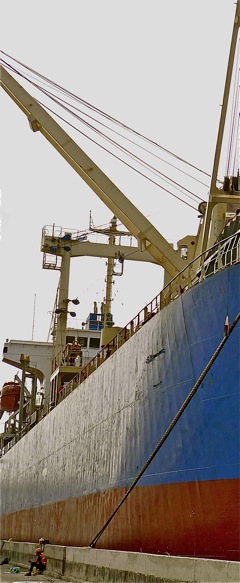
And so a story of ships, sailors, harbours and trafficking begins again on Bassifondi…
“Panama?” responds the Filipino captain uncertainly.
“I thought it was Chinese,” says the inspector.
The captain leans out of the porthole in the mess where we are gathered and looks outside.
“Yes, it’s Chinese,” he admits with a little laugh.
“No, I meant the owners are Chinese, from Taiwan. The flag is Hong Kong’s,” points out the inspector.
“What’s your cargo?” continues the inspector.
“Lots of different things, I’m not sure exactly,” replies the captain, spreading his arms wide.
“No one's complaining. Everything’s fine,” says the captain when the inspector asks to see the crew’s contracts.
“No one's complaining. Nothing is OK,” rebuts the inspector.
These fragments of a conversation sound like a poker game in which everyone is trying a pathetic bluff on board a ship anchored in Bangkok’s harbour. But this is not one of those ghost-ships that cross paths in some remote Asian dock. This is an 11,000-ton gross tonnage ship built in Japan in 2007. It continuously sails the same route between Taiwan, Saigon and Bangkok.
In the meantime, the captain has called his ship-owner, a certain Mr Chu. And the inspector, his Delhi office. And while these useless conversations take place, a few Filipino sailors glance indifferently into the room to see what is going on.
“No one is complaining,” repeats the captain. “We have to support our families.”
And so a story of ships, sailors, harbours and trafficking begins again on Bassifondi…
The Circle
31/12/12 14:10
The void, strength, elegance, the universe, the absolute, infinite space-time, aesthetics. These are just some of the meanings of Enso, which is not a character but a symbol of the Zen tradition. It is also the central subject of Zen painting, symbolising the moment when the mind is given free impulse to create, “the expression of the instant”. Only then can the circle be painted with a single, fluid brushstroke.
I am drawn to the Enso. I think of it as a catalyst of Stories, a portal leading to a world in which chaos seems to take on an elegant order.
A while ago, I admired one at a gallery in Singapore. It had been painted by Fabienne Verdier, the only Westerner to merit the title of calligrapher. A few months later, I met her in her home-studio in the countryside north of Paris. She was preparing a series of works for Bruges Cathedral: twelve paintings depicting the Enso, which came to her while she was observing a detail of a Van Eyck painting. On a stroll through her garden where she burns her canvases that “have no life”, accompanied by a one-eyed cat, she spoke to me of the ascetic meaning of the Enso. She explained that the repetition of the Enso is akin to representing a resonance in a different way to create harmony.
I left with some of her books and a reproduction of an Enso, which I brought back to Bangkok. It is not a perfect circle. “It’s a metaphor for humanity,” said Fabienne. Like many circles painted by Zen artists, it is incomplete, meaning that it is not a separate entity but part of something greater. I placed it on a shelf in the bookcase where I keep amulets, a model Indonesian boat and four little Buddhas in pastel colours. They stand near the books I frequently dip into, so that, each time I do, I am persuaded to reconnect to all that they represent.
Some time later, while doing research for an article on Bangkok, I came across a newspaper clipping about Jukkoo Wong, a famous tattoo artist in Thai show business, in between the pages of a book. Jukkoo is the son of Jimmy Wong, who made a name for himself tattooing American soldiers posted to Bangkok during the Vietnam War. I had already met Jukkoo on another occasion. He is a bizarre character, with a streak of madness in him. I thought he was perfect for the gallery of scenarios we had to feature in our article on Bangkok.
So it was that I and the photographer I was working with went to visit Jukkoo. We were quickly drawn into an absurd comedy directed by Jukkoo in which we were the victims, spectators and protagonists all at once. Just like the first time we had met, I asked him if he could do me a tattoo of the kanji he had on his wrist. I didn’t know what it meant but loved the look of it and its shaded design. Jukkoo gave me the same answer as before: he couldn’t, that tattoo was his alone and had been done by someone else. This time, however, he offered an alternative. He showed me the drawing of an Enso. It was incredibly similar to Fabienne’s. That it was drawn by a tattoo needle seemed impossible.
I don’t often make decisions quickly, almost never in fact. I have to think it over, sleep on it. I am a victim of Doubt. But this time I did not hesitate. It was as if that Enso was pulling me in and I simply couldn’t resist.
While Jukkoo worked the needle over my left forearm as though it were a brush, as though bending it into the strokes left by each bristle, I thought of all the coincidences that had led me to that little tattoo parlour in Pratunam, one of Bangkok’s liveliest districts. It also occurred to me that the year was coming to an end and this tattoo may be another rite of passage in my life. The entry to a new world, a new way of being.
A short time later, I returned to Italy. In my hometown, Ancona, I found winter by the sea, with scenes reminiscent of the film Indian Summer. It was the perfect melancholy in which to collect my thoughts.
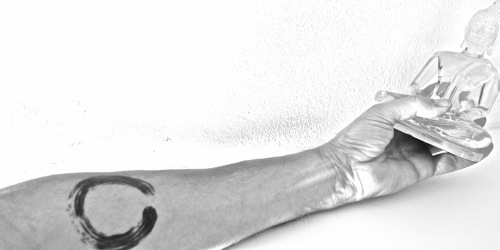
Looking at my Enso, which, as Jukkoo had said, was getting clearer every day, the circle was becoming a way of seeing the world in its “double exposure”, its surface and its depth. This is an idea that came to me while rereading a book on the early 20th century Japanese philosopher, Keiji Nishitani.
I had looked for the book at my Ancona home – recently tidied after yet another move – because I wanted to find some ideas to nourish the Enso on my forearm so that it, in turn, could digest everything and suggest a story. I ended up finding other books, especially on haiku, and a collection by Matsuo Basho, who captivated me once again with his poems. “Traveller I wish to be called, now that the first rain of the season falls,” he wrote a short time before his death. It is a mantra for exorcising my fear.
In the meantime, I downloaded the latest e-book by Nicolai Linin, Storie sulla pelle (Stories on the skin), about the tattoo tradition of Siberia’s “honest criminals”. His stories and his tattoos seem far removed from the absolute simplicity of the Enso. They more closely resemble the idea of Sak Yant, the magical Thai tattoo. And here comes another coincidence: Linin relates that the protagonist of his stories wants to modernise the traditional Siberian tattoo. Which is what Jukkoo is doing with Sak Yant. It would be very interesting to do a comparative analysis. And it would be great if the two were to meet.
For now, though, I can’t wait to show my tattoo to Fabienne. She will be in Singapore soon to present her new work at the gallery where this story began. But the circle will not close just yet.
I am drawn to the Enso. I think of it as a catalyst of Stories, a portal leading to a world in which chaos seems to take on an elegant order.

A while ago, I admired one at a gallery in Singapore. It had been painted by Fabienne Verdier, the only Westerner to merit the title of calligrapher. A few months later, I met her in her home-studio in the countryside north of Paris. She was preparing a series of works for Bruges Cathedral: twelve paintings depicting the Enso, which came to her while she was observing a detail of a Van Eyck painting. On a stroll through her garden where she burns her canvases that “have no life”, accompanied by a one-eyed cat, she spoke to me of the ascetic meaning of the Enso. She explained that the repetition of the Enso is akin to representing a resonance in a different way to create harmony.
I left with some of her books and a reproduction of an Enso, which I brought back to Bangkok. It is not a perfect circle. “It’s a metaphor for humanity,” said Fabienne. Like many circles painted by Zen artists, it is incomplete, meaning that it is not a separate entity but part of something greater. I placed it on a shelf in the bookcase where I keep amulets, a model Indonesian boat and four little Buddhas in pastel colours. They stand near the books I frequently dip into, so that, each time I do, I am persuaded to reconnect to all that they represent.
Some time later, while doing research for an article on Bangkok, I came across a newspaper clipping about Jukkoo Wong, a famous tattoo artist in Thai show business, in between the pages of a book. Jukkoo is the son of Jimmy Wong, who made a name for himself tattooing American soldiers posted to Bangkok during the Vietnam War. I had already met Jukkoo on another occasion. He is a bizarre character, with a streak of madness in him. I thought he was perfect for the gallery of scenarios we had to feature in our article on Bangkok.
So it was that I and the photographer I was working with went to visit Jukkoo. We were quickly drawn into an absurd comedy directed by Jukkoo in which we were the victims, spectators and protagonists all at once. Just like the first time we had met, I asked him if he could do me a tattoo of the kanji he had on his wrist. I didn’t know what it meant but loved the look of it and its shaded design. Jukkoo gave me the same answer as before: he couldn’t, that tattoo was his alone and had been done by someone else. This time, however, he offered an alternative. He showed me the drawing of an Enso. It was incredibly similar to Fabienne’s. That it was drawn by a tattoo needle seemed impossible.
I don’t often make decisions quickly, almost never in fact. I have to think it over, sleep on it. I am a victim of Doubt. But this time I did not hesitate. It was as if that Enso was pulling me in and I simply couldn’t resist.
While Jukkoo worked the needle over my left forearm as though it were a brush, as though bending it into the strokes left by each bristle, I thought of all the coincidences that had led me to that little tattoo parlour in Pratunam, one of Bangkok’s liveliest districts. It also occurred to me that the year was coming to an end and this tattoo may be another rite of passage in my life. The entry to a new world, a new way of being.
A short time later, I returned to Italy. In my hometown, Ancona, I found winter by the sea, with scenes reminiscent of the film Indian Summer. It was the perfect melancholy in which to collect my thoughts.
Looking at my Enso, which, as Jukkoo had said, was getting clearer every day, the circle was becoming a way of seeing the world in its “double exposure”, its surface and its depth. This is an idea that came to me while rereading a book on the early 20th century Japanese philosopher, Keiji Nishitani.
I had looked for the book at my Ancona home – recently tidied after yet another move – because I wanted to find some ideas to nourish the Enso on my forearm so that it, in turn, could digest everything and suggest a story. I ended up finding other books, especially on haiku, and a collection by Matsuo Basho, who captivated me once again with his poems. “Traveller I wish to be called, now that the first rain of the season falls,” he wrote a short time before his death. It is a mantra for exorcising my fear.
In the meantime, I downloaded the latest e-book by Nicolai Linin, Storie sulla pelle (Stories on the skin), about the tattoo tradition of Siberia’s “honest criminals”. His stories and his tattoos seem far removed from the absolute simplicity of the Enso. They more closely resemble the idea of Sak Yant, the magical Thai tattoo. And here comes another coincidence: Linin relates that the protagonist of his stories wants to modernise the traditional Siberian tattoo. Which is what Jukkoo is doing with Sak Yant. It would be very interesting to do a comparative analysis. And it would be great if the two were to meet.
For now, though, I can’t wait to show my tattoo to Fabienne. She will be in Singapore soon to present her new work at the gallery where this story began. But the circle will not close just yet.
Take Ancona, for instance
23/11/12 15:45
“Ancona never changes, but living there is fine”. Ancona is becoming a metaphor for Europe.
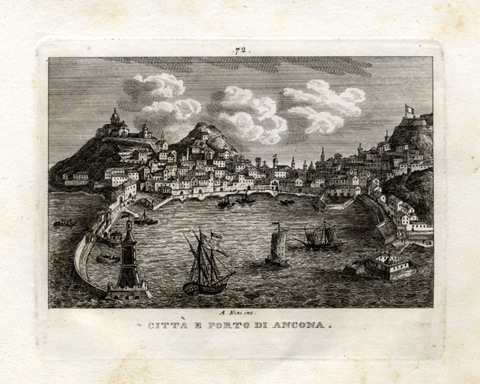
“Vedutina” di Ancona
Written by a native of Ancona, who now lives abroad, the second affirmation may seem parochial-minded. But it is justified by the first, which was said by another native of Ancona living abroad, the eminent doctor Giovanni Capannelli, who is special advisor to the dean of think-tank Asian Development Bank Institute.
These two expat Ancona natives met, demonstrating the Small Worlds Theory, at the Business & Investment Summit held in Phnom Penh alongside the Asean Summit (the Association of Southeast Asian Nations).
In a certain sense, the business summit turned out to be more interesting than the political one. Mainly because it provided an understanding and analysis of the megatrends that are shifting the centre of the world towards the east. In the interview he gave me after his speech, Capannelli defined these trends as “inexorable”, outlining an extremely complex scenario that was at times hard to grasp. As he spoke, I tried to follow his analysis yet could not help recognising my own regional accent, and he was quick to point out, as most Ancona natives are, that he was “from Ancona”. It was then that Ancona was suggested as a metaphor for Europe in the global scenario, and the Asian scenario in particular. While the old continent may currently be going through a period of static development, it can still be upheld as a cultural model. You only need to have the awareness and the ability to declare it. Thanks to that example, it was much easier for me to understand the dynamics and the possibilities of the near future. Which, in the end, thanks to Ancona, does not seem so dark.
It can also be said that Italy at the Asean Summit was well represented by an Ancona native. Not myself of course, but there were two of us.
“Vedutina” di Ancona
Written by a native of Ancona, who now lives abroad, the second affirmation may seem parochial-minded. But it is justified by the first, which was said by another native of Ancona living abroad, the eminent doctor Giovanni Capannelli, who is special advisor to the dean of think-tank Asian Development Bank Institute.
These two expat Ancona natives met, demonstrating the Small Worlds Theory, at the Business & Investment Summit held in Phnom Penh alongside the Asean Summit (the Association of Southeast Asian Nations).
In a certain sense, the business summit turned out to be more interesting than the political one. Mainly because it provided an understanding and analysis of the megatrends that are shifting the centre of the world towards the east. In the interview he gave me after his speech, Capannelli defined these trends as “inexorable”, outlining an extremely complex scenario that was at times hard to grasp. As he spoke, I tried to follow his analysis yet could not help recognising my own regional accent, and he was quick to point out, as most Ancona natives are, that he was “from Ancona”. It was then that Ancona was suggested as a metaphor for Europe in the global scenario, and the Asian scenario in particular. While the old continent may currently be going through a period of static development, it can still be upheld as a cultural model. You only need to have the awareness and the ability to declare it. Thanks to that example, it was much easier for me to understand the dynamics and the possibilities of the near future. Which, in the end, thanks to Ancona, does not seem so dark.
It can also be said that Italy at the Asean Summit was well represented by an Ancona native. Not myself of course, but there were two of us.
To Have and Have Not
15/11/12 16:46
You know how it is there early in the morning in Bangkok, with the soup sellers serving breakfast? Well, I crossed the river and took a mototaxi to Silom Road, one of the city’s main streets. I got off at a crossroads opposite a pagoda-style gateway in a long grey wall. Beyond the gateway was a hut and a canopy furnished with a bed, a stove, a TV and a fan. An old man was smoking next to the fan. On the bed a woman breastfed her baby while watching TV. They both smiled and waved.
Beyond that little house and courtyard was a broad open space dotted with graves. It’s an old abandoned Chinese cemetery. They say the bodies have been moved elsewhere. But the graves don’t seem to have been opened, even though they are overgrown with weeds and scattered with bags of trash and crumbling gravestones. Some still have the leftovers of offerings, flowers or fruit just wilting or rotting, as though people had left them there quite recently.
An India-rubber tree stands over the last few graves and its roots hanging down from the branches form a kind of curtain. Beyond that natural curtain is a metal sheet and mesh construction. This is the Fighting Spirit Gym, where the traditional Thai martial art Muay Thai is taught and practiced.
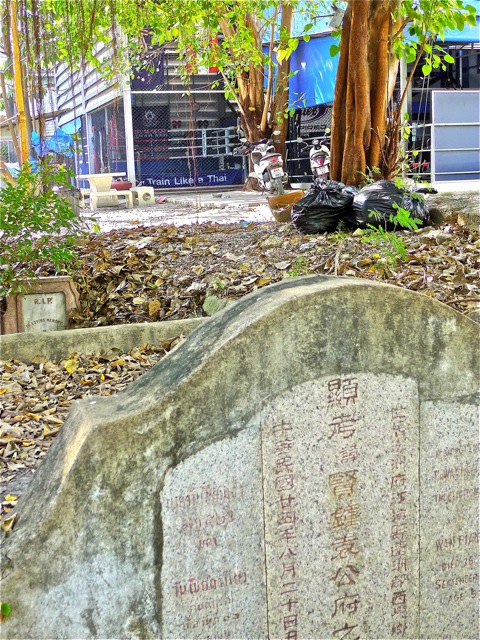
It’s a clean, well-lighted place, open-sided so cool, and populated with animals: seven dogs, cats, a squirrel, a parrot, two iguanas. You will always find a curled-up dog or the parrot perched somewhere. Sometimes they even follow you into the ring. The instructors are all former professionals, and some are still fighting. They have a lot of fun watching the farang, the foreigners like me, try to put power into a kick. But they are kind. “Not bad for an old man”. Strangely, they are not afraid of the phi, the spirits or ghosts, that may be haunting the place. “The energy is good here,” says the Australian who opened the gym, a tattoo-covered character seemingly taken straight from an action movie, with a calm smile.
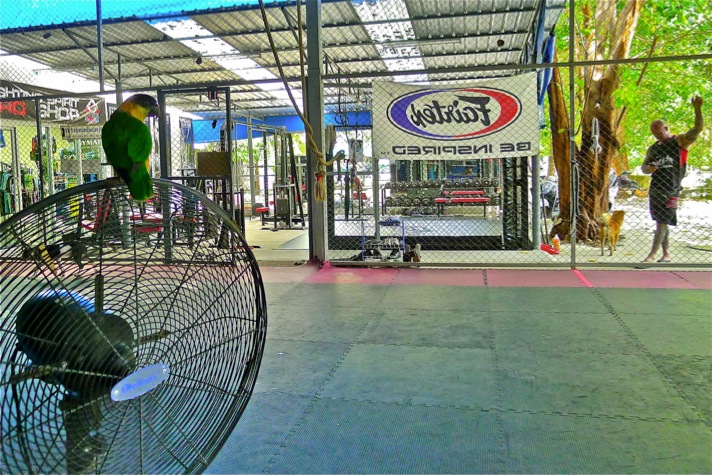
So, this is a fragment of a morning in Bangkok. It would have pleased Hemingway, a few of whose words I have quoted here. It also made me think of To Have and Have Not.
Back home after training, I continued writing one of the many stories that I observe and write for various newspapers. Often I don’t even know what they are about, or whether they will be published. I do it anyway: if nothing else they can feature on this blog. Besides, I’m no good at anything else, not even a good kick.
Beyond that little house and courtyard was a broad open space dotted with graves. It’s an old abandoned Chinese cemetery. They say the bodies have been moved elsewhere. But the graves don’t seem to have been opened, even though they are overgrown with weeds and scattered with bags of trash and crumbling gravestones. Some still have the leftovers of offerings, flowers or fruit just wilting or rotting, as though people had left them there quite recently.
An India-rubber tree stands over the last few graves and its roots hanging down from the branches form a kind of curtain. Beyond that natural curtain is a metal sheet and mesh construction. This is the Fighting Spirit Gym, where the traditional Thai martial art Muay Thai is taught and practiced.
It’s a clean, well-lighted place, open-sided so cool, and populated with animals: seven dogs, cats, a squirrel, a parrot, two iguanas. You will always find a curled-up dog or the parrot perched somewhere. Sometimes they even follow you into the ring. The instructors are all former professionals, and some are still fighting. They have a lot of fun watching the farang, the foreigners like me, try to put power into a kick. But they are kind. “Not bad for an old man”. Strangely, they are not afraid of the phi, the spirits or ghosts, that may be haunting the place. “The energy is good here,” says the Australian who opened the gym, a tattoo-covered character seemingly taken straight from an action movie, with a calm smile.
So, this is a fragment of a morning in Bangkok. It would have pleased Hemingway, a few of whose words I have quoted here. It also made me think of To Have and Have Not.
Back home after training, I continued writing one of the many stories that I observe and write for various newspapers. Often I don’t even know what they are about, or whether they will be published. I do it anyway: if nothing else they can feature on this blog. Besides, I’m no good at anything else, not even a good kick.
Mooncakes
29/09/12 07:21
I am writing these just hours ahead of the fifteen day of the eighth lunar month in the Chinese calendar (which this year falls on 30th September). This is the Mid-Autumn Festival, or Zhōngqiū Jié, which coincides more or less with the autumnal equinox in the solar calendar. The tradition dates back to the Western Zhou dynasty, approximately 3000 years ago, but has its roots in the legends featuring Chang’e, the mythical goddess of the moon and of immortality. Indeed, on that day, the full moon seems fuller and brighter, and is the perfect symbol of Tuan yuan, or reunion. The festival is therefore dedicated to get-togethers with family and friends.
 That makes it a good time to start writing on Bassifondi again, after a few months’ break. I almost always take a break when I go back to Italy. Maybe because of the problems that come with the trip, or because it is easier to perceive the differences. Maybe because in this elsewhere that is Asia I am in that frame of mind that allows you to see a story in the smallest, simplest everyday occurrences.
That’s what happened a few days before Zhōngqiū Jié. When I got back to Bangkok, I contacted Jackie Ho, my Master on the roof, the chef I meet on the rooftop terrace of my block who teaches me Hung Fut Pai, a school of Kung Fu originating from southern China. Jackie replied that he couldn’t teach me at the moment because he was too busy making Mooncakes, a delicacy traditionally eaten during the Mid-Autumn Festival, which is more widely known as Mooncake Festival. These cakes are a kind of soft biscuit made with sesame seed paste, lotus seed paste (in the more expensive version), red bean paste and a duck egg yolk. Jackie’s are a little smaller (40 grams instead of 160), they contain a few secret ingredients and are made solely by hand. This is why they are considered some of the best to be found in Asia and are a major selling point for Bangkok’s Peninsula Hotel at which my Sifu (or Master) is executive chef of all Chinese cuisine at the Mei Jiang restaurant.
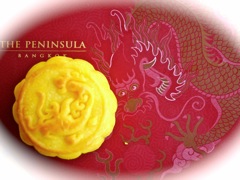 They are extremely popular delicacies (with a beautiful red filling and golden dragon decoration) and as many as 3846 a day are baked to keep up with demand. Which explains why Jackie currently has no time for kung fu despite having a 27-strong staff of chefs working for him.
He is so busy that he finishes work late at night, which is how he ended up knocking at my door with a box of mooncakes at 11pm.
Perhaps this little story explains why many people choose to live in this part of the world. And why these little stories make me want to start writing again. Early tomorrow morning, after eating a mooncake or two for breakfast.
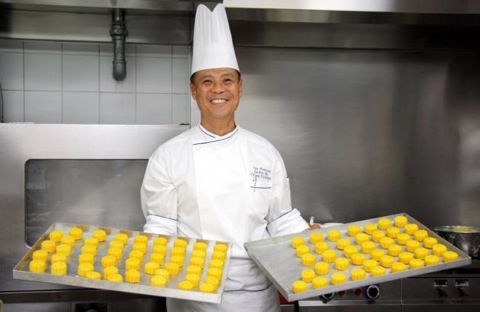
photo: The Nation
“A cloud becomes multi-coloured when it reflects the sun and a mountain stream turns into a waterfall when it drops down a cliff-face. Things change when they encounter other things. This is why so much value is attached to friendship”.
Chang Chao (XVII century)
That makes it a good time to start writing on Bassifondi again, after a few months’ break. I almost always take a break when I go back to Italy. Maybe because of the problems that come with the trip, or because it is easier to perceive the differences. Maybe because in this elsewhere that is Asia I am in that frame of mind that allows you to see a story in the smallest, simplest everyday occurrences. That’s what happened a few days before Zhōngqiū Jié. When I got back to Bangkok, I contacted Jackie Ho, my Master on the roof, the chef I meet on the rooftop terrace of my block who teaches me Hung Fut Pai, a school of Kung Fu originating from southern China. Jackie replied that he couldn’t teach me at the moment because he was too busy making Mooncakes, a delicacy traditionally eaten during the Mid-Autumn Festival, which is more widely known as Mooncake Festival. These cakes are a kind of soft biscuit made with sesame seed paste, lotus seed paste (in the more expensive version), red bean paste and a duck egg yolk. Jackie’s are a little smaller (40 grams instead of 160), they contain a few secret ingredients and are made solely by hand. This is why they are considered some of the best to be found in Asia and are a major selling point for Bangkok’s Peninsula Hotel at which my Sifu (or Master) is executive chef of all Chinese cuisine at the Mei Jiang restaurant.
They are extremely popular delicacies (with a beautiful red filling and golden dragon decoration) and as many as 3846 a day are baked to keep up with demand. Which explains why Jackie currently has no time for kung fu despite having a 27-strong staff of chefs working for him. He is so busy that he finishes work late at night, which is how he ended up knocking at my door with a box of mooncakes at 11pm.
Perhaps this little story explains why many people choose to live in this part of the world. And why these little stories make me want to start writing again. Early tomorrow morning, after eating a mooncake or two for breakfast.
photo: The Nation
“A cloud becomes multi-coloured when it reflects the sun and a mountain stream turns into a waterfall when it drops down a cliff-face. Things change when they encounter other things. This is why so much value is attached to friendship”.
Chang Chao (XVII century)
The Master on the roof
15/05/12 06:24
“When the disciple is ready, the Master will appear”, goes the saying. I sure didn’t feel ready at all, but the Master appeared. It was just before sundown, above the Chao Phraya, the river that crosses Bangkok, with the tower of a pagoda in the background. Of course, he did not just materialise in mid-air. Like me, he was standing on the blooming rooftop terrace on top of the Baan Chao Phraya, the big tall tenement block where I live.
The Master is called Jackie Ho. It sounds like such a typical ‘Master’ name or an echo of Jackie Chan that it doesn’t ring true. But Jackie Ho is a chef, actually the Executive Chef of all Chinese cuisine at the Peninsula Hotel, one of the most luxurious hotels in the capital of the Kingdom of Thailand. He used to hold the same job at the excellent China House restaurant inside the Oriental Hotel. He has also worked in Indonesia, China and his birthplace, Hong Kong. He is considered a Master of Cantonese cuisine.
But I hadn’t invited him that night to show me his cooking skills. That evening he was moving fast, focused, precise and powerful in a form of kung fu. I had asked him if he could teach me and he had agreed. So, according to the ancient rules, he was now my Sifu, or Master. Or almost, given that in order to use this term I would have to be formally accepted as his pupil, with ceremony attached.
Only later did I ask him what particular martial art he practised. He told me it is called Hung Fut Pai and is a style deriving, as they all do, from that practised at the Shaolin monastery. It is not well known and has an uncertain history, at least for those who, like me, are unable to consult Chinese texts. Master Jackie learned it as a child in Hong Kong and has continued to train ever since. To him it is the most effective form of self-defence, and has had to use it on occasion to defend himself from street thugs. He showed me a scar from a knife wound on his forearm. “But they came out much worse”, he laughed.
My training began that evening. Every morning at 8 I go to the rooftop terrace. And I wait. Sometimes the Master comes and teaches me some of the basic form of Hung Fut Pai – I don’t yet know how many moves it contains – more often than not he doesn’t come and I try to repeat the moves I learned the previous session, generally with little success. There is a kind of tacit agreement between us: we don’t make appointments, or set dates or times. We leave it up to chance, to coincidence. Sometimes we miss each other by just a few minutes and find out only later when we bump into each other on the boat taking us to and from home.
According to Jackie, it takes one month to learn the first form, but after a month I understood he meant thirty lessons, which meant that I would take much longer. In the meantime it’s an exercise in patience, a way to begin the day with commitment. It doesn’t matter if it doesn’t work out; it gives you the chance to enjoy the last minutes of cool up on the roof before the heat of the day arrives, shake off your sleepiness and dreams, focus on the body, the breathing, the blood flow and the little aches and pains.
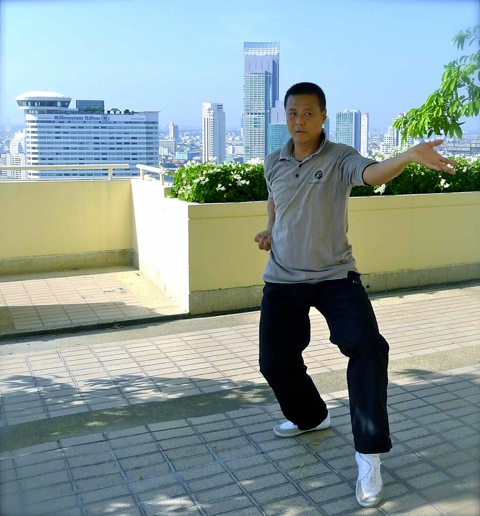
This is one of those stories that in the Japanese tradition (yes, let’s mix up those cultures) is called zuihitsu, literally follow the brush, in reference to the fact that the author gives free reign to his thoughts, allowing the hand to simply record them. You might compare it to a hotchpotch or a collection of random thoughts. In reality it is an actual literary genre (which emerged in the Heian Period, between 794 and 1185 of the Common Era) and refers to a collection of brief pieces in which “the observations and reflections of the writer are presented with stylistic grace”.
Grace and style aside, this story is a pretext for reflecting on the randomness and on the surprises that the world has in store for us, especially in this part of the world, where chance is incorporated into the natural order of things, it is part of a plot. In short, it’s no mere chance. And that is why the Master appears.
The Master is called Jackie Ho. It sounds like such a typical ‘Master’ name or an echo of Jackie Chan that it doesn’t ring true. But Jackie Ho is a chef, actually the Executive Chef of all Chinese cuisine at the Peninsula Hotel, one of the most luxurious hotels in the capital of the Kingdom of Thailand. He used to hold the same job at the excellent China House restaurant inside the Oriental Hotel. He has also worked in Indonesia, China and his birthplace, Hong Kong. He is considered a Master of Cantonese cuisine.
But I hadn’t invited him that night to show me his cooking skills. That evening he was moving fast, focused, precise and powerful in a form of kung fu. I had asked him if he could teach me and he had agreed. So, according to the ancient rules, he was now my Sifu, or Master. Or almost, given that in order to use this term I would have to be formally accepted as his pupil, with ceremony attached.
Only later did I ask him what particular martial art he practised. He told me it is called Hung Fut Pai and is a style deriving, as they all do, from that practised at the Shaolin monastery. It is not well known and has an uncertain history, at least for those who, like me, are unable to consult Chinese texts. Master Jackie learned it as a child in Hong Kong and has continued to train ever since. To him it is the most effective form of self-defence, and has had to use it on occasion to defend himself from street thugs. He showed me a scar from a knife wound on his forearm. “But they came out much worse”, he laughed.
My training began that evening. Every morning at 8 I go to the rooftop terrace. And I wait. Sometimes the Master comes and teaches me some of the basic form of Hung Fut Pai – I don’t yet know how many moves it contains – more often than not he doesn’t come and I try to repeat the moves I learned the previous session, generally with little success. There is a kind of tacit agreement between us: we don’t make appointments, or set dates or times. We leave it up to chance, to coincidence. Sometimes we miss each other by just a few minutes and find out only later when we bump into each other on the boat taking us to and from home.
According to Jackie, it takes one month to learn the first form, but after a month I understood he meant thirty lessons, which meant that I would take much longer. In the meantime it’s an exercise in patience, a way to begin the day with commitment. It doesn’t matter if it doesn’t work out; it gives you the chance to enjoy the last minutes of cool up on the roof before the heat of the day arrives, shake off your sleepiness and dreams, focus on the body, the breathing, the blood flow and the little aches and pains.
This is one of those stories that in the Japanese tradition (yes, let’s mix up those cultures) is called zuihitsu, literally follow the brush, in reference to the fact that the author gives free reign to his thoughts, allowing the hand to simply record them. You might compare it to a hotchpotch or a collection of random thoughts. In reality it is an actual literary genre (which emerged in the Heian Period, between 794 and 1185 of the Common Era) and refers to a collection of brief pieces in which “the observations and reflections of the writer are presented with stylistic grace”.
Grace and style aside, this story is a pretext for reflecting on the randomness and on the surprises that the world has in store for us, especially in this part of the world, where chance is incorporated into the natural order of things, it is part of a plot. In short, it’s no mere chance. And that is why the Master appears.
Stories in the Rosary
26/03/12 12:33
I keep fingering the sandalwood beads of a phat chau, a Buddhist rosary. It was given to me, with a smile and a blessing, by Thay Giau Nghia, abbot of Chua Van Diic, a small, colourful pagoda in a cool side road of Nha Trang, on the central eastern coast of Vietnam.
The rosary is used to keep count of the mantras being recited without distracting the mind. The canonical one has 108 beads, a sacred number for Buddhists, but others have beads in multiples of 9, which represents completeness. Mine has 18. Not many, for the number of stories I am reciting.
For example the one about the monk, or rather the Master (which is what Thay means). He and five other brothers will be going on a mission to three tiny islands, two on each one, in the midst of the Bien Dong, the Eastern Sea, as the Vietnamese call the South China Sea. They are known as the Spratly. The Vietnamese call them the Truong Sa. They are a myriad of rocks, coral reefs, islands and islets seemingly sitting on a sea of oil, in some of the most fish-abundant waters in the world, intersected by major shipping routes since the late 17th century. Which is why they are contested by Vietnam, China, Taiwan, the Philippines and Brunei. According to some global strategy analysts, these waters could spark the Third World War.
Six monks vs. one aircraft carrier, writes one blogger (on a curious site by a Vietnamese eye doctor living in Illinois, but that’s another story), with a certain heroic/melodramatic tone, in reference to the mission headed by Thay Giau Nghia and to the Shi Lang, China’s first aircraft carrier, which will be deployed in the South China Sea. For the Chinese it’s a dirty trick. For the Vietnamese it pits the use of force against the force of reason. For the monks, it’s also an opportunity to meditate, as one of the youngest, Thich Thanh Thanh, says: “A monk needs somewhere to meditate”.
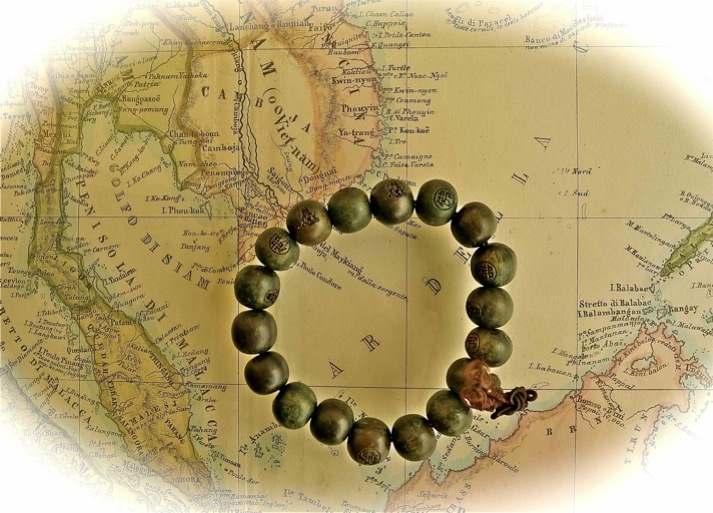
This story has now been encapsulated into the first bead on the rosary; it lives there, in its present and perhaps in its future. It has only to come out from that little sandalwood shell with an ideogram engraved on it to be told. Just like many others that try to get their own rosary bead, settling into latent memory before transforming from notes, impressions, references and links into a story.
Almost as though each of these 18 shiny beads were like a rock, a tree or a termite hill, like those in the Australian songlines: singing revives the story that was deposited in that fragment of a parallel world. In the same way, this rosary is a potential songline reconnecting me to a personal Dream Time.
I may need a bigger rosary, the one with 108 beads perhaps. In the meantime, I move on to the second bead and try to feel who is there and what they are telling me.
The rosary is used to keep count of the mantras being recited without distracting the mind. The canonical one has 108 beads, a sacred number for Buddhists, but others have beads in multiples of 9, which represents completeness. Mine has 18. Not many, for the number of stories I am reciting.
For example the one about the monk, or rather the Master (which is what Thay means). He and five other brothers will be going on a mission to three tiny islands, two on each one, in the midst of the Bien Dong, the Eastern Sea, as the Vietnamese call the South China Sea. They are known as the Spratly. The Vietnamese call them the Truong Sa. They are a myriad of rocks, coral reefs, islands and islets seemingly sitting on a sea of oil, in some of the most fish-abundant waters in the world, intersected by major shipping routes since the late 17th century. Which is why they are contested by Vietnam, China, Taiwan, the Philippines and Brunei. According to some global strategy analysts, these waters could spark the Third World War.
Six monks vs. one aircraft carrier, writes one blogger (on a curious site by a Vietnamese eye doctor living in Illinois, but that’s another story), with a certain heroic/melodramatic tone, in reference to the mission headed by Thay Giau Nghia and to the Shi Lang, China’s first aircraft carrier, which will be deployed in the South China Sea. For the Chinese it’s a dirty trick. For the Vietnamese it pits the use of force against the force of reason. For the monks, it’s also an opportunity to meditate, as one of the youngest, Thich Thanh Thanh, says: “A monk needs somewhere to meditate”.
This story has now been encapsulated into the first bead on the rosary; it lives there, in its present and perhaps in its future. It has only to come out from that little sandalwood shell with an ideogram engraved on it to be told. Just like many others that try to get their own rosary bead, settling into latent memory before transforming from notes, impressions, references and links into a story.
Almost as though each of these 18 shiny beads were like a rock, a tree or a termite hill, like those in the Australian songlines: singing revives the story that was deposited in that fragment of a parallel world. In the same way, this rosary is a potential songline reconnecting me to a personal Dream Time.
I may need a bigger rosary, the one with 108 beads perhaps. In the meantime, I move on to the second bead and try to feel who is there and what they are telling me.
Three men in a boat…
28/11/11 15:09
...But it’s not a funny story. These three men are the last members of the crew of the Magellanic, the latest in a long line of ghost ships off the cost of Thailand.
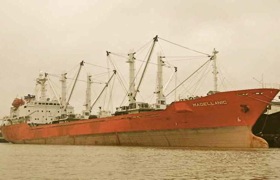
They haven’t been paid for months, they have no money to buy food and get by on what they can fish, and they can’t disembark because their Visas for Thailand have expired.
The men are from the Philippines but it doesn’t look as though their embassy is very interested in repatriating them.
The situation doesn’t even seem to interest the authorities in Panama, which is where the Magellanic is based.
The ship-owners are Greek and their Manila-based agent is keeping a low profile.
All this information comes from the only person who is showing any concern for these men, a woman already mentioned on this blog: Apinya Tajit, from the local Apostleship of the Sea.
She has sent a string of e-mails from which one surreal truth emerges: these men are trapped in an inextricable net with seemingly no way out.
The Magellanic is one of those ships that sail on an ocean with no name.
This is not a funny story and maybe not one that people find particularly interesting.
But Apinya hopes that writing about it will prove useful.
I don’t think so, but I’ve done it anyway.
Message from a ghost ship..Help...We want to go home.
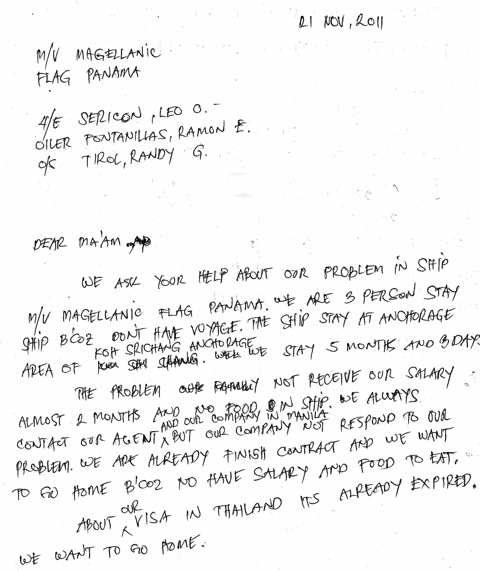
They haven’t been paid for months, they have no money to buy food and get by on what they can fish, and they can’t disembark because their Visas for Thailand have expired.
The men are from the Philippines but it doesn’t look as though their embassy is very interested in repatriating them.
The situation doesn’t even seem to interest the authorities in Panama, which is where the Magellanic is based.
The ship-owners are Greek and their Manila-based agent is keeping a low profile.
All this information comes from the only person who is showing any concern for these men, a woman already mentioned on this blog: Apinya Tajit, from the local Apostleship of the Sea.
She has sent a string of e-mails from which one surreal truth emerges: these men are trapped in an inextricable net with seemingly no way out.
The Magellanic is one of those ships that sail on an ocean with no name.
This is not a funny story and maybe not one that people find particularly interesting.
But Apinya hopes that writing about it will prove useful.
I don’t think so, but I’ve done it anyway.
Message from a ghost ship..Help...We want to go home.
Flows, Part II
07/11/11 09:02
“Free Flow”, the theme announced by the Bangkok Design Festival, sounds ironic considering that the disastrous flood that recently hit Thailand – and especially its still potentially devastating consequences – isn’t over yet.
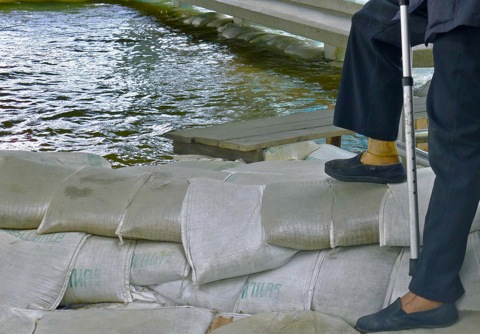
But the festival’s Flow intends precisely to contrast the one that has devastated the country. It’s already happening, thanks to the power of intelligence and creativity, with the exhibition organised at the Bangkok Art and Culture Centre, called “Let’s Panic”. The exhibition has a great impact on the public, turning survival in a monsoonal country into a show, highlighting the positive. But its main feature is representing the essence of danger, within and without.
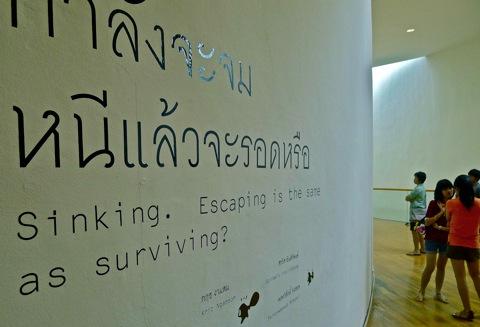
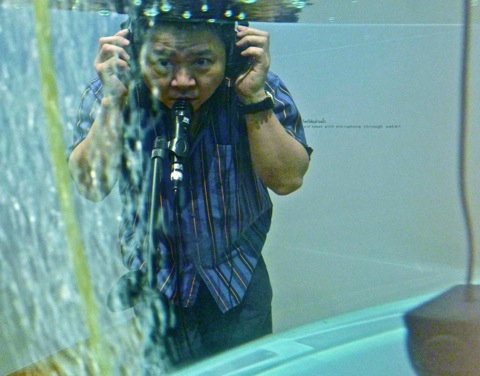
These are the streams and flows of consciousness that cross paths in the midst of chaos and, in spite of the surrounding catastrophes, generate energy and form a current of seeming coincidences.
And so, after the flows of innovation in Singapore, here come the flows of Bangkok, which are unavoidably interconnected. And the cover of the art, architecture and design magazine art4d, which titles its latest editorial “Free Flow”, is dedicated to Gaia Scagnetti – a young Italian researcher who specialises in information design. She teaches in the Faculty of Architecture at Chulalongkorn University in Bangkok, and has recently concluded an exhibition on human interrelations and on the flows of reciprocal knowledge.
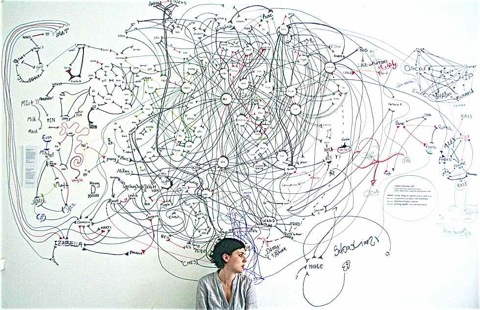
Speaking with her – perhaps because of her background in complexity science – helps us to understand the beauty of the collapse of this megalopolis, which doesn’t change either on the wave of globalisation or with the rains, but metabolises and regenerates these flows, giving beauty to chaos. It all seems so complex, and it is. But it’s a way of detaching ourselves from the Western World’s inescapable linear logic. Here there is no flow, but a vortex which transports us to another dimension
But the festival’s Flow intends precisely to contrast the one that has devastated the country. It’s already happening, thanks to the power of intelligence and creativity, with the exhibition organised at the Bangkok Art and Culture Centre, called “Let’s Panic”. The exhibition has a great impact on the public, turning survival in a monsoonal country into a show, highlighting the positive. But its main feature is representing the essence of danger, within and without.
These are the streams and flows of consciousness that cross paths in the midst of chaos and, in spite of the surrounding catastrophes, generate energy and form a current of seeming coincidences.
And so, after the flows of innovation in Singapore, here come the flows of Bangkok, which are unavoidably interconnected. And the cover of the art, architecture and design magazine art4d, which titles its latest editorial “Free Flow”, is dedicated to Gaia Scagnetti – a young Italian researcher who specialises in information design. She teaches in the Faculty of Architecture at Chulalongkorn University in Bangkok, and has recently concluded an exhibition on human interrelations and on the flows of reciprocal knowledge.
Speaking with her – perhaps because of her background in complexity science – helps us to understand the beauty of the collapse of this megalopolis, which doesn’t change either on the wave of globalisation or with the rains, but metabolises and regenerates these flows, giving beauty to chaos. It all seems so complex, and it is. But it’s a way of detaching ourselves from the Western World’s inescapable linear logic. Here there is no flow, but a vortex which transports us to another dimension
The Naga's Journey
28/10/11 12:04
Bangkok: a sunny morning. People are swimming in the pool of the apartment complex. Guests at the hotel along the river are eating breakfast on the balconies. Longtail boats, those long and narrow traditional craft now used primarily by tourists, ply the river. A couple enjoys the breeze that wafts over the swimming pool in the evening. The restaurants along the river front are brightly lit. Enormous disco boats float along the river.
You are tempted to stay inside your penthouse apartment on the river and write, like a city-dwelling hermit; sometimes writing, sometimes taking a break to swim in the pool or just to gaze out over the city. The Chinese temple across the way looks odd: only the roof of the pagoda and part of the columns decorated with dragons are visible.
Bangkok is, for the most part, under water. Just like almost 15,000 kilometers of Thailand. The economic implications are disastrous. Not to mention the human and social impact. But it all depends on your vantage point: from up on high, they all seem quite removed and distant, as if they belong to another world.
If, on the other hand, you go down there and dare to leave your own small world behind for a moment, you are immediately struck by the fact that the earth has vanished. Many of the streets have become canals, the markets, houses and shops are flooded. The shelves of the small supermarkets are empty, the water taxis that connect the city are not running. The passengers would have nowhere to get off. All of this is, in fact, just a short distance away.
Now a creeping feeling begins to insinuate itself. Your world might very soon, in the next few hours or days, become a prison from which you will be forced to leave to look for food and water. The lights may go out. Suddenly, being up above it all means that you will discover what it is like to climb up thirty flights of stairs.
It seems like a script from a horror film. Nevertheless, the idea haunts you. You get an immediate sense of the fraility of a global system whose disasters can be traced directly to a sacrilegious mismanagement of nature.
Then you think of the even more fragile Asian system, which was perhaps too quickly hailed as the up and coming power of the new century that would see the decline of the West. Skyscrapers here, more often than not, reflect a pretense of power rather than true strength. It is a strange paradox that Bangkok is sinking under the weight of its skyscrapers
The human factor here is too often marginalized: social inequality and decay add to the problems. Then they are carried away with the water.
Finally, though only because it takes time to come to the unpleasant reality at hand, you realize just how weak you are yourself. Most of the Thai people that you meet in front of their flooded homes or businesses smile at you. "Mai pen rai" says someone, with an air of peaceful resignation.
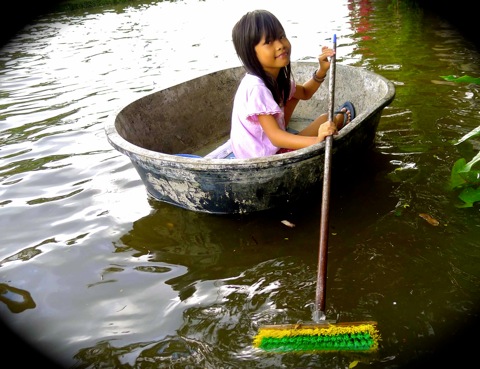
Comparing the way you feel with the way they behave is a little disquieting. You see your flaws and weaknesses, your detachment from reality.
I haven't believed in coincidence for a long time. The Naga has reaffirmed my disbelief; this seven headed serpent which represents the spirit of water in Asian myths. It can be as benevolent as it can be vindicative and devastating. At the moment I am translating a book by the Thai author, Tew Bunnag, titled The Naga's Journey (the Italian edition to be published in 2012 by Metropoli d’Asia). The Naga, in the form of a disastrous flood which wreaks havoc on the fragility of Bangkok and its populace - "Fragile does not mean weak, it means that it breaks easily" says Bunnag - is the underlying character of the book.
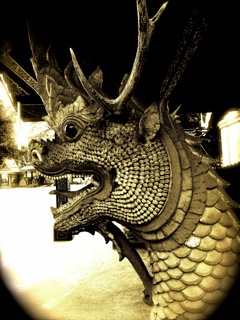
In the meantime, another day has passed. A couple enjoy the breeze.The restaurants are enlighted. At least here, the chance and the chaos are still covered beneath the water, as is the Naga.
A video in Thai with English subtitles that explians, in the Thai fashion, what is happening and why. It is very good in its way.
You are tempted to stay inside your penthouse apartment on the river and write, like a city-dwelling hermit; sometimes writing, sometimes taking a break to swim in the pool or just to gaze out over the city. The Chinese temple across the way looks odd: only the roof of the pagoda and part of the columns decorated with dragons are visible.
Bangkok is, for the most part, under water. Just like almost 15,000 kilometers of Thailand. The economic implications are disastrous. Not to mention the human and social impact. But it all depends on your vantage point: from up on high, they all seem quite removed and distant, as if they belong to another world.
If, on the other hand, you go down there and dare to leave your own small world behind for a moment, you are immediately struck by the fact that the earth has vanished. Many of the streets have become canals, the markets, houses and shops are flooded. The shelves of the small supermarkets are empty, the water taxis that connect the city are not running. The passengers would have nowhere to get off. All of this is, in fact, just a short distance away.
Now a creeping feeling begins to insinuate itself. Your world might very soon, in the next few hours or days, become a prison from which you will be forced to leave to look for food and water. The lights may go out. Suddenly, being up above it all means that you will discover what it is like to climb up thirty flights of stairs.
It seems like a script from a horror film. Nevertheless, the idea haunts you. You get an immediate sense of the fraility of a global system whose disasters can be traced directly to a sacrilegious mismanagement of nature.
Then you think of the even more fragile Asian system, which was perhaps too quickly hailed as the up and coming power of the new century that would see the decline of the West. Skyscrapers here, more often than not, reflect a pretense of power rather than true strength. It is a strange paradox that Bangkok is sinking under the weight of its skyscrapers
The human factor here is too often marginalized: social inequality and decay add to the problems. Then they are carried away with the water.
Finally, though only because it takes time to come to the unpleasant reality at hand, you realize just how weak you are yourself. Most of the Thai people that you meet in front of their flooded homes or businesses smile at you. "Mai pen rai" says someone, with an air of peaceful resignation.
Comparing the way you feel with the way they behave is a little disquieting. You see your flaws and weaknesses, your detachment from reality.
I haven't believed in coincidence for a long time. The Naga has reaffirmed my disbelief; this seven headed serpent which represents the spirit of water in Asian myths. It can be as benevolent as it can be vindicative and devastating. At the moment I am translating a book by the Thai author, Tew Bunnag, titled The Naga's Journey (the Italian edition to be published in 2012 by Metropoli d’Asia). The Naga, in the form of a disastrous flood which wreaks havoc on the fragility of Bangkok and its populace - "Fragile does not mean weak, it means that it breaks easily" says Bunnag - is the underlying character of the book.
In the meantime, another day has passed. A couple enjoy the breeze.The restaurants are enlighted. At least here, the chance and the chaos are still covered beneath the water, as is the Naga.
A video in Thai with English subtitles that explians, in the Thai fashion, what is happening and why. It is very good in its way.
Flows
20/10/11 13:08
I was marooned on a ghost ship. Since my last post that story has been resolved. The sailors were paid, maybe because the post was used as a bargaining tool.
In the meantime, I spent a few months in the west and no stories appeared on the Bassifondi blog. Not that there aren’t any stories in the West. Quite the contrary, the bottom rung of society is getting longer, it’s becoming a swamp where ideas stagnate and rot. It’s as though there were something in the air paralysing ideas. As though our minds were too busy thinking only about the pros and cons of someone or something. It all inevitably comes back to that. Like a labyrinth that has lots of entrances but the exit has yet to be opened.
But enough already. I came back East. Not that there are no crises in the East. Quite the contrary, crises often take on catastrophic, biblical proportions in this part of the world. And beyond the images of development, there are always some shady areas. It’s just that here you feel part of a flow, a current of ideas, far-off horizons can be perceived and people are curious to get there and see for themselves.
This is going on, for instance, at a small Bangkok art gallery which is holding an exhibition in which artists from India of Hindu, Muslim and Christian religion interpret Ramayana. According to the Indian-American curator, Siddharta V. Shah, it’s a way of materialising Jungian archetypes and overcoming the clash between culture and religion. The possibility may be slim, but at least it’s there.
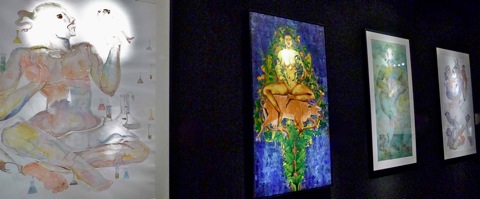
In Singapore, colossal projects that change the very concept of urban planning are taking shape, such as Gardens by the Bay.
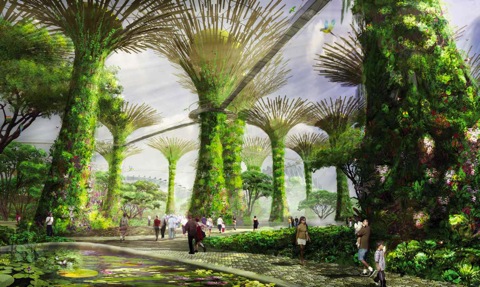
Other, less evident but still striking artistic comingling is also going on. Such as the amazing calligraphic images by Frenchwoman Fabienne Verdier, exhibited at the Art Plural Gallery.
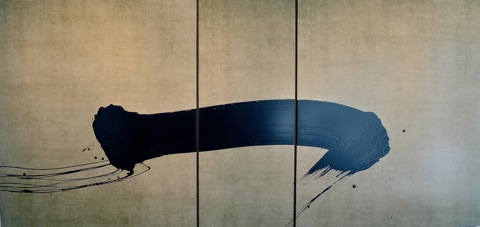
So, in the end, perhaps we can still hope that this flow will reach the West, so that we can take to the seas again.
In the meantime, I spent a few months in the west and no stories appeared on the Bassifondi blog. Not that there aren’t any stories in the West. Quite the contrary, the bottom rung of society is getting longer, it’s becoming a swamp where ideas stagnate and rot. It’s as though there were something in the air paralysing ideas. As though our minds were too busy thinking only about the pros and cons of someone or something. It all inevitably comes back to that. Like a labyrinth that has lots of entrances but the exit has yet to be opened.
But enough already. I came back East. Not that there are no crises in the East. Quite the contrary, crises often take on catastrophic, biblical proportions in this part of the world. And beyond the images of development, there are always some shady areas. It’s just that here you feel part of a flow, a current of ideas, far-off horizons can be perceived and people are curious to get there and see for themselves.
This is going on, for instance, at a small Bangkok art gallery which is holding an exhibition in which artists from India of Hindu, Muslim and Christian religion interpret Ramayana. According to the Indian-American curator, Siddharta V. Shah, it’s a way of materialising Jungian archetypes and overcoming the clash between culture and religion. The possibility may be slim, but at least it’s there.
In Singapore, colossal projects that change the very concept of urban planning are taking shape, such as Gardens by the Bay.
Other, less evident but still striking artistic comingling is also going on. Such as the amazing calligraphic images by Frenchwoman Fabienne Verdier, exhibited at the Art Plural Gallery.
So, in the end, perhaps we can still hope that this flow will reach the West, so that we can take to the seas again.
teaser : fabienne Verdier : flux: un film de philippe chancel from philippe chancel on Vimeo.
The ghost ship
13/07/11 04:10
There is a ghost ship. An old rusty tramp steamer, one of those boats that go wherever there is cargo to be loaded. It has been lingering in South-East Asian waters for months waiting for cargo.
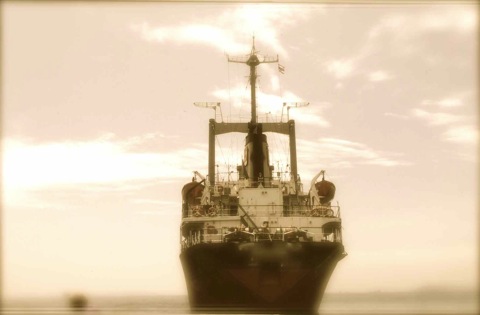
At the moment it is moored off a long beach on the edge of a large city. From the beach, it looks like just another part of the view. At night all you see are a few lights twinkling on the deck.
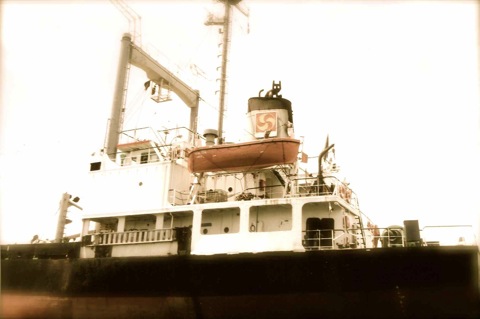
Even the crew are ghosts. They too are tramps, vagabonds who have sold themselves for a two-dollar-a-day pay check.
From on board they look towards the coast, the beach and the city. They would like to disembark, feel the sand under their feet, walk amongst the buildings or buy something at one of the local eateries lit up with coloured lights. Perhaps even find a woman.
But they can’t do any of that, they have to remain ghosts. If they went ashore, they would become men. Or rather, sub-men with no legal identity. They would be put in jail and would probably stay there for a long time. No one would come to free them. And they would lose what little they do have.
That’s why these ill, hungry and desperate ghosts stay on board. They are waiting for the ship owner to pay them and send them back home. In the meantime, they catch fish to survive.
There is only one woman who can help them. She works for charity and sailor protection organisations. She has taken water, rice and chocolate on board. And a phone card. She is the only person that can protect them from Mr Lu, the ship owner. He’s another ghost, but a bad one. He never appears, but he sends the odd message to the captain. He wants to convince him to move elsewhere, where they will be able to repair the ship and set sail with a new cargo. But in those waters there is no possibility of outside help or control. Not to mention that, while sailing to other coasts, the ship may well disappear on the high seas.
For now, the woman and the crew still hope that the ship owner will decide to pay them. If he doesn’t, the final resort would be to report him for human trafficking. In that case the eleven men on board ship would be deported. But they would be going home penniless.
This is just one of many stories of abandoned ships, of crews betrayed and replaced by other equally desperate people. This story quotes no names or nations, no acronyms or flags. That’s because it may still end well. If ending well means anything.
In the meantime many other stories are ending or still going on. There are people working like slaves on fishing boats, and they are the ones that vanish into thin air. There are still many murky areas in the beautiful waters of South-East Asia.
Link.
The International Maritime Organization
The International Committee on Seafarers' Welfare
International Transport Workers' Federation
Apostleship of the Sea
At the moment it is moored off a long beach on the edge of a large city. From the beach, it looks like just another part of the view. At night all you see are a few lights twinkling on the deck.
Even the crew are ghosts. They too are tramps, vagabonds who have sold themselves for a two-dollar-a-day pay check.
From on board they look towards the coast, the beach and the city. They would like to disembark, feel the sand under their feet, walk amongst the buildings or buy something at one of the local eateries lit up with coloured lights. Perhaps even find a woman.
But they can’t do any of that, they have to remain ghosts. If they went ashore, they would become men. Or rather, sub-men with no legal identity. They would be put in jail and would probably stay there for a long time. No one would come to free them. And they would lose what little they do have.
That’s why these ill, hungry and desperate ghosts stay on board. They are waiting for the ship owner to pay them and send them back home. In the meantime, they catch fish to survive.
There is only one woman who can help them. She works for charity and sailor protection organisations. She has taken water, rice and chocolate on board. And a phone card. She is the only person that can protect them from Mr Lu, the ship owner. He’s another ghost, but a bad one. He never appears, but he sends the odd message to the captain. He wants to convince him to move elsewhere, where they will be able to repair the ship and set sail with a new cargo. But in those waters there is no possibility of outside help or control. Not to mention that, while sailing to other coasts, the ship may well disappear on the high seas.
For now, the woman and the crew still hope that the ship owner will decide to pay them. If he doesn’t, the final resort would be to report him for human trafficking. In that case the eleven men on board ship would be deported. But they would be going home penniless.
This is just one of many stories of abandoned ships, of crews betrayed and replaced by other equally desperate people. This story quotes no names or nations, no acronyms or flags. That’s because it may still end well. If ending well means anything.
In the meantime many other stories are ending or still going on. There are people working like slaves on fishing boats, and they are the ones that vanish into thin air. There are still many murky areas in the beautiful waters of South-East Asia.
Link.
The International Maritime Organization
The International Committee on Seafarers' Welfare
International Transport Workers' Federation
Apostleship of the Sea
Emotional times
20/06/11 11:06
I few days ago I spoke with Aung San Suu Kyi. It was her birthday. We had just a few words on a very bad phone line. The interference was probably due to someone listening in. The time we had, though short, was very emotional for me. The voice of Daw, an honorific name given to the lady, is beautiful clear and strong (article published in Il Sole 24 Ore. In Italian only).
The next morning I worked on a different story. I went in search of the last glimpses of the old Bangkok harbour. I walked along a very long and rickety wooden jetty over a muddy canal. And I came upon a wharf where an old tramp steamer was moored. It was just the place I was looking for. Once again, it had an emotional impact.
If you keep looking for them, you will feel and see stories. Then they have to be told.
But that’s another story.
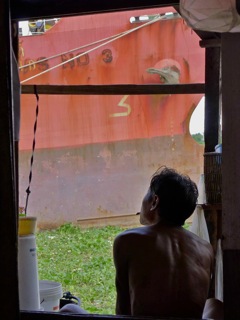
The next morning I worked on a different story. I went in search of the last glimpses of the old Bangkok harbour. I walked along a very long and rickety wooden jetty over a muddy canal. And I came upon a wharf where an old tramp steamer was moored. It was just the place I was looking for. Once again, it had an emotional impact.
If you keep looking for them, you will feel and see stories. Then they have to be told.
But that’s another story.
Bangkok Noir
16/05/11 12:21
Bangkok is a city of many colours. Even its taxis are multi-coloured. But you won’t find any black cabs here.
Black seems to have been removed, overtaken by lights. Maybe because there’s already too much of it around. In the slums and the backwaters, in the alleys under the strips of urban concrete and highway flyovers. But I wouldn’t really call that a colour, that’s more like darkness, an absence of light. That’s also what happens with many stories of this city. They border on the dark side of reality and of magic that is inextricable here. Sometimes they are destroyed by a smile, by a philosophy of life cursed by the blessing of the smile, of mai pen rai and sanuk, the idea that nothing matters and everything can be turned into a game.
But black can sometimes be a colour, when it becomes a means of expression. That’s what has happened with the Bangkok Noir cultural movement headed by Chris Coles, who is attempting to turn Bangkok’s underground lifestyle into art.
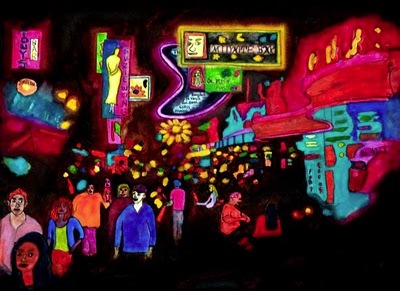
One night in Bangkok, by Chris Coles
Black, or Noir, is also the style of the stories collected by Christopher G. Moore in Bangkok Noir.
 The introduction to this book is found in the stories section. You could read it while listening to the Bangkok band Banglumpoo Blues. In the end, black, like the blues, is a state of mind.
Black seems to have been removed, overtaken by lights. Maybe because there’s already too much of it around. In the slums and the backwaters, in the alleys under the strips of urban concrete and highway flyovers. But I wouldn’t really call that a colour, that’s more like darkness, an absence of light. That’s also what happens with many stories of this city. They border on the dark side of reality and of magic that is inextricable here. Sometimes they are destroyed by a smile, by a philosophy of life cursed by the blessing of the smile, of mai pen rai and sanuk, the idea that nothing matters and everything can be turned into a game.
But black can sometimes be a colour, when it becomes a means of expression. That’s what has happened with the Bangkok Noir cultural movement headed by Chris Coles, who is attempting to turn Bangkok’s underground lifestyle into art.
One night in Bangkok, by Chris Coles
Black, or Noir, is also the style of the stories collected by Christopher G. Moore in Bangkok Noir.
The introduction to this book is found in the stories section. You could read it while listening to the Bangkok band Banglumpoo Blues. In the end, black, like the blues, is a state of mind.Requiem
21/04/11 13:05
In memory of Tim Hetherington. He was not a "saint", he’s not a “martyr”. As some, too many others. He was and is a great reporter. A Man.
Sunday Blessed Sunday
20/04/11 17:15
One sunny Sunday morning in Bangkok. In Suan Rot Fai park, people are strolling, cycling and sitting on benches around a lake. A short distance away lies the bustle of one of Asia’s largest markets, Chatuchak. On the edge of the lake, a modern building extends its columns into the water. This is the headquarters of the Buddhadasa Indapanyo Archives (BIA), a Buddhist studies centre.
It takes its name from Buddhadhasa Bhikkhu (1906-1993), monk (Bhikkhu) and “servant of Buddha” (Buddhadhasa), who was “a Buddhist thinker for the modern world”. The essence of his doctrine is the idea that the secular and the spiritual are not in fact separate entities; economics, politics and social life no longer go against ethics. The monk’s teachings are based on the study of other religious doctrines and on the avoidance of rituals and symbols, which are replaced by meditation, so that each individual can become conscious of being part of a single universe and therefore of the need to live in harmony with it.
BIA is not just a centre for study, but also a mental and spiritual gymnasium where the anapanasti meditation technique can be practised. Visitors can also do courses of yoga and Tai Chi or simply relax the body and mind overlooking the lake in large open spaces dotted with stone-shaped cushions.
It’s a serene, soothing place with a simple, structural modernity. People need places like this. To switch off and get away from the harsh realities of life, even if only for a short while.
It takes its name from Buddhadhasa Bhikkhu (1906-1993), monk (Bhikkhu) and “servant of Buddha” (Buddhadhasa), who was “a Buddhist thinker for the modern world”. The essence of his doctrine is the idea that the secular and the spiritual are not in fact separate entities; economics, politics and social life no longer go against ethics. The monk’s teachings are based on the study of other religious doctrines and on the avoidance of rituals and symbols, which are replaced by meditation, so that each individual can become conscious of being part of a single universe and therefore of the need to live in harmony with it.
BIA is not just a centre for study, but also a mental and spiritual gymnasium where the anapanasti meditation technique can be practised. Visitors can also do courses of yoga and Tai Chi or simply relax the body and mind overlooking the lake in large open spaces dotted with stone-shaped cushions.
It’s a serene, soothing place with a simple, structural modernity. People need places like this. To switch off and get away from the harsh realities of life, even if only for a short while.
Eating pizza with death
29/03/11 16:58
Imagine you’re having dinner on the terrace of an Italian restaurant in a luxury shopping mall in Bangkok, with background music provided by the Gipsy Kings. In the midst of that you browse on your iPad through the pages of a book on asymmetric conflict, i.e. warfare fought between unequal forces. The book is entitled Moral Dilemmas of Modern War. The author, Michael L. Gross, is chair of Applied Ethics at The Department of International Relations at Haifa University. In the preface he writes: “I see it as a practical guide, because it aims to answer the moral and legal questions posed by policymakers, military officers, political leaders, journalists, philosophers, lawyers, students, and citizens as they confront the different tactics, weapons, and practices placed on the table during asymmetric conflict”. The practical guide that follows covers themes such as torture, targeted assassination, heavy-handed interrogators, non-lethal weapons (whether chemical or structural, such as logistics), attacks on civilian combatants, blackmail, and terrorism. All analysed with a cool and clinical gaze. Machiavelli and Hobbes look like Candide in comparison. While you scroll quickly through the backlit pages, which look like just another table decoration, your brain short-circuits due to the overload of information, the meaning, and the discrepancy between the words and your surrounding environment.
In this surreal situation, you start to think that you’re turning into a monster: how can you enjoy your food, the music, the evening, while reading about acronyms such as Sirius (superfluous injury or unnecessary suffering)? A vague feeling of fear grips you. It’s not your conscience pricking you; it’s the fear caused by reality dawning, the fact that the alternatives are limited: either you get involved in the events or you try to analyse them.
And that’s what I began to do. I found out that the company of “monsters”, i.e. those that also chose to analyse without giving in to politically correct stereotypes, is numerous and interesting. For example, professor Peter Andreas, who wrote the unsettling and fascinating book Sex, Drugs and Body Counts, subtitled The Politics of Numbers in Global Crime and Conflict. In this book I discovered that in these cases it’s almost impossible to obtain real statistics because they are manipulated to fit the situation: when governments push for an intervention (such as in Kosovo), the figures are exaggerated; when they want to stay away (as in Darfur), they are toned down. This happens for the number of people killed in genocides, the number of migrants, the scale of drug and human trafficking. Apparently it’s a widely held belief that figures speak louder than words, especially when no one bothers to dispute them. Once again, then, we need some clean-cut analysis.
Another “monster” shedding light on the dark side of the current world order is Laura Dickinson, director of the Center for Law and Global Affairs at Arizona State University. In her book Outsourcing War and Peace: Preserving Public Values in a World of Privatized Foreign Affairs she addresses an increasingly widespread phenomenon, that of contractors, who used to be called “mercenaries”. Dickinson does not make judgements. She acknowledges the issue and assesses the risks posed by the use of contractors while attempting to set out reforms so that contractors too can be made accountable, and respectful of human rights, democracy and transparency.
However, some people aren’t content with just understanding; they take action. Even more so in the West, so spoilt by its wellbeing and tranquillity. It wouldn’t take much, after all. Just minor acts of civil resistance or opposition to what we feel is unjust. We’d only have to follow the example of those that have already done so, at much greater risk, across the planet. Their stories are told by Steve Crawshaw and John Jackson, both on the front line of civil rights defence, in Small Acts of Resistance: How Courage, Tenacity, and a Bit of Ingenuity Can Change the World. The book is a collection of minor yet great stories of people who stood up to repressive authorities with more or less legal (considering the relative value of the concept) but always non-violent action. It shows that, in the end, something can be done. It just might be a little tough and mean giving something up. “So long as it’s not my pizza”, some might say.
Extract from: Finché c'è guerra c'è speranza (While There's War There's Hope), directed by and starring Alberto Sordi.
“Because you see...wars aren’t made by weapons factories and the travelling salesmen that sell them. They’re also made by people like you, families like yours that want, want, want and can never get enough! Houses, cars, motorbikes, parties, horses, rings, bracelets, fur coats and whatever else they can get their hands on! ...That all costs a lot, and in order to get it someone has to lose out!”
In this surreal situation, you start to think that you’re turning into a monster: how can you enjoy your food, the music, the evening, while reading about acronyms such as Sirius (superfluous injury or unnecessary suffering)? A vague feeling of fear grips you. It’s not your conscience pricking you; it’s the fear caused by reality dawning, the fact that the alternatives are limited: either you get involved in the events or you try to analyse them.
And that’s what I began to do. I found out that the company of “monsters”, i.e. those that also chose to analyse without giving in to politically correct stereotypes, is numerous and interesting. For example, professor Peter Andreas, who wrote the unsettling and fascinating book Sex, Drugs and Body Counts, subtitled The Politics of Numbers in Global Crime and Conflict. In this book I discovered that in these cases it’s almost impossible to obtain real statistics because they are manipulated to fit the situation: when governments push for an intervention (such as in Kosovo), the figures are exaggerated; when they want to stay away (as in Darfur), they are toned down. This happens for the number of people killed in genocides, the number of migrants, the scale of drug and human trafficking. Apparently it’s a widely held belief that figures speak louder than words, especially when no one bothers to dispute them. Once again, then, we need some clean-cut analysis.
Another “monster” shedding light on the dark side of the current world order is Laura Dickinson, director of the Center for Law and Global Affairs at Arizona State University. In her book Outsourcing War and Peace: Preserving Public Values in a World of Privatized Foreign Affairs she addresses an increasingly widespread phenomenon, that of contractors, who used to be called “mercenaries”. Dickinson does not make judgements. She acknowledges the issue and assesses the risks posed by the use of contractors while attempting to set out reforms so that contractors too can be made accountable, and respectful of human rights, democracy and transparency.
However, some people aren’t content with just understanding; they take action. Even more so in the West, so spoilt by its wellbeing and tranquillity. It wouldn’t take much, after all. Just minor acts of civil resistance or opposition to what we feel is unjust. We’d only have to follow the example of those that have already done so, at much greater risk, across the planet. Their stories are told by Steve Crawshaw and John Jackson, both on the front line of civil rights defence, in Small Acts of Resistance: How Courage, Tenacity, and a Bit of Ingenuity Can Change the World. The book is a collection of minor yet great stories of people who stood up to repressive authorities with more or less legal (considering the relative value of the concept) but always non-violent action. It shows that, in the end, something can be done. It just might be a little tough and mean giving something up. “So long as it’s not my pizza”, some might say.
Extract from: Finché c'è guerra c'è speranza (While There's War There's Hope), directed by and starring Alberto Sordi.
“Because you see...wars aren’t made by weapons factories and the travelling salesmen that sell them. They’re also made by people like you, families like yours that want, want, want and can never get enough! Houses, cars, motorbikes, parties, horses, rings, bracelets, fur coats and whatever else they can get their hands on! ...That all costs a lot, and in order to get it someone has to lose out!”
Stockholm Syndrome
28/02/11 11:26
On Thursday 23rd August 1973 a man walked in to the Stockholm branch of Kreditbanken. He sprayed the ceiling with bullets and yelled: “The party starts! Down on the floor!”. It was not a robbery: he was demanding three million Swedish Kronor and the liberation of a pal of his from a high security jail.
The ‘party’ went on for six days and finally ended with the man being arrested and the four hostages freed. Out of all this came the coining of a new psychopathological term: “Stockholm syndrome”, a form of understanding and emotional attachment that some hostage victims can develop for their captor.
The man responsible for Stockholm syndrome is called Jan-Erik Olsson, or simply Janne. He is about to turn seventy and lives in Thailand, in the home village of his latest wife, Phian, whom he met in Sweden. It’s not actually a village, more an expanse of paddy fields with huts and cabins dotted nearly up to the border with Laos, in the far east of Isaan, the country’s poorest north-easterly region. Olsson bought land there, built a big house and opened a minimarket. He made money and was a local figure of authority. But his fortunes have turned: the minimarket is about to close down, crushed by competition from the big shopping malls that are even opening there. Some of his land is being farmed by his wife’s relatives. Most of it has been sold off. As has his car. The land he still owns brings him 50 Euros a month in rent. And the Swedish government has docked his pension.
“They’ve never forgotten me”, he says, spreading his big arms wide. Now he hopes to earn something with the book he has written (Stockolm-Syndromet, currently only available in Swedish), the film they may make out of it, and the talks he may give in Swedish schools.
In the meantime, as soon as he meets a Westerner, a farang as they are called in Thailand, he immediately lets off some steam. He tells his story and talks about criminal life and the thieves’ code, about a Beretta he bought in Italy, a beautiful woman he met in Via Prè in Genoa, about travelling across European borders during the Cold War. Those would seem to have been the days of his life. Like a war for those that have been through it.
I was his guest for a day. I slept on top of 200 bottles of whisky he had bought for the minimarket but didn’t want to hand over to the person who now rents it. I feel asleep to the sound of his wife reciting her daily hour-and-a-half prayers in front of the altar in the living room and I awoke at six in the morning as she set off to the temple to pray again.
Whether walking, eating or drinking beer under the little canopy out front, Janne never stopped talking. Of his ever-changing fortunes, his children, his love stories, Swedish winters and the dry season in Isaan. Of his being a Buddhist, of the amulets given to him by a venerable monk that hang on a gold chain over his chest and distended stomach.
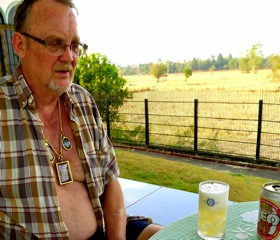
At times he got upset, the occasional little outburst, and often he laughed. As he remembers certain things, and especially while talking about his children, he gets the shivers and rubs his forearms. He seems sincere. He has no regrets and makes no apologies. “What’s the point?”. He prefers to help the people in this poor region. He has even offered to pay for a big statue of Buddha for a small monastery.
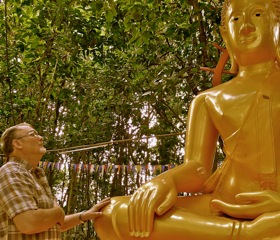
The day after I left he called me to say that I had left my cigarettes at his house. “Good job, really”, he said, “They’re bad for you”.
The ‘party’ went on for six days and finally ended with the man being arrested and the four hostages freed. Out of all this came the coining of a new psychopathological term: “Stockholm syndrome”, a form of understanding and emotional attachment that some hostage victims can develop for their captor.
The man responsible for Stockholm syndrome is called Jan-Erik Olsson, or simply Janne. He is about to turn seventy and lives in Thailand, in the home village of his latest wife, Phian, whom he met in Sweden. It’s not actually a village, more an expanse of paddy fields with huts and cabins dotted nearly up to the border with Laos, in the far east of Isaan, the country’s poorest north-easterly region. Olsson bought land there, built a big house and opened a minimarket. He made money and was a local figure of authority. But his fortunes have turned: the minimarket is about to close down, crushed by competition from the big shopping malls that are even opening there. Some of his land is being farmed by his wife’s relatives. Most of it has been sold off. As has his car. The land he still owns brings him 50 Euros a month in rent. And the Swedish government has docked his pension.
“They’ve never forgotten me”, he says, spreading his big arms wide. Now he hopes to earn something with the book he has written (Stockolm-Syndromet, currently only available in Swedish), the film they may make out of it, and the talks he may give in Swedish schools.
In the meantime, as soon as he meets a Westerner, a farang as they are called in Thailand, he immediately lets off some steam. He tells his story and talks about criminal life and the thieves’ code, about a Beretta he bought in Italy, a beautiful woman he met in Via Prè in Genoa, about travelling across European borders during the Cold War. Those would seem to have been the days of his life. Like a war for those that have been through it.
I was his guest for a day. I slept on top of 200 bottles of whisky he had bought for the minimarket but didn’t want to hand over to the person who now rents it. I feel asleep to the sound of his wife reciting her daily hour-and-a-half prayers in front of the altar in the living room and I awoke at six in the morning as she set off to the temple to pray again.
Whether walking, eating or drinking beer under the little canopy out front, Janne never stopped talking. Of his ever-changing fortunes, his children, his love stories, Swedish winters and the dry season in Isaan. Of his being a Buddhist, of the amulets given to him by a venerable monk that hang on a gold chain over his chest and distended stomach.
At times he got upset, the occasional little outburst, and often he laughed. As he remembers certain things, and especially while talking about his children, he gets the shivers and rubs his forearms. He seems sincere. He has no regrets and makes no apologies. “What’s the point?”. He prefers to help the people in this poor region. He has even offered to pay for a big statue of Buddha for a small monastery.
The day after I left he called me to say that I had left my cigarettes at his house. “Good job, really”, he said, “They’re bad for you”.
The art of escape
11/02/11 04:58
Lots of people want to buy a good guidebook. Not an existential, cultural, moral, political or philosophical compendium. A travel guide. But it’s increasingly difficult to find good ones. So much so that, today, travel writing is turning into a series of stereotypes, banalities and the vain aspirations of self-styled travellers. The best guidebook is increasingly turning out to be an escapist novel: a thriller, a crime or action story involving lots of sex and intrigue.
This is the case with the novels of John Burdett, the British former lawyer who divides his time between the Côte d'Azur and Thailand. His detective stories (where the mixed-race detective is torn between the mystical drive of an ex-monk and the carnal desires of a bordello patron) are the perfect guide to Bangkok and the wider Asia area.
Another recent example is the first novel by Ron McMillan, a Scottish journalist based in Bangkok with extensive experience of Korea and China. His first effort is entitled Yin Yang Tattoo and leads its reader on a discovery of Seoul and the rest of Korea.
“It’s not great literature”, said Ron in a recent interview. It’s escapist fiction, which offers a psychological escape from everyday problems, immersing the reader in an exotic, adventurous and erotic dimension far-removed from the mundane reality of existence.
The term escapist (whether associated with a novel, film or other artistic expression) is often used as a derogatory term, as opposed to more high-brow forms of expression. It indicates something politically incorrect.
But there are other areas in which escape has held on to a deeper, more complex meaning. It can express a sense of rebellion, abandon, transgression, desperation and vitality. A search for meaning in life. In this way, escape gives value and meaning to the forms in which it is expressed.
The perfect example of this is Easy Rider, the Dennis Hopper film that came to symbolise an age and a generation.
The escape trilogy by director Gabriele Salvatores (Marrakech Express, Turné, Puerto Escondido) was no less influential. The last of the three was adapted from the homonymous novel by Pino Cacucci, known for his protagonists prone to escape.
In this sense, escapist guidebooks are often books about escape itself. Especially because they have been written by expatriates, people who stay where nothing is familiar, where the light is surreal, the smells come from unknown spices and the sounds are alien. These self-exiles immerse themselves in a far-off place that reflects a reverse image of themselves. In Asia this feeling of escape is stronger than elsewhere. Outsiders have to deal with a complex mix of survival, adapt to traditions that are as ancient as they are outlandish, the language barrier, murky bureaucracy, corruption and adventure. It’s easy to get lost in this maze, giving in to self-indulgence and absolving oneself from one’s sins by committing others. Perhaps that’s what enables good guidebooks to be written. The problem lies in then wanting to go beyond, and starting to think about Conrad. But that’s another story. Another escape route.
This is the case with the novels of John Burdett, the British former lawyer who divides his time between the Côte d'Azur and Thailand. His detective stories (where the mixed-race detective is torn between the mystical drive of an ex-monk and the carnal desires of a bordello patron) are the perfect guide to Bangkok and the wider Asia area.
Another recent example is the first novel by Ron McMillan, a Scottish journalist based in Bangkok with extensive experience of Korea and China. His first effort is entitled Yin Yang Tattoo and leads its reader on a discovery of Seoul and the rest of Korea.
“It’s not great literature”, said Ron in a recent interview. It’s escapist fiction, which offers a psychological escape from everyday problems, immersing the reader in an exotic, adventurous and erotic dimension far-removed from the mundane reality of existence.
The term escapist (whether associated with a novel, film or other artistic expression) is often used as a derogatory term, as opposed to more high-brow forms of expression. It indicates something politically incorrect.
But there are other areas in which escape has held on to a deeper, more complex meaning. It can express a sense of rebellion, abandon, transgression, desperation and vitality. A search for meaning in life. In this way, escape gives value and meaning to the forms in which it is expressed.
The perfect example of this is Easy Rider, the Dennis Hopper film that came to symbolise an age and a generation.
The escape trilogy by director Gabriele Salvatores (Marrakech Express, Turné, Puerto Escondido) was no less influential. The last of the three was adapted from the homonymous novel by Pino Cacucci, known for his protagonists prone to escape.
In this sense, escapist guidebooks are often books about escape itself. Especially because they have been written by expatriates, people who stay where nothing is familiar, where the light is surreal, the smells come from unknown spices and the sounds are alien. These self-exiles immerse themselves in a far-off place that reflects a reverse image of themselves. In Asia this feeling of escape is stronger than elsewhere. Outsiders have to deal with a complex mix of survival, adapt to traditions that are as ancient as they are outlandish, the language barrier, murky bureaucracy, corruption and adventure. It’s easy to get lost in this maze, giving in to self-indulgence and absolving oneself from one’s sins by committing others. Perhaps that’s what enables good guidebooks to be written. The problem lies in then wanting to go beyond, and starting to think about Conrad. But that’s another story. Another escape route.
I observe the gecko
07/02/11 11:54
It’s been a long time since my last post. Here’s a little story telling why.

I observe the gecko. It’s motionless under the lamp that casts a weak light on the table. It’s small and looks as though it’s made of rubber. I don’t move my hands, I try to stay still and keep watching it. Observing a gecko is useful: it teaches you attention, patience, perception of territory. We should observe animals more often, as the ancient Chinese wise men used to do.
Then, in among these esoteric meanderings, a quote from Colonel Kurtz in Apocalypse Now comes to mind: “I watched a snail crawl along the edge of a straight razor. That's my dream; that's my nightmare. Crawling, slithering, along the edge of a straight razor... and surviving”. This unsettling thought distracts me from the gecko. I make an imperceptible movement and it scuttles off the table and under another lamp on the railing that stands between me and the river. I look back to the notebook next to me, seeing the three lines of the haiku I was writing before the gecko appeared.
Wet following the
Rain opposite the
Temple at dawn.
The syllables don’t add up, and I can’t fit in the required five, seven, five pattern. For some unknown mental dysfunction, I am unable to scan the syllables.
This is how I sometimes end up spending my evenings in Bangkok. Holed up in an inn next to the river, perhaps in front of a bowl of crab curry and rice, I feel I am exactly where I should be. I don’t know why. It’s as though the end of the day gives me hope. Mornings scare me, as they bring the idea that I have to face my thoughts again for the rest of the day. During those evenings, though, I often get a flash of mental presence, a sense of synchronicity, a connection between subjective and objective events that occur at the same and between which there’s no relationship of cause-effect but a clear communion of meaning. I see the stories I would like to tell. And that often, by the time morning comes, have disappeared into my uncertainties. I end up just waiting for something to happen.
As Captain Willard says in the first scene of Apocalypse Now: “I wanted a mission, and for my sins, they gave me one.”
I observe the gecko. It’s motionless under the lamp that casts a weak light on the table. It’s small and looks as though it’s made of rubber. I don’t move my hands, I try to stay still and keep watching it. Observing a gecko is useful: it teaches you attention, patience, perception of territory. We should observe animals more often, as the ancient Chinese wise men used to do.
Then, in among these esoteric meanderings, a quote from Colonel Kurtz in Apocalypse Now comes to mind: “I watched a snail crawl along the edge of a straight razor. That's my dream; that's my nightmare. Crawling, slithering, along the edge of a straight razor... and surviving”. This unsettling thought distracts me from the gecko. I make an imperceptible movement and it scuttles off the table and under another lamp on the railing that stands between me and the river. I look back to the notebook next to me, seeing the three lines of the haiku I was writing before the gecko appeared.
Wet following the
Rain opposite the
Temple at dawn.
The syllables don’t add up, and I can’t fit in the required five, seven, five pattern. For some unknown mental dysfunction, I am unable to scan the syllables.
This is how I sometimes end up spending my evenings in Bangkok. Holed up in an inn next to the river, perhaps in front of a bowl of crab curry and rice, I feel I am exactly where I should be. I don’t know why. It’s as though the end of the day gives me hope. Mornings scare me, as they bring the idea that I have to face my thoughts again for the rest of the day. During those evenings, though, I often get a flash of mental presence, a sense of synchronicity, a connection between subjective and objective events that occur at the same and between which there’s no relationship of cause-effect but a clear communion of meaning. I see the stories I would like to tell. And that often, by the time morning comes, have disappeared into my uncertainties. I end up just waiting for something to happen.
As Captain Willard says in the first scene of Apocalypse Now: “I wanted a mission, and for my sins, they gave me one.”
War without Peace
14/01/11 12:10
“The war that we have known throughout history, and up until a few years ago, does not exist and presumably will not exist anymore. War will increasingly know no bounds and will be asymmetrical. Not only that: the distinction between peace and war, civilian and military, nation and nation, war and post-war will disappear.”
“The opposition of war and peace and the very notion of war as a function of peace disappear in the face of a new situation in which we all are and will be in a permanent state of war. So war and peace will effectively become, or are already, obsolete concepts”.
These are two extracts from an interesting book entitled Guerra e Società (War and Society) by Enzo Rutigliano, sociology professor at the university of Trento.
The book, explains Rutigliano, aims to investigate the role that societies have played in the evolution of wars and the role that wars have played in the development of societies. “According to our hypothesis, the sociology of war is the analysis and interpretation of the changes occurring in society and their effects on the evolution of war (the way it is conducted, the strategies it uses) and in the social strata that take part in it”.
This book is part of a new school of thought, which has been called The Softer Side of War. It’s an expression that describes the philosophy of war or, rather, the culture of war. Further examples and confirmation of this new approach are provided by two other recent books which explore the influence of culture on military doctrine: The Culture of Military Innovation by Dima Adamsky and Beer, Bacon, and Bullets by Gal Luft. Both affirm that culture plays a basic role in the conduct of war, and that policy makers and military leaders must either understand culture’s impact on military matters or face the unpleasant consequences of their ignorance.
It is an inescapable factor also for those that write about and report on war. “The future will be one of continuous global conflict and one of its chief instruments will be, and in fact is, information, which includes information, misinformation and counter-information. But it also includes the contamination of news on the economy and stock exchanges or, simply, the use of the news media”, writes Rutigliano.
In short, we have to get over any political correctness and become embedded in the most profound sense of the term: immerse, insert, amalgamate and entrench ourselves in war. Not just physically but also conceptually. Only in this sense, perhaps, will we be able to resolve the doubts, schizophrenia and criticism aimed at embedded reporters, who are considered, depending on ideological standpoint, as purveyors of “War Porn”, of the obscenity of war, spokespersons of power, partial observers, and information contractors. As the photographer (and friend of mine) Andrea Pistolesi wrote in his blog, this induces us to believe “that there are no doubts on the rightness of an action or a war, or rather, no doubts should be stated in the media”. Doubts, nonetheless, cannot be created or resolved by taking one side or the other (granted that ‘being on the other side’ enables their actions to be reported on). It’s rather a question of being courageous enough, being so embedded, as to analyse war as just another cultural phenomenon, as a timeless condition of man.
“The opposition of war and peace and the very notion of war as a function of peace disappear in the face of a new situation in which we all are and will be in a permanent state of war. So war and peace will effectively become, or are already, obsolete concepts”.
These are two extracts from an interesting book entitled Guerra e Società (War and Society) by Enzo Rutigliano, sociology professor at the university of Trento.
The book, explains Rutigliano, aims to investigate the role that societies have played in the evolution of wars and the role that wars have played in the development of societies. “According to our hypothesis, the sociology of war is the analysis and interpretation of the changes occurring in society and their effects on the evolution of war (the way it is conducted, the strategies it uses) and in the social strata that take part in it”.
This book is part of a new school of thought, which has been called The Softer Side of War. It’s an expression that describes the philosophy of war or, rather, the culture of war. Further examples and confirmation of this new approach are provided by two other recent books which explore the influence of culture on military doctrine: The Culture of Military Innovation by Dima Adamsky and Beer, Bacon, and Bullets by Gal Luft. Both affirm that culture plays a basic role in the conduct of war, and that policy makers and military leaders must either understand culture’s impact on military matters or face the unpleasant consequences of their ignorance.
It is an inescapable factor also for those that write about and report on war. “The future will be one of continuous global conflict and one of its chief instruments will be, and in fact is, information, which includes information, misinformation and counter-information. But it also includes the contamination of news on the economy and stock exchanges or, simply, the use of the news media”, writes Rutigliano.
In short, we have to get over any political correctness and become embedded in the most profound sense of the term: immerse, insert, amalgamate and entrench ourselves in war. Not just physically but also conceptually. Only in this sense, perhaps, will we be able to resolve the doubts, schizophrenia and criticism aimed at embedded reporters, who are considered, depending on ideological standpoint, as purveyors of “War Porn”, of the obscenity of war, spokespersons of power, partial observers, and information contractors. As the photographer (and friend of mine) Andrea Pistolesi wrote in his blog, this induces us to believe “that there are no doubts on the rightness of an action or a war, or rather, no doubts should be stated in the media”. Doubts, nonetheless, cannot be created or resolved by taking one side or the other (granted that ‘being on the other side’ enables their actions to be reported on). It’s rather a question of being courageous enough, being so embedded, as to analyse war as just another cultural phenomenon, as a timeless condition of man.
Travelling Storytellers
06/12/10 12:45
Now that I’m banned from entering Burma I find myself thinking back to the many stories about that country, its people and its places. One of these, in a certain sense, is a metaphor for Burma itself. It’s a cocktail of violence, courage, resignation, honour, dishonour and desperation. You’ll find it in the stories section.
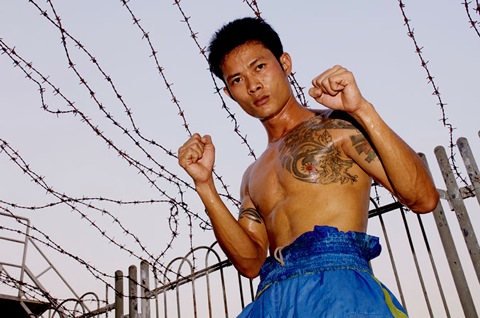
If you want to see the images, simply download the new iPad app, PadPlaces, which showcases this and many more photographic stories by Andrea Pistolesi.
This is what Andrea and I do: we go looking for stories and then try to relate them to others.
It’s not always easy and often we just don’t manage it. But whatever the outcome, our work is easier now because of this tool which eschews market logic and enables us to see and discover a world that, in the end, is not so global.
If you want to see the images, simply download the new iPad app, PadPlaces, which showcases this and many more photographic stories by Andrea Pistolesi.
This is what Andrea and I do: we go looking for stories and then try to relate them to others.
It’s not always easy and often we just don’t manage it. But whatever the outcome, our work is easier now because of this tool which eschews market logic and enables us to see and discover a world that, in the end, is not so global.
A sense of honour
15/11/10 12:22
“You have not been a man of honour”, says the Burmese consulate official in Bangkok as he hands me back my passport.
This is the explanation I get for having my visa denied. Well, not denied outright, because, with a bizarre sense of irony, first they stuck the visa sticker into my passport and wrote ‘journalist’ on it, then they stamped ‘Cancelled’ on top.
In truth, I wasn’t completely honest with them: in the visa application I lied about my profession, but not about my motives. I said I wanted to go to Rangoon because it seemed an interesting time to go there.
All I told the official was something about him not being the best person to speak about honour.
They have granted me a visa in the past. It was almost like a game. I lied and they pretended to believe me. Evidently, this time, after the “election”, they don’t want too many witnesses.
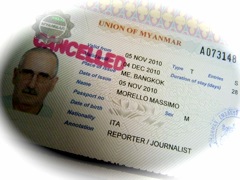
Anatomy of a sham election
“Anatomy of a sham election” is the title of an article by Patrick Winn published on the Global Post website. Anatomy is the perfect term. It’s used when talking about a dead body. It's reserved for the mortuary, when the body lies cold on the slab, not for when it lies bleeding and beaten in the street, when some vague hope of recovery still lingers.
This is what has happened. Now, at this late stage, the whole of the West discovers that the Burmese election was a farce. The opposition party – the one opposed to the boycott called for by Aung San Suu Kyi – asks for an annulment. Before, they had come up with nothing except talk of the lesser evil, the only possibility, the lack of alternatives. In a certain sense, the governments of Asia and China have been more straightforward, sticking to their original judgement that the election is a “step forward”.
The best comment came from Tim Heinemann, a retired US Army colonel and head of Worldwide Impact Now, an NGO that assists oppressed peoples. “The election was like putting the facade of a church on a whorehouse».
This is the explanation I get for having my visa denied. Well, not denied outright, because, with a bizarre sense of irony, first they stuck the visa sticker into my passport and wrote ‘journalist’ on it, then they stamped ‘Cancelled’ on top.
In truth, I wasn’t completely honest with them: in the visa application I lied about my profession, but not about my motives. I said I wanted to go to Rangoon because it seemed an interesting time to go there.
All I told the official was something about him not being the best person to speak about honour.
They have granted me a visa in the past. It was almost like a game. I lied and they pretended to believe me. Evidently, this time, after the “election”, they don’t want too many witnesses.
Anatomy of a sham election
“Anatomy of a sham election” is the title of an article by Patrick Winn published on the Global Post website. Anatomy is the perfect term. It’s used when talking about a dead body. It's reserved for the mortuary, when the body lies cold on the slab, not for when it lies bleeding and beaten in the street, when some vague hope of recovery still lingers.
This is what has happened. Now, at this late stage, the whole of the West discovers that the Burmese election was a farce. The opposition party – the one opposed to the boycott called for by Aung San Suu Kyi – asks for an annulment. Before, they had come up with nothing except talk of the lesser evil, the only possibility, the lack of alternatives. In a certain sense, the governments of Asia and China have been more straightforward, sticking to their original judgement that the election is a “step forward”.
The best comment came from Tim Heinemann, a retired US Army colonel and head of Worldwide Impact Now, an NGO that assists oppressed peoples. “The election was like putting the facade of a church on a whorehouse».
The Rime of the Esmeralda
06/09/10 16:25
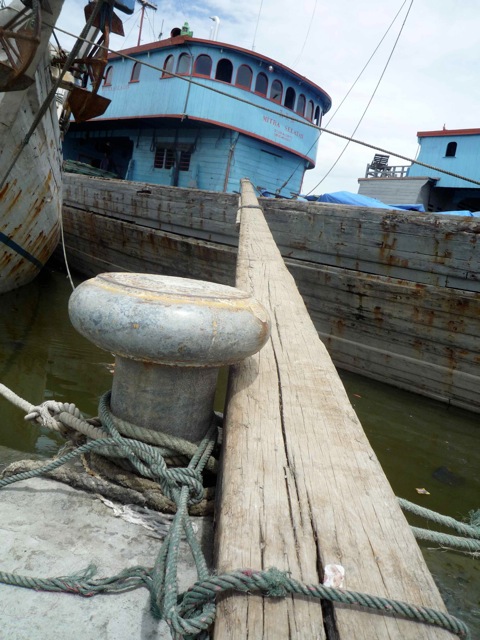
Men, half men...
22/07/10 14:50
Let’s play the game of Don Mariano, a character in Leonardo Sciascia’s novel The Day of the Owl.
According to that old mafia Padrino, humanity is divided into five categories: Men, of which there are very few, then Half-Men, few and still decent. Then there are the Pigmies, who are like children trying to be grown-ups, and the “pigliainculo”, the losers, passed over by everyone. Last place is taken by the “quaquaraquà” who, as the name’s sound suggests, are like ducks in a pond, and whose lives have no point or meaning.
To start this game, the player has to be prepared to put himself out there. Only then is the game on. Jon Krakauer, the writer and journalist known for his non-fiction books such as “Into Thin Air” and “Into the Wild”, has put himself out there, placing himself among the half-men or even the “quarter-men”, half of a half-man, but perhaps he’s unconsciously thinking of the quarterback in American football to lessen his limitations (the quarterback is after all the most important man on the pitch).
For Krakauer, Men are people like the protagonists of his books. Especially the last one: Pat Tillman, an American football player who left his career and enlisted to go to Afghanistan, where he was killed in a friendly fire incident. His story is told in the book Where Men Win Glory: The Odyssey of Pat Tillman.
«He walked the tightrope between opposites. He was full of contradictions and doubts but he accepted them. He managed to control them. Once he had chosen his path, he followed it all the way» Krakauer tells me. Then he quotes Emerson: “Always do what you are afraid to do”.
As you can see, this game can become very dangerous. But the risk isn’t physical. «Taking risks is easy, especially when you’re young» says Krakauer, who has taken his fair share and almost put an end to his human adventure on Everest. Real danger is finding yourself on murky ethical ground, giving in to pride, losing yourself in that theatre of shadows where honour and courage may just be a front for arrogance and egocentricity. Where men would like to be men, but little by little slip into the lower categories. This is, in Krakauer’s view, what happened to General McChrystal, “a man of great skills, who would not normally compromise his principles to get results”, but who appears to have done just that when he allegedly concealed the real cause of Tillman’s death for personal ambition.
It’s an even more dangerous game for those that tell the story of these Men: they move in treacherous territory, where they need to walk a fine line between demons and influences, where it's easy to fall into moralising or even abuse. As Nietzsche wrote: "if you gaze for long into an abyss, the abyss gazes also into you".
This also happened to Sebastian Junger, another American reporter known mainly for The Perfect Storm. His latest work is Restrepo, a multimedia operation that relates the life of a platoon of American soldiers in a remote Afghan outpost. It's a powerful, epic work of extraordinary complexity. A work which embodies what the philosopher James Hillman called a terrible love of war, where one is pushed into a “martial state of the soul”. This is why Junger was accused of writing about war “as if it is a storm at sea, a force of nature that is ... put on earth to test men’s strength, wits and courage. Junger’s view of war is a purely apolitical one, a timeless condition of man”.
Junger, even more than Krakauer, is open to contradictory, even unsettling, interpretations. But both are testaments to total, uncompromising journalism. In the end neither Krakauer nor Junger, nor even a thousand heroes’ faces can be pigeon-holed into Don Mariano’s game. Maybe this is the real solution to the game. Don’t play it.
According to that old mafia Padrino, humanity is divided into five categories: Men, of which there are very few, then Half-Men, few and still decent. Then there are the Pigmies, who are like children trying to be grown-ups, and the “pigliainculo”, the losers, passed over by everyone. Last place is taken by the “quaquaraquà” who, as the name’s sound suggests, are like ducks in a pond, and whose lives have no point or meaning.
To start this game, the player has to be prepared to put himself out there. Only then is the game on. Jon Krakauer, the writer and journalist known for his non-fiction books such as “Into Thin Air” and “Into the Wild”, has put himself out there, placing himself among the half-men or even the “quarter-men”, half of a half-man, but perhaps he’s unconsciously thinking of the quarterback in American football to lessen his limitations (the quarterback is after all the most important man on the pitch).
For Krakauer, Men are people like the protagonists of his books. Especially the last one: Pat Tillman, an American football player who left his career and enlisted to go to Afghanistan, where he was killed in a friendly fire incident. His story is told in the book Where Men Win Glory: The Odyssey of Pat Tillman.
«He walked the tightrope between opposites. He was full of contradictions and doubts but he accepted them. He managed to control them. Once he had chosen his path, he followed it all the way» Krakauer tells me. Then he quotes Emerson: “Always do what you are afraid to do”.
As you can see, this game can become very dangerous. But the risk isn’t physical. «Taking risks is easy, especially when you’re young» says Krakauer, who has taken his fair share and almost put an end to his human adventure on Everest. Real danger is finding yourself on murky ethical ground, giving in to pride, losing yourself in that theatre of shadows where honour and courage may just be a front for arrogance and egocentricity. Where men would like to be men, but little by little slip into the lower categories. This is, in Krakauer’s view, what happened to General McChrystal, “a man of great skills, who would not normally compromise his principles to get results”, but who appears to have done just that when he allegedly concealed the real cause of Tillman’s death for personal ambition.
It’s an even more dangerous game for those that tell the story of these Men: they move in treacherous territory, where they need to walk a fine line between demons and influences, where it's easy to fall into moralising or even abuse. As Nietzsche wrote: "if you gaze for long into an abyss, the abyss gazes also into you".
This also happened to Sebastian Junger, another American reporter known mainly for The Perfect Storm. His latest work is Restrepo, a multimedia operation that relates the life of a platoon of American soldiers in a remote Afghan outpost. It's a powerful, epic work of extraordinary complexity. A work which embodies what the philosopher James Hillman called a terrible love of war, where one is pushed into a “martial state of the soul”. This is why Junger was accused of writing about war “as if it is a storm at sea, a force of nature that is ... put on earth to test men’s strength, wits and courage. Junger’s view of war is a purely apolitical one, a timeless condition of man”.
Junger, even more than Krakauer, is open to contradictory, even unsettling, interpretations. But both are testaments to total, uncompromising journalism. In the end neither Krakauer nor Junger, nor even a thousand heroes’ faces can be pigeon-holed into Don Mariano’s game. Maybe this is the real solution to the game. Don’t play it.