


Monsoons, migrations, horrors and values
Monsoons and migrations happen on a repeated cycle, like natural phenomena. And as such they are interconnected and variable. This year, the monsoon in the south east seems milder than normal. So the number of boats packed with migrants is on the up: these are the last few days before conditions worsen. Then it won't be possible to set sail and the sea and the rains will flood the “land of tides”, creating yet another environmental disaster that will further add to the numbers seeking to escape.
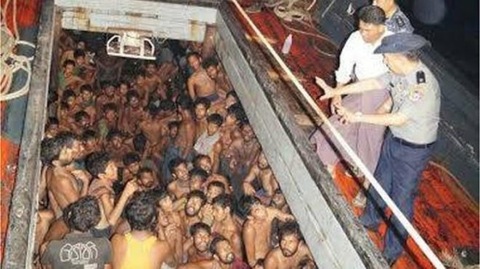
The majority are Rohingya. There are about one million of them, all Muslims, settled in northern Rakhine, a Burmese state on the Bay of Bengal. They are the unwanted of Southeast Asia. They are also part of this natural cycle, in an inescapable fate of poverty, slavery, escape, capture, escape.
When this monsoon season ends, the dead will once again be counted and the horrors related. But, in the end, the story is always the same. I read today's reports (such as these two articles by Il Foglio and Wall Street Journal, which feature singular coincidences). I reread old articles, including my 2009 report on the Rohingya refugee camps in Bangladesh (here, in Italian). Not much has changed. Some things have got worse: from news of mass graves discovered in the forest between Thailand and Burma, to the new persecutions in Burma.
Many have compared this to the tragic situation of migrants in the Mediterranean. Some say it is just another form of globalisation. In fact, it is a sign of how divided the world is. Aside from all cultural conformism and despite many ambiguities, the West is demonstrating that its “universal values” are still the strongest.
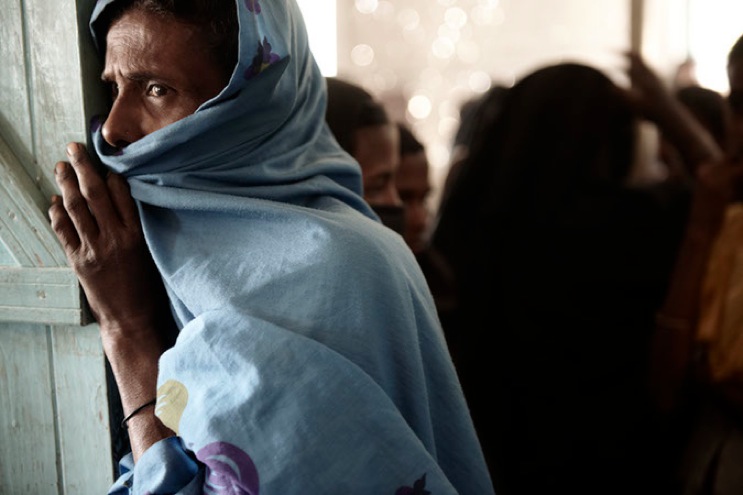
Photo by Andrea Pistolesi, from: Rohingya refugees in Bangladesh
The Theatre of Stories
"If he had been staying here, he wouldn't have died. No one dies at the Oriental."
It's a brief conversation but it has many meanings, at least for me. It reminds me of people such as that Trappist monk who studied oriental religions or the elderly lady who spent her whole life at the legendary Bangkok hotel reminiscing of meetings with writers and secret agents. It triggers a sequence of lost stories rediscovered in travel journals, published and unpublished articles, and little notes.
All of this just to talk about a book: "Sophisticated stays in Southeast Asia".
Initially, I'll admit, it seemed excessive to me. In the end it's just a book about hotels, no matter how fascinating and “smart” they may appear. However, the book did involve a great deal of work and lots of travelling. The photographer Andrea Pistolesi and I thought it was worth presenting to the best of our ability. So, little by little, while looking for ideas, I realised the book is not merely a collection of hotels; it's a concentration of stories that happened at those places and that continue to replicate with different characters.
I remember something Matsuo Basho wrote: “I decided to note down my impressions in no particular order, just like the ramblings of a drunkard or a person talking in their sleep, about the unforgettable places I visited: do not give me all that much attention…”.
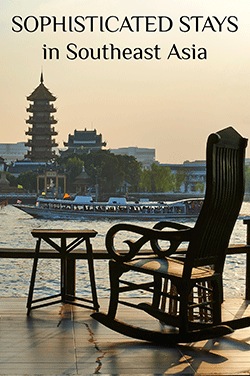
At this point I'd better reproduce the introduction to the book.
"There is the culture of luxury and the luxury of culture," a wise man once said. He was no hermit or philosopher, but the director (and a bit of a hermit and philosopher) of a hotel at the foot of the Himalayas (so not featured here). His aphorism is useful for understanding the spirit of this book: “the luxury of culture”. The hotels featured here are luxurious, at times extremely so. But luxury does not just mean excellence or exclusivity; it can also describe a place that enables us to live in the moment, to appreciate the natural and cultural space in which we find ourselves. They are places of eminent history, art or design because they are indicative of a trend. Unlike “non-places”, spaces devoid of identity, these are charged with meaning; they are remarkable spots on the Asian landscape, models of that architecture and life style that is redefining the Orient and spreading from there to the West. Intelligent places.
That being said, this book is not aiming to be any kind of guide. Nor does it claim to be comprehensive (over time, who knows, given it is a work in progress). In order to be featured here, the hotels must have been actually visited and experienced by us. The idea is luxurious in its very simplicity: to offer a useful tool for sophisticated travellers. For those discerning travellers for whom a hotel is not just a place to go to (or to get bragging rights from), but a part of the journey. Intelligent travellers.
“Sophisticated stays in Southeast Asia” can be downloaded as an e-book from various platforms (at a cost of approximately 4 euro) or ordered in print (32 euro). Also available in English. All references here
Between Europe and Asia
Sometimes stories find their own way, sometimes they don't. I often forget them anyway. But they keep on living, more or less latent in my archive. Sometimes they pop up serendipitously while I'm looking for something else.
That's what happened with an article about the Asia-Europe Meeting, held last October in Milan. I attended the meeting and wrote the article to try to give a professional meaning to my stay in Italy and because I thought it would be interesting to observe a spectacle I normally follow in Asia from another perspective. But the article turned out to be too abstract, too obscure, perhaps precisely because I was outside my comfort zone.
Reading it again in Bangkok, though, I found its shadows came into sharper focus. So much clearer than what is actually happening on a global scale. It's a spectacle of lights and shadows that I want to expose here on Bassifondi.
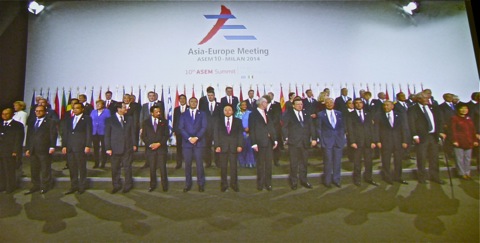
“Overshadow”. This is the oft-repeated mantra and the formula for understanding the Asia-Europe Meeting (ASEM). In a certain sense, it was like attending a production of what in Southeast Asia is known as the “theatre of shadows”, the Cambodian “Sbaek Thom”: every shadow can tell a story and the puppeteers themselves question the meaning of the shadows they create.
The tenth edition of ASEM, the two-yearly forum launched in 1996 to reinforce cooperation and dialogue between Europe and Asia, was held in Milan, Italy, in October. It was attended by Heads of State, ministers and civil servants from 53 countries: 29 from the European Union plus Norway and Switzerland, and 22 Asian countries. Together, ASEM members account for 62.5 percent of the world’s population, 57 percent of global GDP and 60 percent of global trade. “Responsible partnership for sustainable growth and security” was the theme of this “informal platform for dialogue”: such a vast topic can lend itself to all manner of discussions on economic, political, cultural, climate and energy issues.
There were so many people and so many discussions, of which only fleeting visions and vague information were glimpsed, created a shadowy effect. In Cambodia, at the 2012 ASEAN Summit, in Bangkok where I live, at other international meetings, I saw how hard it is to decode the webs of power. But in Milan, in my home country, it was even harder. Probably because here it was more complex to establish a boundary between East and West: “What is Asia? Where does Europe end? Where do they meet or collide?”, were not rhetorical questions: at ASEM Russia came under the Asian countries while the president of Mongolia called his remote country – which will host ASEM in 2016 - a “bridge between Europe and Asia”.
In a certain sense, Russian President Vladimir Putin's geopolitical strategy, Eurasia, seemed to hold sway. Located between Western and Eastern Europe (i.e. Central Asia) and bordered to the east by Mongolia, this is the theatre in which Russia can play a proactive role in the new round of “The Great Game” (as defined in 1898 by Lord Curzon, Viceroy of India, in reference to the murky conflict between Great Britain and Russia for control of Asia). China reacts to Russia's moves with plans for a “New Silk Road”, which connects the Middle Kingdom to Germany over land via Kazakhstan, Belarus, Poland and connects with the Maritime Silk Road via Italy or Spain.
As was revealed at ASEM, all this does not help bring Europe and Asia closer together. “We talk about global interdependence, and it is real. But while, whatever the economic dynamics, each region is intellectually aware of what is going on at the other end of Eurasia, each sees the other as distant and ultimately unconnected from its concerns,” wrote George Friedman, CEO of the private intelligence corporation Stratfor.
The contemporary Great Game, then, would be more appropriately named “Tournament of Shadows”. At ASEM, the biggest shadow was cast by the crisis in Ukraine, which overshadowed any other issues. Vladimir Putin and Ukraine President Petro Poroshenko met to discuss a possible solution. To no avail. To justify “Much Ado About Nothing”, José Manuel Barroso, current President of the European Commission (until November 2014), pointed out that "it was right to discuss Ukraine here", as though the discussion could raise the meeting's profile. The real justification is that the crisis in Ukraine may increase the risk of volatility of financial markets that could impact Asia and Europe. "Stability and peace are fundamental for the economy," declared Herman Van Rompuy, President of the European Council (until December 2014).
In the Theatre of Shadows the most brightly lit scene was the economy. Despite the followers of conspiracy theory, the hundreds of Asian and European entrepreneurs attending the Asia-Europe Business Forum (AEBF), which coincided with ASEM, all agreed on the liberalisation of economies. "Europe needs Asia. A strong Asian economy is a driver for global growth. At the same time, Asia needs Europe, its technologies and its markets," declared Van Rompuy. "From an economic point of view, Asia has become the largest trading partner of the European Union, which remains the world's largest single economy. Future growth in Asia, therefore, depends on access to European markets." For Asia's part, Benjamin Philip Romualdez, President of Chamber of Mines of the Philippines, pointed out "Our growth is your opportunity". Indeed, in this second phase of globalisation (in which consumption, more than output, is shifting Eastwards), managing to compete successfully will be decisive for Europe.
In fact, Europe must attract China’s Super-consumers more than Asia in general. Due to its enormous economic surplus, China's strategies are changing: it is giving up on short-term profit and investing huge amounts of capital. The activism of premier Li Keqiang at ASEM and on the other stops on his European tour demonstrated this. China is making the most of what Li calls a “global economic recession” to acquire business bases in the Old Continent, where the price of companies has dropped and more than one government has requested help from Beijing. The Chinese premier demonstrated yet more Soft Power in his meetings with Vietnamese premier Nguyen Tan Dung, shoring up bilateral relations and strengthening trade links. Thailand has also been offered collaboration: taking advantage of the European halt on commercial negotiations following last May's coup d'état, Li pledged to cooperate with Thailand in developing roads and basic infrastructure.
In short, bilateral agreements were one of the most evident features of ASEM. Which also represents its dark side. Not so much because of the secrecy involved, but mainly because they overshadow ASEAN. The Association cannot propose itself as a sole interlocutor. In 2009 the European Commission decided to redirect its goal, placing greater emphasis on bilateral agreements with individual members of the Association, and at ASEM the European Union remained sceptical. The 2015 ASEAN Business Outlook Survey highlighted the widespread concern that the much-anticipated ASEAN Economic Community (AEC) would not be launched by the end-2015 deadline. Too many of the specified deadlines of AEC implementation have been missed and some major initiatives have not taken off. According to some observers, this is partly down to ASEAN's inability to act as a supranational organisation. For others, especially the Germans (who perhaps fear an Asian repeat of European discord), one of the biggest obstacles to the ASEAN economic community is the presence of CLMV, i.e. Cambodia, Laos, Myanmar and Vietnam - countries that will need more time to adapt to this new economic space.
Offsetting this, the European Union has pressed the accelerator on the Free Trade Agreement (FTA) between ASEAN and EU - a move aimed at countering two other hyper-agreements: the American Trans-Pacific Partnership (TPP) and the Chinese Comprehensive Economic Cooperation in East Asia. In ASEAN the biggest supporter of the FTA with Europe is Malaysia, which will have the presidency of ASEAN in 2015. "Malaysia will take the lead to encourage the FTA process, which was discontinued a few years ago. We hope there will be an ASEAN-EU FTA that will complete the regional integration," declared Prime Minister Datuk Seri Najib Razak.
Ahead of these macro-agreements, ASEM has forged relations that may appear marginal in the global scenario, but are fundamental for regional integration. For example, between Cambodia and Thailand. The two premiers, Hun Sen and Prayut Chan-o-cha, held their first bilateral talks, demonstrating “the right chemistry” in pushing their cooperative friendship to a new level. According to well-informed sources, the two premiers discussed the development of special economic zones (SEZ), roads, customs facilities and crossings along the border. General Prayut proposed the setting up of an initial SEZ near Cambodia’s Poipet, while Cambodian authorities will consider setting up a similar estate in their territory to boost trade. And the shared desire to set up a joint development area (JDA) in the Gulf of Thailand was an open secret.
Shadows are often misleading. What might seem overshadowed may eclipse the global threat of “Super Chaos”.
The dark side of globalisation
Today the Golden Triangle is a tourist destination attracting travellers in search of adventure. It's a reassuring image, almost a marketing strategy, especially where Thailand is concerned. In Laos and Burma, however, year-on-year opium cultivation is increasing. According to the Southeast Asia Opium Survey conducted by the United Nations Office on Drugs and Crime (UNODC) and released on 8th December, cultivation rose from 61,200 hectares in 2013 to 63,800 in 2014, the eighth consecutive year of growth and triple the amounted harvested in 2006.
The triangle has evolved into a graph - a set of interconnected points extending over the entire so-called “Greater Mekong Subregion”, which includes the Chinese province of Yunnan, Burma, Thailand, Laos, Cambodia and Vietnam and which, in turn, fits into the global market system.
The Golden Triangle imports the chemical products needed to transform opium into heroin, which is then exported to China, Southeast Asia and the rest of the world. The exchange is gradually facilitated by the developing infrastructure, and the reduced commercial barriers and frontier controls.
The Golden Triangle symbolises the dark side of globalisation, as defined by Giovanni Broussard, the Italian Programme Officer for UNODC's initiative on Border control and transnational organized crime, a 90 billion dollar business.
The enormity of that figure (which refers to all “Transnational Organized Crime”) confirms the last, macroscopic connection: that between the power of the traffickers and the impotence of the populations involved (especially in opium cultivation), who have no economic alternative and find themselves in the midst of ethnic or territorial disputes.
Southeast Asia Opium Survey 2014. Il Full Report
Border Control in the Greater Mekong Sub-region. Full Report
History and Fantasy
"How are cities born? Why does a village grow into a city? This teaches us the mechanisms of history." These are the questions that inspired the research of Italian archaeologist Patrizia Zolese, “The Lady of Lost Cities”.
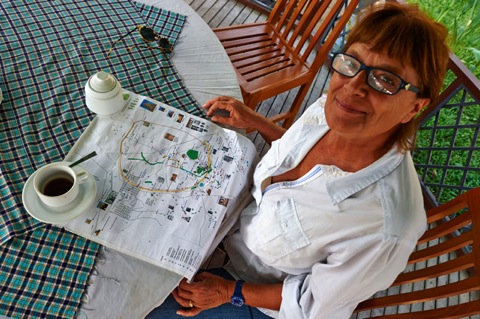
The two characters belong to distant philosophical and spiritual dimensions. But, as in parallel universes, they co-exist and are connected by gateways in the space-time continuum. In their case, that gateway is in the ancient East.
“The course of history depends less on what actually happens than on the falsehoods people believe,” wrote historian Felipe Fernandez-Armesto, thus offering another gateway. It's one way of explaining the previous connection. Zolese's research is perfect for constructing mental representations: temples, monuments or entire cities of long-gone civilisations are not only pieces of stone in the domain of history. They are a gateway to stories, even fantastical ones. And Zolla, that connoisseur of secrets, seemed to me to be a character that could introduce the meaning, or the sapiential perspective, of Zolese's research.
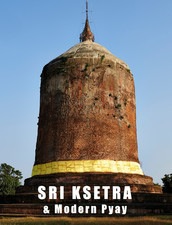
Other characters and other histories could come in at this point: the situation in the South China Sea on the routes of the ancient Cham merchants, the explorations into the deep jungle of the sacred mountain that dominates the Lao coast of Mekong, the things that inspired Kipling on his Road to Mandalay. These are all mental representations constructed on Patrizia's research. All of them are in places that, thanks in part (if not entirely) to her (as the Lerici Foundation's head of archaeology and culture for Asia), have become World Heritage sites: the Vat Phu site, in southern Laos, called the “cradle of the Khmer civilisation”; My Son, on the central coast of Vietnam, one of the most important centres of the ancient kingdom of Champa. Finally, the sites of the cities of the ancient kingdom of Pyu, in central Myanmar (better known as Burma).
Patrizia calls it "one of the greatest civilisations in Southeast Asia". "One of those populations that change things." Once again, history and its representations seem to meet: last June, the ancient cities of Pyu became Myanmar's first World Heritage Site.
As Patrizia says: "In the end my job can be summed up in two words: logos and archeo." Archeo in Greek means ancient. Logos means reason, but also story.
A post-modern coup
It has always been this way. Without studying the classics (whether it be Sun Tzu or Machiavelli), we need only browse through an interesting book by Edward N. Luttwak: Coup d'État: A Practical Handbook. Published in 1968, at a time when coups d'état were much more common and the concept of information more in-depth. Information in the age of social media seems confirmation of the uncertainty principle. Information cannot be fast and in-depth at the same time.
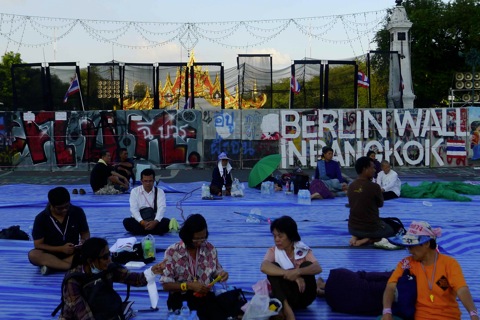
The Thailand of the coup d'état, and Bangkok in particular, is becoming a laboratory where this phenomenon of quantistical politics is occurring. Few protesters observed a great deal by a hail of photographers, reporters and operators. Communication via Twitter is more useful to the journalists for finding out where the protesters are than to the protesters themselves. A distortion of the observed object, and therefore of communication, is bound to follow. As demonstrated by the stupefying question: the effect (control) conceals the cause (the seizing of power). A lack of depth also justifies another distortion of the reality: the one in which photos from 2006 and 2010 are used simply because they are more dramatic or because they feature tanks in the street.
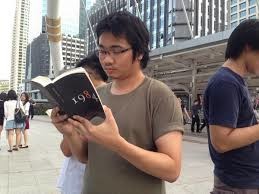
This is a post-modern coup in every sense. The few protesters on the streets of Bangkok, mainly at the weekend, use increasingly creative ways to show their dissent, inspired by messages and forms taken from global culture. Such as the “revolutionary” salute taken from the film The Hunger Games, reading George Orwell's 1984 in small groups (so as not to infringe the martial law), the “sandwiches for democracy” (“we're just eating a sandwich” said the university students held for infringing martial law). Not to mention that, immediately after the coup, one of the emblems of the opposition was Ronald McDonald, the fast-food chain's clown mascot, simply because the protesters used to hang out there.
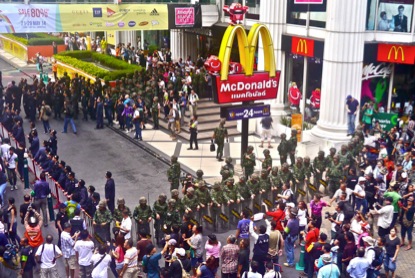
As for the military, they have adopted an “overt and covert” strategy, which is a reworking of the hard-soft approach inherent in all Asian culture and martial arts.
Overtness, or softness, is expressed above all in the “return happiness to the people” operation, based on the idea of gross national happiness. The indicator of well-being was adopted several years ago in the Himalayan state of Bhutan and has become a model of Buddhism-inspired economic policy, as well as a happy example of marketing.
The Thai junta has an ambitious plan to return happiness to the people: economic measures (some already supported by the deposed government) in support of the poorer classes and farmers. Re-launching of great works (high speed, flood prevention). Campaign against corruption and for transparency in public officials' income. Improvement of public services. Promotion of domestic tourism (with low cost tour operators). The military has also launched a campaign of national pride, which pits Asian values (those supported by China) against those that the West slightly arrogantly insists on calling “universal”.
Considering the Thai vocation for “sanuk”, or fun, happiness is also pursued with concerts, shows, female dancers in mini-fatigues, free food stalls and even a barber service. Also in the name of fun and with a nod to the tourists, the curfew has been cancelled at holiday destinations and in places where “full moon parties” have been scheduled.
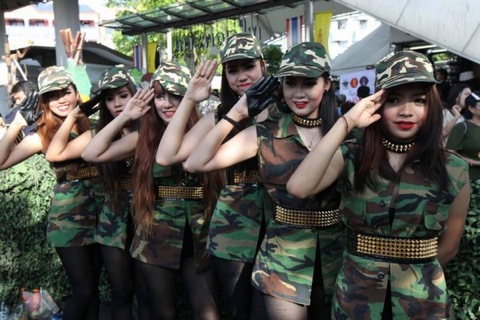

Wilawan Watcharasakwet/The Wall Street Journal
All this makes unhappiness look like a sin, like an antisocial, nihilistic protest by those who do not credit the military for bringing order back to the country. More than Orwell's 1984, it's more a case of Huxley's Brave New World.
A more hidden, harder aspect manifests itself in the repression of all dissent, even minimal, in the limitation of rights and civil liberties, in control of the media and even more of education. More worrying still is the ability to convince arrested protesters to sign a sort of abjuration. Which has happened despite detention periods being very short in many cases and, as the former detainees admitted, “a kind of holiday”. Perhaps the unspoken is the most powerful mechanism of psychological pressure, at least for the Asian mind. Teamed with an awareness that, if the confrontation degenerates, there is no more room for agreement.
As far as public opinion is concerned, the real flop was when Facebook was blocked for half an hour. It should have been a warning. But it backfired on the military: the reaction of millions of users was ferocious. Not because they felt their freedom of expression had been under threat, but because they were no longer able to message friends, post photos, arrange appointments, set up meetings and share them.
The Essence of Drama
Violence and brutality explode from time to time on the streets. But in most cases, it is transformed into the spectacle of a demonstration. The drama, understood as a representation, takes on all of its standard forms: comedy, farce, tragedy. And the essence of drama, whether theatrical or real, is always conflict. Just as the origin of conflict is a desire for control. It's a term heard increasingly often in Thailand. It is one of the codes of a culture based on the “pee-nong” relationship (superior-inferior), which in turn derives from the interaction between Dharma, the ethic and social order, and kharma, the action determining individual destiny. Now, though, control seems to be eluding the standard rules and stage actors are trying to create a new one, or bring back the old one. So, as Muay Thai Live prepares for its final shows, the other spectacle seems destined to go on for a long time to come.
Occupy Bangkok
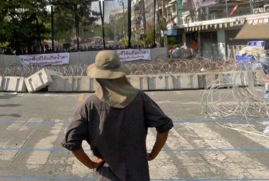
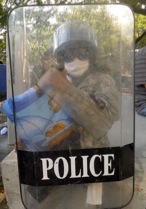
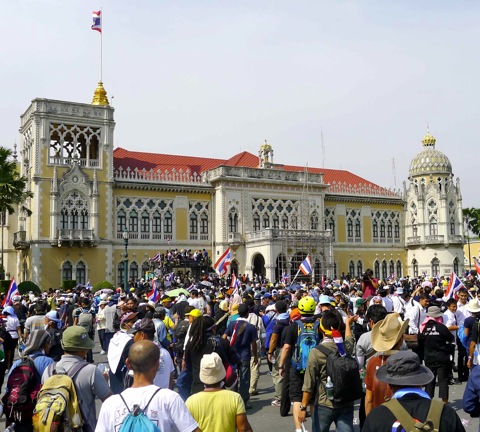
Sitting on a blue plastic chair beneath the statues, next to a soldier with a white carnation in his belt, I think how absurd it is to dwell on architectural details at a time like this. But this whole story is absurd in itself.
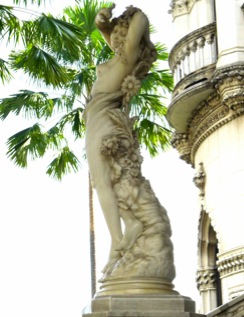
"Today everyone is happy," says a man who calls himself a Bangkok police officer. He observes the scene with a smile that seems more ironic than happy.
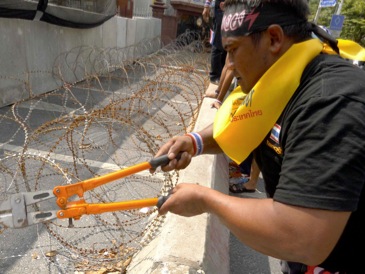
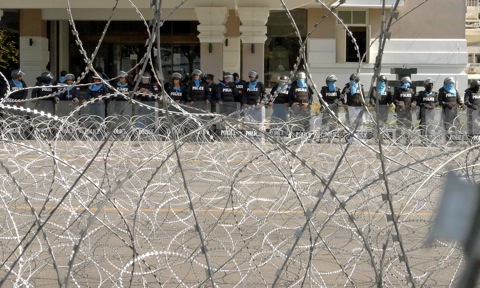
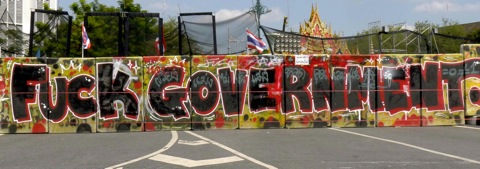
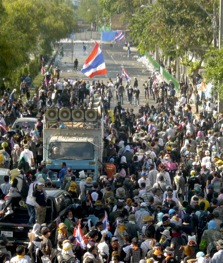
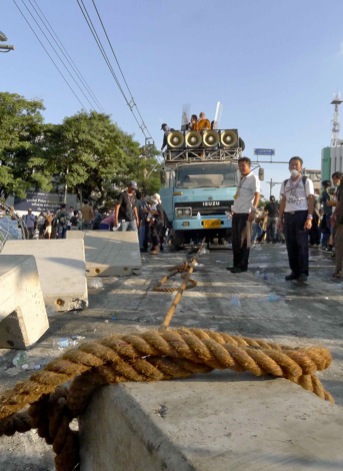
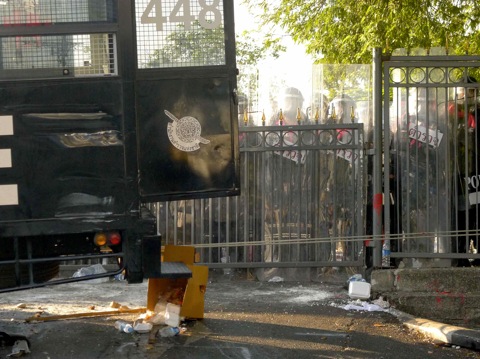
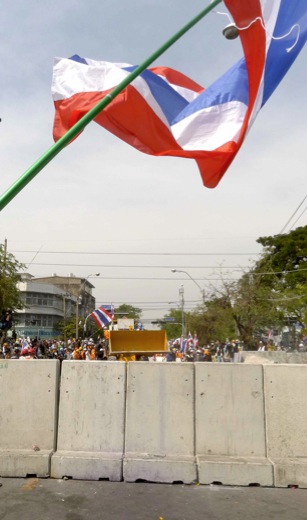
Just a few minutes earlier, the concrete blocks surrounding the government building and the police headquarters were removed. A river of protesters flowed in between two lines of police officers. Everyone is smiling, they make the sign of the wai, palms pressed together, they take photos on their mobiles.
"What about tomorrow?"
"Tomorrow…'mai pen rai'," he replies with the same smile, accentuating the meaning of the expression, which is somewhere between optimistic, fatalistic and resigned, ultimately used to say don't worry, don't think about it.
"What do I hope for? Peace," says a young Bangkok police officer.
"It won't be easy."
"Well exactly, it's a hope."
***
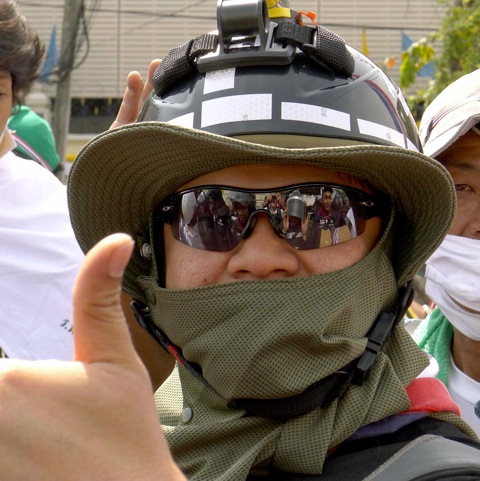
Only the previous evening there was little hope. A woman points to the Bangkok sky and says salvation can only come from there. The young man translating for the woman says not to take any notice. "We have to do something to create a new country. This may be a dangerous way of doing it, but we have no choice." He is denouncing corruption and inefficiency. "My family is poor. I got an education and found a job. But I can't see beyond that," he says in perfect English.
The woman hoping for a solution from the sky – and it should be pointed out that Thais often use the sky to indicate the royal palace – and the young man working as a programmer in a software firm are two faces of the protest which began at the end of November and escalated into violence and danger in early December.
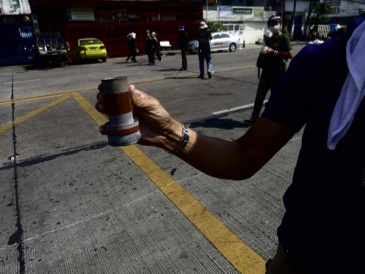
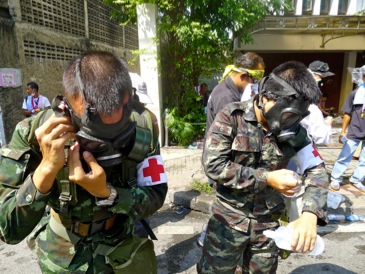
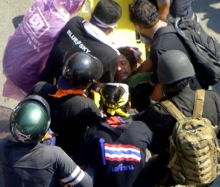
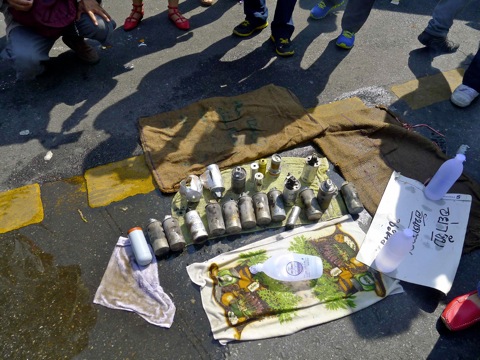
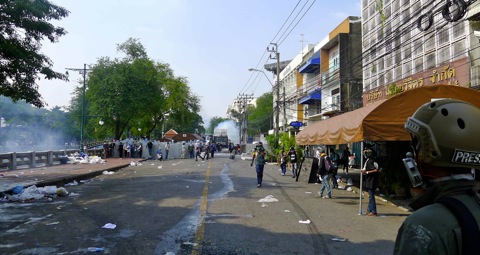
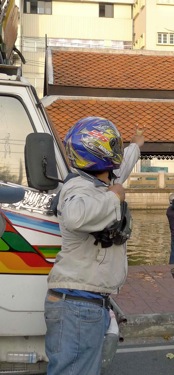
While the woman and the young man try to demonstrate in different ways that democracy is an opinion, the Bangkok sky is streaked with tear gas and rubber bullets used by the police and with cobbles, ball bearings and Molotov cocktails thrown by the demonstrators facing off on the two banks of a canal, or khlong, alongside the government building.
While the clashes continue, I look for a quieter spot inside a monastery, the Wat Somanas Rajavaravihara. As I write under a bodhi tree, I hear shots that don't sound like tear gas.
***
I arrived at the government building in the company of a kind man who claimed to be a university professor of political science. I ask him to explain how this crisis might pan out. He says that we can talk as we walk towards the area that has just been “liberated”. But first he wants to stop in front of the statue of Rama V, the king worshipped by the Thais for the role he had in keeping the country independent at a time when all other Asian states were becoming European colonies and for the contribution he made to the modernisation of Siam. He kneels and prays for a moment. "He will protect us. And he'll protect you too," he tells me later. The professor claims we are at a turning point. If the prime minister steps down, a group of sages will ask the king (Rama IX, Bhumipol Adulyadej) to name some unallied person to form a new government. This person would remain in power for a few years. Then elections would be called, once the country is ready. When we part, the professor invites me to visit him at his traditional furniture shop.
***
In reality, the day of hope is for some just a good tactical move on the part of the government. For everyone, it is just a brief respite on the eve of the king's birthday, 5th December. The cause of the uprising was the government's proposed amnesty for all those involved in the series of uprisings since 2006. The amnesty would also have quashed the prison terms (after an extremely politicised trial) for corruption, abuse of power and lese majesty of the former premier Thaksin Shinawatra, deposed in a 2006 coup d'état and now exiled abroad. Since then, Thailand has been literally split in two: Thaksin's supporters, the so-called red shirts, made up of the phrai, the people, the poorer classes, and his opponents, the yellows (after the colour of the royal palace), representing the ammart, the elite. In 2010 the reds occupied central Bangkok, triggering an uprising that ended with 90 dead and a thousand injured. In the 2011 elections, the red party won and the sister of the former premier, Yingluck Shinawatra, was made prime minister. It seemed that Thailand was finally on the way to normalisation. But it was just another hope.
***
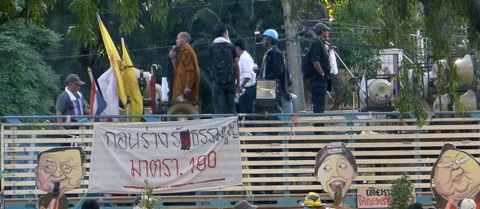
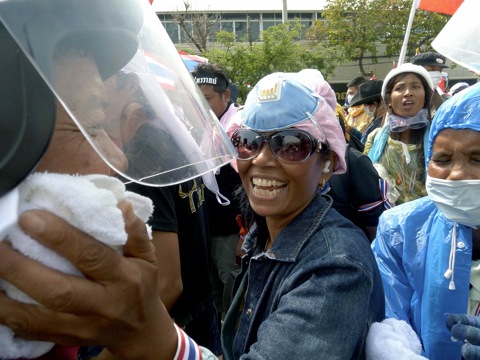
"Kanom, kanom," calls a woman in the middle of the road, inviting the protesters to help themselves to the Thais' favourite sweet snack. The woman also hands out bottles of water and face cloths – like the damp perfumed ones normally used to freshen up – to bathe eyes smarting from tear gas. The series of demonstrations are reminiscent of the scenes in 2010, during the red uprising. There are the same street sellers hawking T-shirts, hooters, whistles, food stalls, massage stations, and first aid volunteers. Even the soundtrack is the same: a mixture of propaganda speeches backed by roars from the crowd and interspersed with Thai pop music. Everything is extremely loud (so much so that, this time, earplugs have also been handed out). And there are the same surreal differences between one side of the city and the other. Just outside where the clashes are taking place, life goes on as normal. One evening, on my way home, I suddenly heard some violent shots. I think they must have moved on to heavy arms. Then I see fireworks going off in the sky.
***
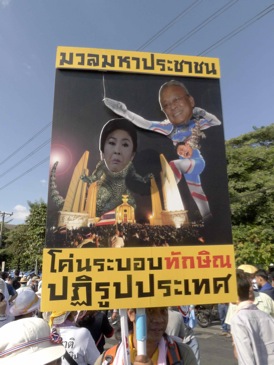
But the differences are there. In the slogans, in the faces on the T-shirts or in the caricatures. This time round, the bad guy, which in 2010 was the then conservative prime minister Abhisit Vejjajiva, is Thaksin, in all of his incarnations. Public opinion has also changed about Berlusconi, who, after certain footballers, is the Italian best-known around here. In 2010 the reds told me proudly that Thaksin was like Berlusconi - wealthy, loved and witty. Today's demonstrators tell me that they want to get rid of Thaksin's sister just like we have got rid of Berlusconi. "Thailand could be a wealthy, happy country, if it abandoned this drive towards self-destructive politics," says a Thai friend of mine. "As an Italian, you should understand that."
The greatest difference, however, is hope. In 2010 hope was placed in the elections. Today, things are not so clear. Suthep Thaugsuban, former deputy prime minister in the Abhisit government and leader of the opposition movement, wants to dissolve parliament and form a council of sages who can then form a “parliament of the people”. "I don't understand what that means," declared political writer Pavin Chachavalpongpun. The military probably don't understand it either, as they don't seem prepared to launch another coup d'état (there have already been 18 of them since 1932). At least not in support of Suthep's plans. If they intervene, they will do it when they can appear as the saviours of the Kingdom, rather than over-throwers.
***
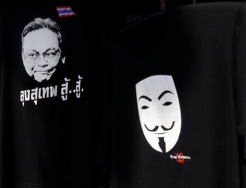
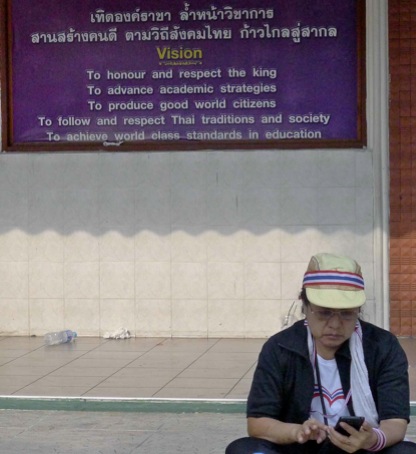
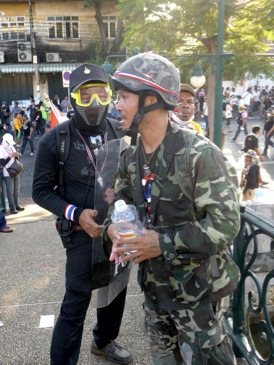
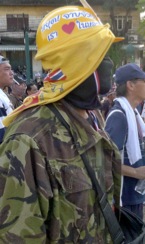
"You see any yellows around here?" a demonstrator asks me. Actually there aren't that many yellow shirts. Almost everyone, including the guy asking the question, is wearing a black one. It's officially a sign of mourning for the recent passing of the supreme Buddhist patriarch. But it's probably also the expression of a desire to split from the “yellows”, as they represent an aristocracy that is seen to sympathise with the very system they want to bring down. This black makes no reference to the Western extreme right-wing associations. It seems to be more in tune with the international protest movement Occupy. Many of the T-shirts feature a Guy Fawkes mask (as seen in V for Vendetta) alongside Suthep's face. There are undoubtedly some yellows around, but they are only one of the opposition groups. The majority are students, kids that have tweeted every instant of the demonstrations, who want to do away with a corrupt, inefficient system (there are many similarities with Italy in this too). Supporters of an anti-capitalist, anti-consumerist ideology, of that sustainable economy extolled by His Majesty Rama IX. The burgeoning groups of the so-called “civil society” largely agree with them. Then there are the supporters of the Democratic Party (resembling the Italian one only in its inability to win elections), representing the Thai middle classes. All prepared to swap democracy for a regime of honest men. Other groups include the ultraconservative realists and the fundamentalist Buddhists, who call for national-religious purity and oppose the animistic contaminations of the peasants in Isan, Thailand's poorest region, who are often of Laos or Cambodian descent.
In one way or another, Thailand, which was the first Asian country to try modernisation (during the reign of Rama V), seemed to have become a battle ground between the so-called universal values of Western political philosophy and Asian values submitted by Lee Kuan Yew, the demiurge of the city-state of Singapore. It's a conflict that could easily spread into nearby countries such as Myanmar, Cambodia or Laos, dissuading them from the path to political reform.
"Many of them are scum," says an expat of the protesters of any colour, who he claims are damaging business with their protests.
***
"I'm afraid this situation could allow Thailand to descend into a low intensity civil war," declared Paul Chambers, a researcher at the Institute of Studies on Southeast Asia at the Chiang Mai university. The danger is real precisely because cultural and social divisions are deepening in Thailand. Some have called it a “philosophical conflict”. In the meantime, the reds, who have kept a low profile in recent days, are ready to mobilise, mustering all the new supporters recruited from many of the villages in the north and north-east.
Benedict Anderson, an expert on Southeast Asia at Cornell University, has quoted Antonio Gramsci: “When the old refuses to die and the new fights to be born, monsters appear”.
***
I have spent time sorting out my ideas and notes beneath the government building. Many demonstrators have started to drift off. I leave too. A young woman picks up plastic bottles off the street that just yesterday evening was a battle ground. Thousands of them were used for drinking and for washing tear gas away. She will sell them for a few cents a kilo.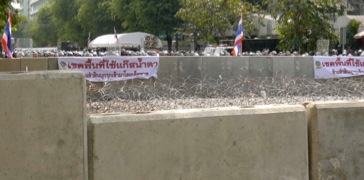
If on a winter's night a traveller...
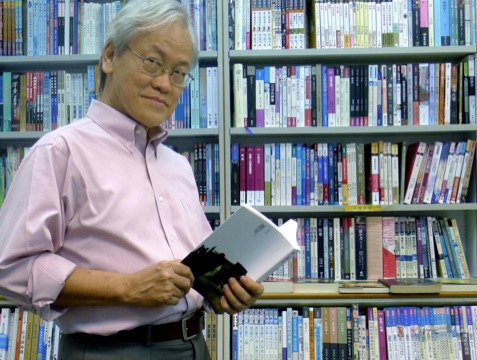
I have been talking about it in Singapore with Yeng Pway Ngon, a writer, poet, painter, bookseller, intellectual and free thinker with a difficult life. His latest book, L’Atelier, has just been released in Italy. The English-language translation (The Studio) by Singaporeans Loh Guan Liang and Goh Beng Choo is expected to hit the market in January 2014.
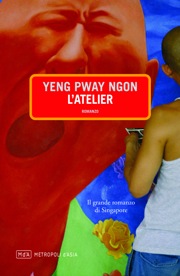
It's a novel of overlapping stories “on love, on art. On life,” says Yeng. The book is not similar to Calvino, yet, like him, Yeng also seems to want to go back in time to cancel out the consequences of certain events and restore an initial condition.
So Yeng's story and his life become metaphors for Singapore, on the very fine line separating Utopia from Dystopia. This was one of the central themes at the recently held Writers Festival.
"The system has stabilised," says Yeng. Which means that control can be loosened, even culturally. The problem, according to this author who calls himself an “existentialist”, is that if that has happened it is because the system has achieved its goal, i.e. mental assimilation to a preset model of thought. Singaporeans, by now, are definitively “kiasu”: “afraid of loss”. And it is not freedom that is at stake. "Once Mao's books were forbidden. Now you can sell them, but no one will buy them," he says.
He gets worked up as we talk, switching from hesitant English to Cantonese (immediately translated by the ever-smiling Goh Beng Choo, his wife of 36 years). What irritates him is cultural conformism caused by loss of culture. Beginning with one's language. Chinese, his Chinese (he writes in Mandarin interspersed with various dialects), has become an “economic” language. People speak it but don't know how to write it; they don't know the characters. We agree that illiteracy is a global problem, even the real consequence of a globalisation of values and ideas. We are all becoming a bit kiasu.
"It takes courage. Moral courage," says Yeng.
If on a winter's night – and, let's remember, it is winter now in Singapore – the world changed, other visions appear that seem to contradict what Yeng has to say. They can be seen at “If The World Changed”, the title of the Singapore Biennale. The city-state's museums, universities and galleries are exhibiting collective and solo shows by Southeast Asian artists. The idea is to mark out the region as a corridor of ideas. Personally, it's a chance for me to discover some artists I did not know, such as Wu Guanzhong, one of the greatest contemporary Chinese painters, or Hong Zhu An.
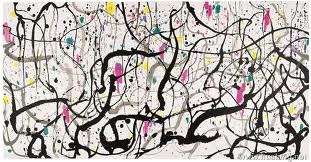
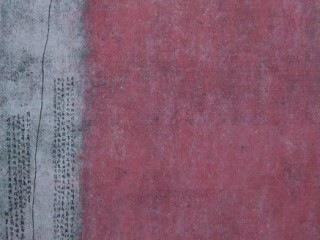
The comparison with some young experimenters is pitiless. As always, on occasions like these, Plato's Cave comes to mind. In the allegory, many cannot distinguish shadows from reality, the opinion self-induced by knowledge. But this idea of the Cave, of fluid, shady knowledge, has generated some of the most interesting installations at the event. Such as the interactive digital installation by the Japanese teamLab or the digital images by Vietnamese Nguyen Trinh Thi, who presents “living” tableaus of women and men from Hanoi.
If on a winter's night - and it's winter in Thailand too - you take a look at Bangkok, “the best you can expect is that you avoid the worst”. Because the traveller has gone from the utopia-dystopia of Singapore to the chaos of a metropolis whose charm lies in its very chaos.
As in Calvino's book, its stories are intertwined. What is happening in Bangkok, yet more anti-government demonstrations - even though the party now in power are former protesters and the current protesters used to be in power – which may lead to yet another coup d'état, leads back to my conversation with Yeng Pway Ngon about control and democracy. Only, here, the system has not stabilised; it has become dysfunctional: control without democracy or uncontrollable democracy.
In this intersecting plot of paradoxes and oxymorons, the opposition, which condemns the “tyranny of the majority”, inferring a political philosophy of limited or unlimited democracy (a little like that in Singapore) and seeming to augur a military coup, has chosen the V for Vendetta mask as its symbol, epitomising the anti-establishment hero.

I am tempted to make that mask my own. V for Voyager.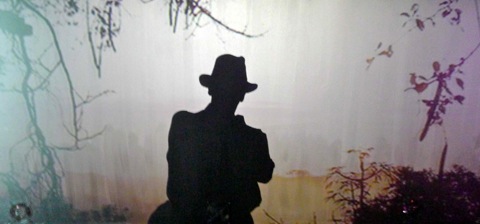
The course of History and Peace
One of the nominees is Thein Sein, president of the Republic of the Union of Myanmar (Burma’s official name). For Kristian Berg Harpviken, director of the Peace Research Institute of Oslo (PRIO), an independent study centre, Thein Sein is one of the five favourites among the 231 valid nominations being considered by the Norwegian Nobel Committee.
In the words of the prize founder, Alfred Nobel, the peace prize must be assigned to someone who “shall have done the most or the best work for fraternity between nations, for the abolition or reduction of standing armies and for the holding and promotion of peace congresses”.
In this sense, for Harpviken, Thein Sein would be a worthy winner, because he is “spearheading a gradually evolving peace process in the country. Peacemaking is certainly at the core of the Nobel mandate, and many prizes have been awarded to both mediators and lead representatives of conflict parties”.
However, awarding the prize to Thein Sein would prove controversial. The Burmese president was, after all, a member of the military junta that for many years dominated Burma in one of the most brutal dictatorships of the modern age.
As Harpviken says, though, the Nobel Committee has often insisted that the “prize is not to be for saints only” and in recent years has been particularly eager that it “makes a difference in processes unfolding, even if that may carry high risk”.
Since he was elected president, in February 2011, there is no doubt that “processes unfolding” in Burma have seen an extraordinary acceleration: from the by-elections at which Aung San Suu Kyi (1991 Nobel Peace Prize winner for her opposition to the regime) was elected to parliament, to the recent declarations by Thein Sein, according to which he would not be opposed to the Lady becoming president, should she win the 2015 elections. So much so, that San Suu Kyi herself admitted: “Parliament has more democracy than I expected”.
For some, Thein Sein’s behaviour springs simply from his desire to wipe the slate clean of the sins of the past. For the majority, it is a strategic calculation. The Burmese “historical compromise” is the only possibility for the country to play on more than one table. This is clarified by an article written by a Burmese civil servant and approved “by the highest authorities”, which states, “We do not want our nation to become a Chinese satellite”. The road to democracy, in this case, is paved with the benefits of an end to the embargo and of economic aid, and is headed ultimately towards the metamorphosis of Burma into the next Asian Tiger.
The biggest obstacle are the conflicts with the various ethnic groups in the country, for which the army has been accused, and found guilty of, all kinds of human rights violations. Thein Sein’s government has established ceasefire agreements with ten of the eleven armed ethnic groups, but the truce remains fragile and fighting continues in Kachin State, where the conflict has already caused thousands of deaths and tens of thousands of internally displaced people. According to representatives of the ethnic groups, then, the acceleration of processes unfolding is rather too quick and risks sacrificing the people’s rights on the altar of economic interest in a race to develop marked by even more profound inequality and unscrupulous territory management. Some even say that Aung San Suu Kyi has become an accomplice of Thein Sein’s for not denouncing government attacks on Kachin, “I do not want to add fire to any side of the conflict,” replied the Lady, defending herself against those accusing her of betraying her humanitarian credentials.
From this perspective, awarding the Nobel Peace Prize to Thein Sein would be a gamble indeed, definitively legitimising his government and justifying in the name of the greater good new ethnic repressions and uncontrolled development at the expense of the Wretched of the Earth. But it could also turn out to be a decisive step towards democracy, with all of its associated limitations, and lead to the civil reconciliation that would bring an end to over sixty years of civil war.
When I wrote (in italian only) in April that “it would not be surprising – or perhaps undesirable - if president Thein Sein were to win the Nobel Peace Prize”, comparing him to Frederik Willem de Klerk, the last president to rule over apartheid in South Africa (and thus comparing Aung San Suu Kyi to Nelson Mandela), many judged what I said to be provocative, eccentric and political fiction.
But, however this story ends, it is clear that History is moving fast.
As St Augustine said: Solvitur ambulando.
The Thein Sein’s conference at the Asia Society in New York on September 27 last year (with translation). Below: full video (also from the Asia Society) of Aung San Suu Kyi visit in Washington DC.
Hysteria
"How can we be proud? Everyone knows it’s down to Thaksin”, declared Sutada Mekrungruengkul, director of the Gender and Development Research Institute of Thailand, to the AFP news agency.
Indeed, Yingluck’s success is largely due to her being the younger sister of Thaksin Shinawatra, the former prime minister overthrown after a military coup in 2006, and as adored by the poor as he was hated by the elite.
Yingluck’s success has, however, gone beyond all expectations, which is a sign that she managed to convince not only her brother’s followers but also many undecided voters. Without counting that, if she won because of being Thaksin’s sister, she could easily have lost for the very same reason. Yingluck may go from little sis to the Big Sister.
But Sutada’s declaration, shared by all the political adversaries of Thaksin’s Pheu Thai party, doesn’t stop there. It falls into the ridiculous with a comparison to Aung San Suu Kyi, who, they say, «has fought for twenty years and is still not prime minister of Myanmar». That can’t be said to be Yingluck’s fault. It shows that, despite many limits, there is democracy in Thailand, unlike in Burma. The comparison also ignores the fact that Aung San Suu Kyi succeeded in becoming leader of the opposition because she was the daughter of general Aung San, the founder of independent Burma. Another powerful female Asian politician, Indira Gandhi, owed her success to her family. Not Gandhi’s (her husband, no relation to Mahatma Gandhi), but her father Nehru’s, the Indian Prime Minister between 1947 and 1964.
The problem may lie less with gender and more with dynasties, which in Asia often result in a chiefly female line.
Using Yingluck for the umpteenth feminist controversy could also be seen as a symptom of hysteria. Not because hysteria is to be considered as a solely female condition (the term derives from the Greek hystera meaning womb). But because, as many psychologists maintain, it is the manifestation of a crisis that a person expresses in a coded representation that he/she knows.
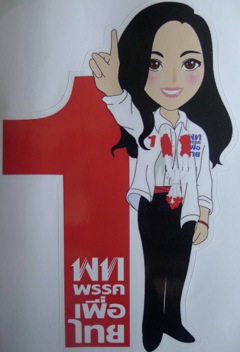 Yingluck’s victory could positively be interpreted as the recognition of female qualities, such as moderation and reconciliation, on which she based her election campaign.
But in the coded representations of extreme feminism, that could not happen. So there must be another reason.
You have to wonder: would the feminists have been quite so critical if she had been ugly? But then, male honesty demands: would she have won in that case?
What is important for Thailand right now is that Yingluck really manages to unite all the different factions. Under the same sky.
The Deal with the DevilL
On 10th February, Ross was arrested in Rangoon on immigration charges. He is also reported as having been charged with consorting with prostitutes and marijuana possession. Ross is being held at Insein prison, a place where political adversaries are detained and tortured. His hearing is set for 24th February. If found guilty, he risks up to five years in jail.
Up to last Thursday this big, bald-headed Australian could call himself a lucky man. He had always managed to get on in a country where the worst nightmares can come true in a rude awakening.
In fact, Ross had made a deal with the devil. His Mephistopheles was Khyn Nyunt. In 2000, when Ross launched The Myanmar Times, the operation was approved by the then first secretary of the military junta and military intelligence commander. That’s why, when I asked Ross how he was coping with the censorship (I’m still amazed by how ingenuous the question was), he replied: “I said: I could be more useful to you if the newspaper weren’t subject to the standard censorship, Military Intelligence control would be more appropriate”.
At the time of our meeting, General Nyunt was prime minister and Ross had the benefit of full protection: he was the man presenting the human face of the junta to the West. A few months later, though, the General was removed from office “for health reasons”, then arrested for corruption and sentenced to 44 years in jail at Insein. Some say that he was later placed under house arrest, but no one really knows where he has ended up.
A few years later I met Ross again. He was still fighting fit and busier than ever. In the meantime he had made other deals with other devils. The first with “Sonny” Myant Swe, the son of General Thein Swe, who in 2005 was head of the department of international relations at the Military Secret Service. Then the Swe family also fell out of favour and ended up in jail. Ross then made a deal with doctor Tin Tun Oo, a local tycoon who had links with the junta.
The problem is that Dr. Oo has not been disgraced. On the contrary, he has become a member of the Union Solidarity and Development Party, the “democratic” side of the junta. So when discussions began over the running of The Myanmar Times editing company (which in the meantime had started other publications in South East Asia), it was time for Ross to suffer for his past deals. This is the view taken by many local observers and by his partner and fellow countryman David Armstrong.
Maybe Ross wound up in jail because he thought times really had changed and that in Burma there was room for discussion (which insults his intelligence). More probably, his bosses in the authorities thought they didn’t need him, or his help improving the country’s image, anymore. They seem to be convinced of having initiated a country on its way to a new era, a new system and a new political platform towards democracy. “Discipline-flourishing”, as General Than Shwe, the real Lucifer of Burma, puts it, but still democracy.
Some western newspapers will have you believe that the Burmese and Than Shwe have achieved their goal. This deprives many people of strong outside support and puts them at risk. Not Ross though. He will probably, and hopefully, be alright. But what of the over 2000 political prisoners held at Insein jail and at other detection centres across Myanmar? They have been there for years and will probably remain there. Forgotten.
Once again, it’s the world that’s making a deal with the devil. So how can we condemn Ross? Let’s not, however, turn him into a martyr.
The risk of the Icon
 Aung San Suu Kyi is finally free. The hard work starts now. All scenarios are possible. Perhaps the military junta really has started on the road to democracy after all. It’s a hope we can’t help but have, for ethical if not political reasons. But it’s a hope that soon fades. You only have to read the clear, concise analysis of Bertil Lintner, one of the most acute observers of Burmese affairs, published in the New York Times.
For now the Burmese government seems to have reached an important objective on the road to legitimation. Another important target is to be able to play on different tables. Not only with China, Russia, India and Asean, but also with the United States and the European Union. It’s also an excellent result for the multinationals that do business with the Burmese military. Now they look a little less tainted.
Much depends on the lady herself. She now has to put her political and diplomatic skills to the test. Some are already bringing them into doubt. As though the courage, dignity and moral strength she has shown in the last twenty years were no longer sufficient. The symbol remains such only if under house arrest.
Let’s give her the time she needs. And hope the generals do the same. And this can only be done if international politics is committed to this situation and recognises her as their interlocutor.
These analyses have to be done calmly and clinically. Otherwise the opportunity may turn into a limitation. The risk being the “Tibetization” of Burma. Or rather its opposition. Which could be want the generals are aiming for. “This is not an ordinary military dictatorship we are talking about,” said Bertil Lintner. “This is a military that has become expert at staying in power.” The risk is that Aung San Suu Kyi ends up being just another “icon” used on T-shirts or in rock songs, a mere marketing tool. A female Che Guevara, peaceful and wearing flowers in her hair. A sort of layman’s saint comparable to Mandela, Gandhi or the Dalai Lama, with no analysis of the differences in context, history, strategy and geopolitics.
The risk is that Burma will be remembered only when peace protests or mega-concerts are held.
The true story of Sergeant Smack
Moving between here and the Bangkok bars where the American soldiers spent their R&R, Sergeant Smack peddled the heroin that would quickly become an epidemic among soldiers and back in the United States. According to the Drug Enforcement Agency (DEA), turnover quickly rose to 400 million dollars. To counter the smuggling a special unit was set up by the DEA, code-named Centac 9, which conducted a 3-year investigation spanning three continents.
Smack was arrested in 1975 at his home in Goldsboro, North Carolina, and later sentenced to 31 years in prison. He was eventually released in 2007. It is said that he never carried a weapon and the officers that framed him called him “a gentleman”.
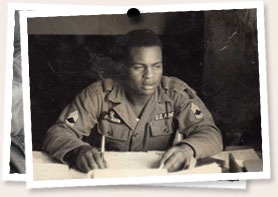
His story is told in Sergeant Smack: The Legendary Lives and Times of Ike Atkinson, Kingpin, and his Band of Brothers. The book was written by Ron Chepesiuk, who analyses and describes the players, associates and crime scenes with the precision of an investigative journalist and the narrative style of a screen writer.
The book reveals the intrigues and dealings of the African-American gangs that operated between the United States and Southeast Asia like so many fish in the murky waters that were American-Thai relations at that time. It tells of a business that involved foreign embassies in Bangkok, senior military, police, government and some of “the most respected Thai families”.
One of the many mysteries that Chepesiuk sheds light on concerns one of the most worrying and macabre legends of the Vietnam War: the so-called Cadaver Connection, according to which heroin was smuggled to the USA inside the coffins of soldiers killed in Vietnam. According to Chepesiuk, this legend was fed by one of the men working for Sergeant Smack, Frank Lucas, who has always boasted that Cadaver Connection was his idea.
Smack is quoted in the book as saying, “When Lucas dies, his epitaph should read: ‘He fooled the world into believing the cadaver connection’”. He did it so well that the legend was even used in the film American Gangster starring Denzel Washington as Lucas.
American Ganster: the trailer
Click here to read an extract from the book
Pirates of the street
This sounds like the kind of news story you hear quite often.
But this one happened in Pegu, a city 50 km north of Rangoon in Burma. According to the state-run media the incident was caused by two young drunks.
According to Burma Partnership, the organisation representing exiled Burmese, the two youngsters, named as Aung Thu Hein, 22, and Soe Paing Zaw, 18, were travelling on a trishaw (a cycle rickshaw) when it collided with a motorbike ridden by two army officers. After the argument, the two officers and some of their associates went looking for the youngsters. They eventually found them and killed them.
In a bid to minimise the consequences of these killings and placate the resentment of friends of the victims, the local authorities offered their families one million kyat (just less than 800 Euros) in exchange for their silence. Perhaps it was due to the fact that they did not accept the pay-out and even protested that the bodies of the two young men were immediately cremated without allowing parents and relatives to say their last goodbyes.
Unfortunately this kind of news story does happen often. In Burma.
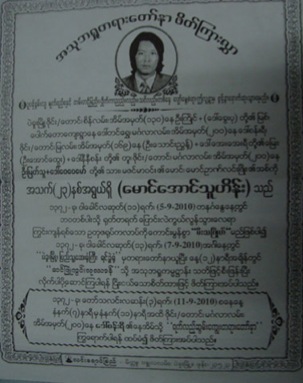
A funeral notice for Aung Thu Hein appears in a local newspaper with his picture at top. Authorities denied his family basic rights over the funeral arrangements and officials kept everyone away from the coffins during the proceedings. Photo: Mizzima
We’re Sorry Thailand
Thai Prime Minister Abhisit Vejjajiva has asked for the ban to be removed, judging the video for what it actually appears to be: a declaration of shared responsibility. By doing so he is sending a strong signal, which seems to demonstrate a serious will to move towards national reconciliation, and above all towards implementing profound change in the culture and society.
Unfortunately, censorship appears to be sending an even stronger signal, one inspired by the desire to continue presenting the country as the “Land of Smiles”.
If this line prevails, perhaps even more apologies will have to be made to Thailand.
The banned cip
The Great White Elephant
For others, better acquainted with the superstitions of the ruling junta, the news has a more worrying meaning.
A report by the Democratic Voice of Burma has alleged that the Myanmar government is developing a secret programme to create nuclear weapons and ballistic missiles: a “Great White Elephant”, a magical symbol of power. It's to be hoped that the project remains just a symbol. But it may turn out to be one of the worst monsters populating the Asian imagination thanks to the government’s cooperation with North Korea.
The real mystery of this latest act of lunacy by the military junta is not if they can make weapons of mass destruction, but why. For a dissident exile in Bangkok, this is proof that the generals are nothing more than a bunch of psychopaths living in fear of invasion. Others see it as a move controlled by the Koreans. Yet others see it as a much more complex strategy to gain control over the region. In the meantime, the new planes made for the top junta chiefs have also been named “White Elephant”.
Click here to see the full DVB documentary.